
Smartphone camera diagnostic accuracy: what a 2026 pilot proves
TL;DR
Smartphone camera diagnostic accuracy is an output of a measurement study, not an input to a contract, and in 2026 the evidence for that is public. An early FDA cleared smartphone test strip reader got there by shipping a physical color reference with the strips and testing ten lighting conditions on one handset. The systems cleared after it reached a wider device matrix by refusing bad captures rather than by trusting the algorithm. Every external performance figure below comes from a regulator, a standards body or a peer reviewed study.
- The 2019 clearance tested a single iPhone 7. The 2021 clearance ran 16 representative handsets.
- Published consumer apps measure pupillary distance with limits of agreement from 2.89 mm below a pupillometer to 1.70 mm above it.
- Color correction cuts measurement variance across lighting conditions by up to 90%.
- A QR module narrower than 3 pixels stops decoding, whatever the lens does.
When a camera measurement becomes a regulated device
Intended use decides, and the camera is part of the device. When your app reads a strip and returns albumin and creatinine, the phone stops being a phone and becomes the readout of an in vitro diagnostic. The FDA set that policy out in Policy for Device Software Functions and Mobile Medical Applications, issued in September 2022.
That changes what your accuracy target is. It stops being a product preference and becomes a performance claim someone will audit, against a reference method you have to name. Write the intended use statement before the capture spec. Everything downstream follows from it, including how many pixels your marker needs.
If the intended use lands on the device side, our comparison of healthcare compliance standards shows which frameworks then apply to the code.
What the cleared smartphone strip readers actually did
On July 26, 2019 the FDA cleared the ACR | LAB Urine Analysis Test System under K182384, a class II in vitro diagnostic comprised of a smartphone application, a proprietary Color-Board and reagent strips. It is an early cleared example rather than the only one, and the trail it starts is the useful part.
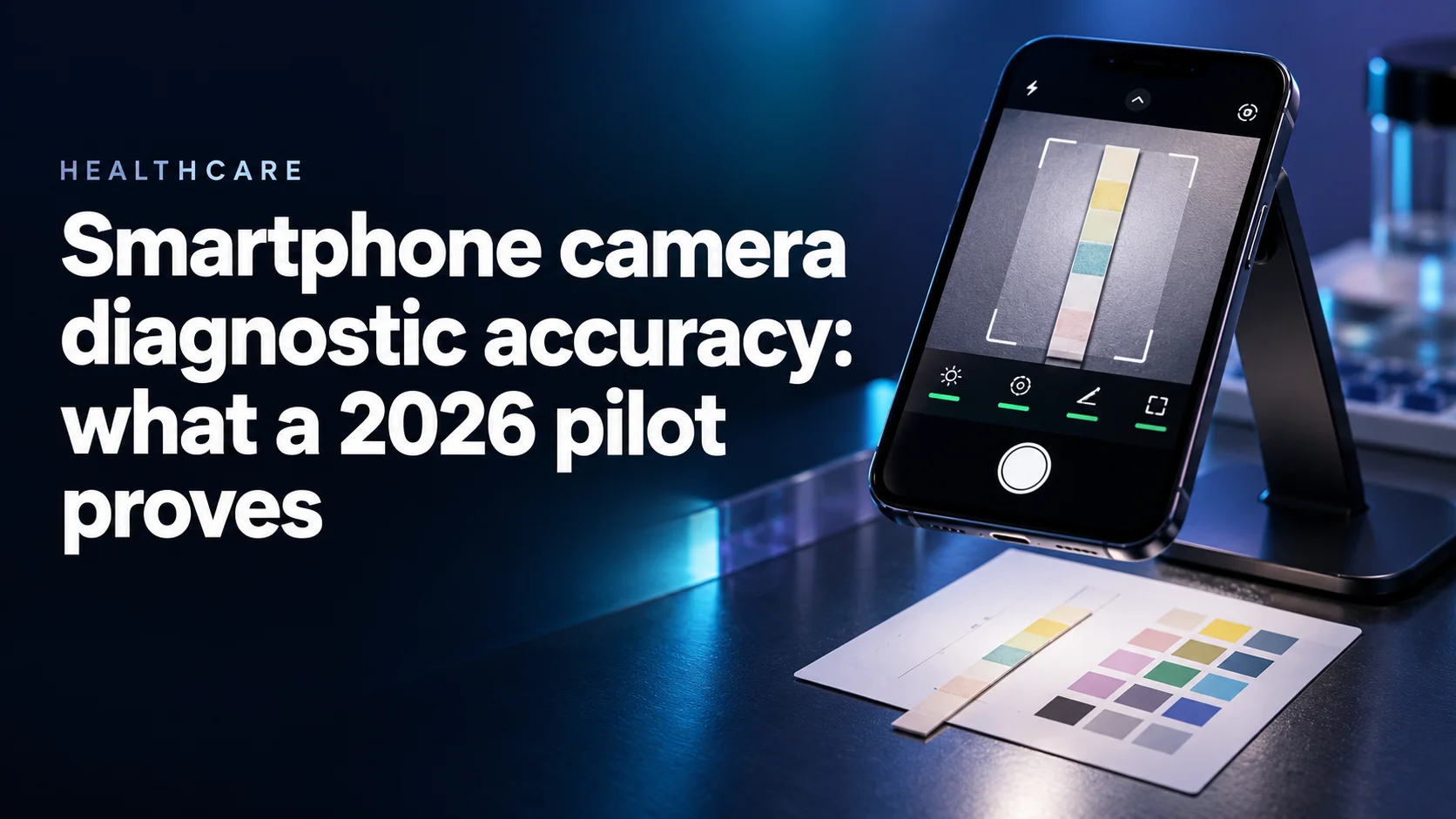
The decision summary is blunt about the hardware. Testing ran on a dedicated iPhone 7 on iOS 12.0, with no multi device comparison, because there was only one device. Each kit carries 100 strips and 10 individually wrapped Color-Boards, so a physical color reference sits beside the strip in the frame. Accuracy was tested under ten simulated lighting conditions covering fluorescent, LED, incandescent and halogen sources, plus a boundary study across distances, angles and extreme lighting. Exact match with the predicate ran from 80.2% to 92.2% across albumin and creatinine, with 100% agreement within one color block.
Then look at what it took to leave the single handset behind. The Minuteful Kidney Test under K210069 pairs a single use Color-Board with a strip and was validated on 16 representative smartphones across iOS and Android. It bought that range by refusing bad captures: the application blocks the photo when light intensity sits outside its boundary conditions, when blur is too high, when distance or angle is wrong, when shadows cross the board, or when the board is contaminated. In the method comparison 466 lay users tested their own samples and reached 92.7% overall exact match against a trained operator running the predicate. The 2023 modification under K222921 went further and took direct control of exposure and white balance during capture.
Read that as a cost curve. Device freedom is bought with capture control and study work, and every number along it came out of a protocol.
For a waived test the FDA publishes Recommendations for Dual 510(k) and CLIA Waiver by Application Studies, issued February 2020, with study designs that support both in one program.
How we built this guide
Three rules, applied to every claim below.
- Regulatory facts come from the instrument or the clearance file, not from a summary of either.
- Performance numbers come from peer reviewed studies or from a regulator's own review memo, with the sample size attached.
- Where we publish our own numbers, any group with fewer than three data points is not published.
One disclosure. Mercury Development builds device connected and camera driven software, so the engineering examples are our own.
Where the error in a camera measurement comes from
Six things move your number, and the algorithm is none of them.
| Error source | What it moves | What actually controls it |
|---|---|---|
| Ambient illumination | The color your sensor records | A physical reference target in the same frame |
| Auto white balance across models | The same strip read two ways on two handsets | Taking control of the capture pipeline, then correcting against the reference |
| Camera angle and head tilt | Apparent distance between two points | Two markers with a known separation, plus a capture gate |
| Working distance | Millimeters per pixel | A fixed distance, or a scale reference in frame |
| Marker size against sensor resolution | Whether the code decodes at all | Arithmetic, covered below |
| Operator technique | All of the above | A usability study with the people who will hold the device |
White balance is the one teams underestimate, because on a phone it is automatic and invisible. A 2023 study in PLOS ONE measured color across 15 lighting conditions on two iPhone models and found that correcting against a reference cut variance by up to 90%. Software does not fix color. Software fixes color when something of known color is in the picture.
The iPad is a harder camera target than you think
Clients ask for iPad because the screen is big and a clinician can hold it. The optics do not care. Apple's tech specs for the iPad Pro 11-inch (M5) list one rear camera, a 12MP Wide at f/1.8, and a 12MP Center Stage front camera at f/2.0 mounted along the long edge.
Read that pairing against your workflow. If the patient faces the screen while the app measures, you are on the front camera, the slower of the two apertures, in whatever light the room happens to have. There is no second rear lens to switch to and no optical zoom to trade against working distance. Capture geometry is set by where a human comfortably holds a slab of glass, further away and less steady than a phone, and that lands on the pixel budget for your marker.
Marker size is arithmetic, not a design choice
Designers want the sticker small. Decoders have a floor. A 2022 study in Sensors on QR code detectors near the Nyquist limit found that for practical decoding the module should be no smaller than 3 to 3.5 pixels, and that at 1 to 1.5 pixels per module recognition falls to near zero.
Turn that into millimeters. A 12MP frame in 4:3 is roughly 4,000 pixels across. If your capture distance puts a 400 mm field of view in that frame, one pixel covers about 0.1 mm. A version 2 QR code is 25 modules wide, and Denso Wave requires a four module quiet zone on every side, so the printed area is 33 modules. At the 3 pixel floor that is 99 pixels, or about 9.9 mm of print. That is before motion blur, JPEG compression, off axis sampling and a patient who moves.
Run this calculation in week one. It often kills the square code and sends you to a larger marker or a shorter working distance, and finding that out early costs a day instead of a release.
What a feasibility phase buys
A feasibility phase is a fixed scope measurement study, not a prototype with nicer screens. It answers one question: what is the error distribution of this capture method, on this hardware, under these conditions.
Four deliverables make it real. A written protocol that names the reference method. A dataset captured under the conditions you will actually ship into, including the bad ones. A statistical comparison against that reference. And a decision, in writing, about whether the target is reachable or the capture design has to change.
Pediatric capture is a separate arm of that study, not a setting in the app. Children fixate differently, hold still for less time, and sit at different distances, so the error distribution you measured on adults does not transfer. Budget the sample, or do not make the claim.
The study protocol is one of the inputs in our checklist of what a vendor needs before an estimate for a device app.
How to write an accuracy clause both sides can sign
ISO 5725-1:2023 splits accuracy into trueness, the closeness of the mean of many results to a reference value, and precision, the closeness of results to each other. A clause that says "within 1.5 mm" without saying which one it means cannot be tested, which means it cannot be enforced.
Here is what the ambiguity costs. In a 2024 comparison in Clinical Optometry of 40 participants, a mobile app measured distance pupillary distance with a mean difference of 0.59 mm against a pupillometer and limits of agreement running from 2.89 mm below to 1.70 mm above. A clause reading "mean error within 1.5 mm" passes on that data. A clause reading "every measurement within 1.5 mm" fails on the same data, from the same app, in the same study. Bland and Altman made the point in The Lancet in 1986: correlation measures relationship, agreement is the spread of the differences.
The spread between shipped products is wider than the tolerance people write down. A 2023 Cureus study of 44 subjects put two consumer apps at a mean absolute error of 0.51 mm and a third at 1.375 mm.
Check what consumes your number. Under the ANSI Z80.1-2020 tolerances a progressive lens fitting cross had to land within 1.0 mm of the specified monocular pupillary distance. Treat that as the order of magnitude rather than a live figure: The Vision Council announced ANSI Z80.1-2025 on January 15, 2026, superseding that edition with a fully revised tolerance table. The point survives the revision. Your number is consumed by a millimeter scale tolerance someone else sets, and it moves without asking you.
What our own capture dependent record shows
Counted by hand across the case studies we publish, around 30% describe products whose core function depends on data captured by hardware we did not design: a camera, a Bluetooth radio, a cellular modem or clinical imaging equipment. Across that group the dated numbers attach to the capture layer, every time.
On Fitbit our team spent two months deciphering Samsung's proprietary Bluetooth technology so early Android handsets could sync at all. On Kensington Proximo a fully functional Android application took three months, built against a pre-release Samsung BLE SDK that was partially unstable and supported exactly one handset, the Galaxy S4. On ORIGO we wrote our own modem driver after the manufacturer's proved unstable and cut data traffic to 8 MB per device per month. The clinical case is MatchedFlicker, a 510(k) FDA cleared application that displays changes between serial retinal images, moved from Windows desktop to a web platform with HIPAA compliant online access in three months.
The pattern in our discovery records is narrower. In every camera dependent product we have scoped, the written analysis flags a capture condition dependency before anyone writes production code, and the dominant variable is different each time: auto white balance and camera quality across consumer handsets in one, camera angle and marker placement in another, on-device detection behaving differently per phone model in a third. Nobody predicted which one would dominate. Each was found by measuring.
When the camera is one sensor on a connected device, cost and FDA path follow our guide to medical device companion app development.
The honest limit of a camera measurement
Opinion, stated plainly. A phone camera can be made accurate enough for clinical work, and almost never by the algorithm alone. The cleared strip readers on the US market got there with printed cardboard and an application that refuses to take the picture when conditions are wrong. That is the shape of the answer.
Which exposes an uncomfortable truth about buying this work. The things that move your number sit mostly outside the software line item: the hardware, the physical reference, the capture conditions. A vendor who quotes a measurement app without a feasibility line is quoting the part they control and leaving you the risk on the part they do not. We are not a regulatory consultancy and hold no ISO 13485 certificate, a real limitation if you have no quality system of your own. What we do is build to HIPAA and GDPR requirements, run the capture study first, and put the assumptions in writing, as we have since 1999.
Written by Alexey Rodionov, Lead Front-end Developer at Mercury Development since 2020. Alexey is a Google Developer Expert in Web Technologies and a Chromium contributor whose code ships in Chrome DevTools, Google's Bubblewrap and Microsoft PWABuilder. The platform tests and image pipeline reviews behind this article's capture analysis come from the front-end practice he leads.
Send us your capture conditions and we will scope the pilot
Tell us what you are measuring, on which device, who holds it, and what reference you can put in the frame. We will come back with the capture design we would test, the protocol for testing it, and an honest read on whether your target survives contact with real lighting.