
Wrapper app vs native app for physician groups in 2026
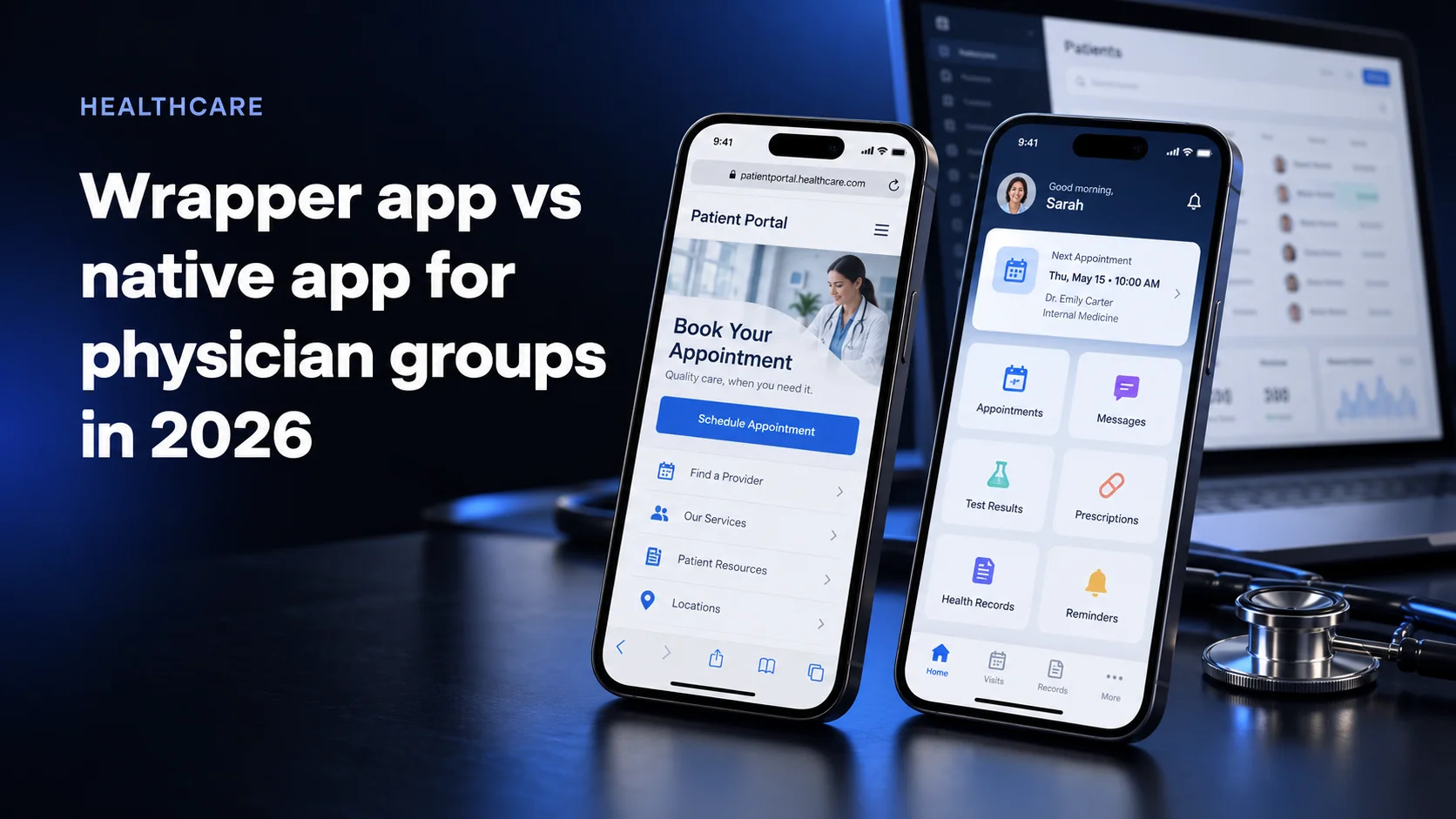
TL;DR
Wrapper app vs native app is a narrower choice in 2026 than it looks for a physician group running a WordPress site and the athenahealth patient portal: a store wrapper is enough when the app's job is the website's job. athenahealth already ships athenaPatient for iOS and Android with self-scheduling, messaging, test results and push reminders, so neither option should rebuild the portal.
- In 2024, 57% of patients who used a portal reached their records through an app, per ASTP/ONC survey data.
- Apple's guideline 4.2 turns away apps that are only a repackaged website, so a wrapper needs real app-only value.
- A wrapper is still a native binary: Xcode 26 builds since April 28, 2026, Android 16 targeting since August 31, 2026.
- Bluetooth devices, offline data capture and push from your own clinical data need native code; when they are the core of the app, go native.
Patients already reach your practice through apps
Start with what patients do. In 2024, 65% of individuals were offered and accessed an online medical record or patient portal, per ASTP/ONC Data Brief 77. Among those who used a portal in the past year, 57% reached their records through an app, while web-only access fell from 60% in 2020 to 42% in 2024. And 59% of individuals had more than one portal.
The record side is covered. athenahealth says its network connects 170K+ providers serving over 20% of the U.S. population, and WordPress runs 40.1% of all websites, per W3Techs on October 13, 2026. A physician group with WordPress in front, athenaOne behind and a scheduling and queue tool such as Clockwise.MD on the site is an ordinary setup, and the one this guide assumes.
For that stack the app question is smaller than it looks. The portal already has an app. What has none is your website's job: which location treats what, who the providers are, how a new patient books and how long the wait is.
Two 2026 store deadlines apply to wrappers too
A wrapper feels like a one-off project. The stores treat it like any native app. Since April 28, 2026, App Store Connect uploads must be built with Xcode 26 or later using an iOS 26 SDK, and since September 9, 2026 they must target iOS 13 or later. Since August 31, 2026, new Google Play apps and updates must target Android 16 (API level 36), and existing apps that target Android 14 or lower stop reaching new users on devices running a newer Android version than the app targets.
None of this cares whether the screens are HTML. Google raised its floor in August 2025 and again in August 2026, from Android 15 to Android 16, so an Android app needs a rebuild about once a year to keep reaching new users. Apple sets no schedule, but every fix must be built with the current Xcode, and its App Store Improvements process flags apps not updated in three years that also fail a minimal download threshold. Name the owner of the developer accounts and signing keys before launch.
How we built this comparison
Three rules, applied throughout.
- Platform rules come from the stores' own policies and from WebKit and IETF documents. athenahealth behavior comes from athenahealth's help pages.
- Where behavior depends on your configuration, we tell you to test it.
- Our own figures are shares rounded to five points; any group with fewer than three data points is not published.
Two disclosures. Mercury Development builds native apps in Swift and Kotlin, cross-platform apps in React Native and Flutter, and has built web apps since 2008, so we earn from every option here. The author also contributes code to Bubblewrap and PWABuilder, two tools discussed below.
The ranking guides come from elsewhere. Appilix, which turns websites into apps, compares WebView and native apps and ends with its own product. Medical Web Experts asks mobile app or web app and files push under mobile apps only. Neither asks what your EHR vendor already ships.
Website, wrapper, hybrid or native at a glance
| What you need | Mobile site or PWA | Store wrapper | Wrapper with native features | Native or cross-platform |
|---|---|---|---|---|
| Listing in App Store and Google Play | Google Play only, as a Trusted Web Activity | Yes, if it passes review | Yes | Yes |
| Push notifications | On iOS only after Add to Home Screen | Native plugin over APNs and FCM | Native | Native |
| Offline | Whatever the service worker caches | Error page unless you build a fallback | Key screens cached | Full control |
| athena portal login | Browser | In-app browser tab or athenaPatient | In-app browser tab or athenaPatient | Same, or the FHIR API |
| Bluetooth devices | Not in Safari on iOS | Only through a native plugin | Through a native plugin | Yes |
| Apple guideline 4.2 risk | None | High if it mirrors the site | Lower | Low |
| Rebuilds for store SDK rules | No | Yes | Yes | Yes |
| Content updates | Publish in WordPress | Publish in WordPress | WordPress plus app releases | App releases or remote content |
The wrapper's real advantage is the last row: marketing keeps publishing in WordPress, and the app changes with the page.
Start with the patient app athenahealth already ships
Before anyone wraps the portal, open athenaOne's settings. athenaPatient is athenahealth's patient app for iOS and Android. Its user guide covers self-scheduling, self check-in, telehealth launch, secure messaging, test results and billing, and opted-in patients get push notifications for results, check-in reminders and upcoming appointments. Patients of several athena practices who use one email address log in once.
The conditions sit with you. athenaPatient is only available to customers who have enabled the athenaOne Patient Portal, and self-scheduling, self check-in and athenaTelehealth appear in the app only once enabled. So the first deliverable of an app project on athenaOne is a settings review, and it costs nothing to build.
Then draw the line. Your app, wrapper or native, should not rebuild records or bills. It should do what athenaPatient does not: point a new patient to the right location and the shortest wait, then hand off to athenaPatient.
Push notifications need native plumbing even in a wrapper
Push is what marketing asks for first, and a wrapper does not inherit it from the page inside. It needs native code: Apple Push Notification service on iOS, Firebase Cloud Messaging on Android. Capacitor's push plugin, for one, needs the Push Notifications capability on iOS and the Firebase project's google-services.json file on Android. Behind it sits a small server job that keeps device tokens and honors opt-outs.
Two rules narrow the content. Apple's guideline 4.5.4 says push must not be required for the app to work, should not carry sensitive personal or confidential information, and needs explicit opt-in before any promotional use. And athenaPatient already sends appointment and results reminders, so your push should cover what athena cannot know, such as a new location or this week's flu shot hours.
The web is closer than it was. Since iOS 16.4, Home Screen web apps can receive Web Push once a direct user action asks for permission. The catch is the install step: the patient must add your site to the Home Screen first.
Offline is a fallback screen you have to design
A wrapper that loads your live site shows an error page without signal unless you design a fallback. Pick the screens that must work offline, such as addresses, phone numbers and opening hours with a call button. Bundle or cache them, and let the rest fail politely with a retry. On the web a service worker does the same job, and it is the first step toward a progressive web app.
App Store review is where wrappers get rejected
Guideline 4.2 is the gate. Apple asks for features, content and UI beyond a repackaged website, and 4.2.2 says apps shouldn't primarily be marketing materials, web clippings, content aggregators or a collection of links. A physician group's website is marketing and links by design.
Two more rules bite healthcare wrappers. Guideline 4.2.6 rejects apps built from a commercialized template or app generation service unless the provider of the content submits them. Guideline 5.1.1(ix) says apps in highly regulated fields, healthcare included, should be submitted by the legal entity that provides the services, and enrolling an organization takes legal entity status, a D-U-N-S Number and a public website on a domain associated with it.
So the app ships from your group's own developer account, never your agency's, and gives patients something the site cannot, such as native push or a location-aware wait screen. That is a minimum, not a pass: nobody can promise approval. Google Play is easier on your own site: its spam policy bars apps whose primary purpose is a webview of a website without permission from its owner.
How to fit the athena portal and scheduling into a wrapper
Three pieces of the stack behave differently inside a wrapper.
- Portal login. Keep it out of your WebView. RFC 8252, the IETF best current practice for native apps, says apps MUST NOT use embedded user-agents for OAuth authorization requests, because the host app can record every keystroke in the login form. A framed portal login raises the same concern. Open the portal in an in-app browser tab, SFSafariViewController or Android Custom Tabs, which keeps the browser's security properties, or link to athenaPatient. Patient data then stays out of your app's web storage.
- Booking. athenahealth lets practices link to its Patient Self-Scheduling web application, embedded by iframe or opened in a new tab. In a wrapper, prefer the full page. Since iOS 14, Intelligent Tracking Prevention is on by default in every WKWebView app, and ITP blocks all third-party cookies by default. So don't count on cross-site cookies inside the wrapper: a scheduler framed in your WordPress page is third-party content, and a flow that depends on its cookies can break in the app while working on desktop. Test before launch.
- Wait times. A queue tool such as Clockwise.MD takes bookings through your website and the call center, and check-ins at on-site kiosks. Treat its web flow like booking. Wait times on a native screen or in a push need the vendor's data through an integration it supports.
Everything else stays in WordPress, which is the point.
Where a PWA or a Trusted Web Activity fits
A fourth option is built from the website itself. A progressive web app is your site plus a web app manifest and a service worker: installable, offline for the screens you cache, and able to push on iOS 16.4 and later once installed.
On Android it can enter Google Play without a WebView. A Trusted Web Activity opens your web content from an Android app through a protocol based on Custom Tabs; the browser renders it fullscreen, and Digital Asset Links verify that app and site come from the same developer. Bubblewrap builds apps that launch a PWA inside a Trusted Web Activity, and PWABuilder, which uses Bubblewrap internally, also lists the Apple App Store as a target. iOS has no Trusted Web Activity, so a PWA in the App Store is a wrapper again and meets guideline 4.2 like any other.
On a tight budget, start here: a solid PWA on WordPress and Google Play through a Trusted Web Activity, with the App Store decided separately.
When native is the right call
Native, or cross-platform in React Native or Flutter, earns its cost when the phone must do what a web page cannot. Bluetooth is the cleanest test: Web Bluetooth is not supported in Safari on iOS, so a blood pressure cuff or glucose meter needs native code, in an app or in a native module inside a wrapper.
Other signals: offline data entry that syncs later, push driven by your own clinical data, a roadmap with remote monitoring or device-based care. Each turns a wrapper into a native app with a shrinking website inside.
For records in your own app, athenahealth publishes FHIR R4 API documentation. Weigh that against athenaPatient first, since you would rebuild an app your patients already have. Our healthcare app development cost guide covers native budgets.
Which option fits your physician group
The marketing director wants reach. The CIO will own the developer accounts and every rebuild. Decide by job, together.
- A store listing and Home Screen icon for services and booking: a fast mobile site with a visible athenaPatient link, plus a wrapper only if it offers patients something the site cannot and has a named owner for rebuilds.
- Push for your own announcements: a wrapper with native push, opt-in consent and no sensitive content in messages.
- Records and bills on the phone: promote athenaPatient instead of rebuilding it.
- Android-heavy patients or a tight budget: a PWA, published to Google Play as a Trusted Web Activity.
- Devices, offline data capture or a care program: native or cross-platform from the start.
- Nobody to own developer accounts and rebuilds: no app, a better mobile site.
What our requirement records show
Counted by hand in October 2026 across our healthcare requirement records where the requested product included an iOS or Android app. Veterinary products and web-only or service-only scopes were excluded. Record counts stay unpublished under our client agreements; shares are rounded to five points.
- Around 45% started from something the client already ran: an app, a website, a portal, a prototype or a backend.
- Around 35% needed a Bluetooth, RF or NFC link to a device, or OS-level kiosk control, which a wrapper reaches only through native modules.
- App Store review came up as a named delivery risk in around 10%, each time over policy wording or reviewer judgment rather than code.
Requests framed explicitly as a wrapper or a container app had fewer than three data points, so we do not publish a share.
A wrapper is a decision about year two
Opinion, stated plainly. For a physician group on athenaOne with a WordPress site, the right first move is rarely an app. It is a fast mobile site, a visible link to athenaPatient and booking in one tap. Then decide whether a store listing is worth the upkeep.
If it is, build the wrapper honestly: your own developer account, portal login in a browser tab, an offline screen with phone numbers, native features that earn their place under guideline 4.2.
What we would not do is sell a wrapper as a native app, or a native app to a group whose app has the website's job. A static wrapper with no roadmap is a small job. A wrapper service or your web team can do it well, and you should not pay for agency discovery to get it. The project grows, and becomes worth a custom team, when the roadmap adds devices or your own clinical data.
Written by Alexey Rodionov, Lead Front-end Developer at Mercury Development since 2020. Alexey is a Google Developer Expert in Web Technologies and a Chromium contributor whose code ships in Chrome DevTools, Google's Bubblewrap and Microsoft PWABuilder. The requirement reviews behind this article, where incoming mobile app requests are read for platform capabilities, existing systems and store constraints, come from the engineering practice he works in.
Send us your site and portal setup, and we will mark the wrapper line
Send your website address, the athenaOne patient features you have enabled and the booking or wait-time tools on your site. We will come back with what a wrapper can carry, what needs native code and what athenaPatient already covers, so you can decide before anyone writes an estimate.