
MVP development budget in 2026: weekly caps, CPA review, team size
TL;DR
An MVP development budget in 2026 works best as a weekly spend cap tied to a written schedule, a scope list ranked by priority, and a contract your CPA and lawyer can both read. A cap turns a blank check into a burn rate you can defend.
- Opportunity Zone money runs on a clock. Treasury designated 6,576 census tracts effective January 1, 2027, and the working capital safe harbor gives a startup 31 months to spend under a written schedule.
- Since 2025, domestic software development can be expensed at once, while foreign research is amortized over 15 years. Your CPA will ask where the code is written.
- More developers do not shrink the timeline in step. In QSM's 491-project study, teams of three to seven were optimal.
- One developer per component is a single point of failure. In 65% of 133 popular GitHub projects, losing two people would stall the code.
A blank check is a schedule problem
Founders fear the blank check because it hides two numbers: how much you spend each week and when you stop. Fix the first, and the second becomes a calculation.
A media founder with a launch window and outside money usually has three people watching the spend. You watch the product. The accountant watches the cash. The lawyer watches the contract. A plan that only you can read will fail the other two reviews, and that costs weeks.
So the plan needs a weekly cap with a named team, a written schedule of what ships when, and a contract that turns both into obligations.
Opportunity Zone money got a new clock in November 2026
On November 5, 2026, the U.S. Treasury and the IRS announced that all 6,576 nominated census tracts become Qualified Opportunity Zones on January 1, 2027, for ten years. The program is now permanent, and a new round of capital will look for businesses in those tracts.
If your build is funded through a Qualified Opportunity Fund, your spending plan is a compliance document. The working capital safe harbor in Treasury Regulation 1.1400Z2(d)-1 requires the money to be designated in writing for developing a business in the zone, a written schedule that spends it within 31 months, and actual spending that stays consistent with that schedule. Sequential applications can stretch the period to 62 months.
Founders often call this a 30-month plan. The rule says 31. The difference matters less than the word "written": a weekly cap mapped to milestones is the schedule your accountant files.
How to build a plan around a weekly spend cap
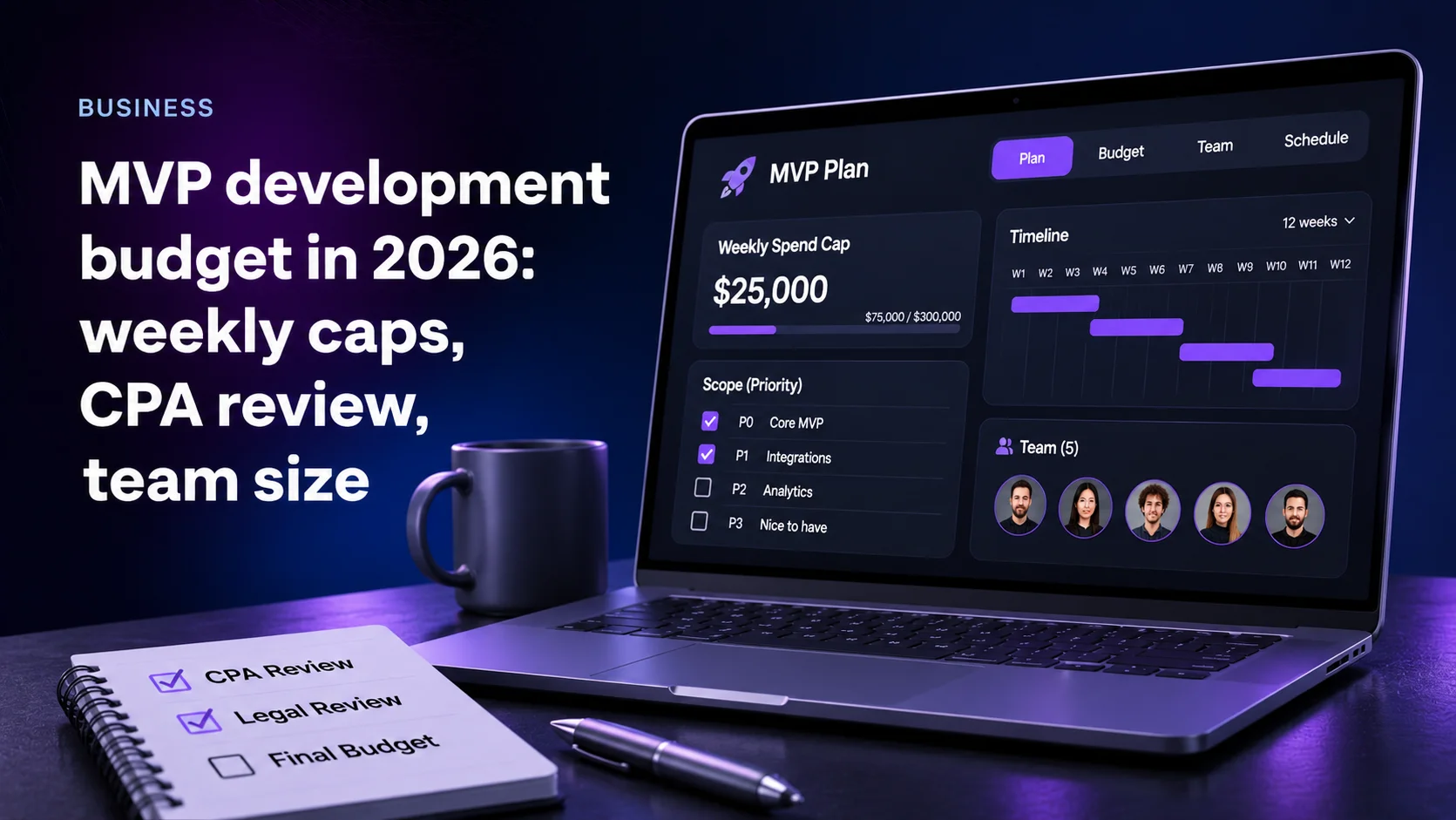
Start from the cap, not from the feature list. Take $10,000 a week. Over 30 weeks that is $300,000. Over the 31 months of a safe harbor, roughly 134 weeks, it is about $1.34 million. Everything else is a choice.
Build the plan in this order:
- Name the team the cap buys: roles and weekly hours. A cap without a staffing table is a wish.
- Rank the scope. Put every feature in one list, ordered by what you would cut last.
- Draw the cut line. Estimate down the list until the weeks run out before your date.
- Add a reserve. Hold back a few weeks of budget for store review, fixes after the first beta and the change you have not thought of yet.
- Agree on a weekly report: hours burned, features done, features moved below the line.
The weekly report is the control. When spend and progress sit on one page each week, a CPA can reconcile it and you can change course before a month is lost.
What your CPA will check before you sign
Your CPA will read the plan as a tax and cash document. Expect three questions.
Where is the code written? Under the One Big Beautiful Bill Act, new Section 174A lets companies fully expense domestic research and experimental expenditures in tax years beginning after December 31, 2024. Foreign research must still be amortized over 15 years, and software development counts as research, as Grant Thornton explains. If your vendor's engineers sit outside the US, as many of ours do, ask for invoices that split hours by location. Companies with average annual gross receipts of $31 million or less may also elect to apply the new rule back to 2022.
Does the spend match the schedule? Monthly invoices should map to the milestones in your written plan. A gap between the two is what auditors and fund managers notice first.
Can the cap be enforced? A cap in an email is a hope. A cap in the statement of work, with a not-to-exceed amount per week or month, is a control.
We are not your accountants; use this list to prepare the meeting.
What your lawyer will check in the contract
Your lawyer will read for ownership, exit and change.
Ownership first. Under US copyright law, a commissioned work counts as work made for hire only in nine listed categories, with a signed written agreement, according to Copyright Office Circular 30. Software from an outside firm is not on that list. You need an assignment clause that transfers the code and the IP to you. At Mercury Development, all work is work-for-hire; the customer owns the code and all underlying IP.
Then exit. Ask for termination on short notice, a handover of the repository and documentation, and access to the code from the first week, not at the end.
Then change. Every feature added above the cut line needs a change order that names its cost in weeks. That is how the cap survives a good idea.
The ownership clauses themselves are covered in our guide to who owns the code when outsourcing.
Why more developers will not launch you faster
The idea that twice the people means half the time is old and wrong. Fred Brooks wrote it down in The Mythical Man-Month in 1975 as Brooks's Law: adding manpower to a late software project makes it later. The work you split grows in step with headcount. The coordination grows with its square.
Count the conversations. Three developers have 3 pairs who need to stay in sync. Six have 15. Ten have 45.
The data agrees. QSM studied 491 medium-sized projects and found that groups of three to seven were optimal. At 50,000 lines of code, large teams spent 99 person-months where small teams spent 19, and the small teams needed about three quarters of the time. In a later QSM study of 390 applications, larger teams cut the schedule by approximately 30%, but cost rose 350% and testing found 500% more defects.
So extra people buy some calendar time at a steep price, and only if the work splits cleanly. Under a weekly cap, a bigger team means fewer weeks before the money runs out, not an earlier launch.
One person per component is a single point of failure
The lean version of a team looks efficient on paper: one iOS developer, one Android developer, one backend developer, one designer. Each component has exactly one person who understands it.
That person will take a vacation, get sick or leave. When that happens, the component stops. Researchers call this the truck factor: how many people must leave before a project stalls. In a study of 133 popular GitHub projects, 65% had a truck factor of two or less.
Plan coverage into the cap. Pair people across the client and the server, keep code review mandatory, and write down how each part is built and released. Ask your vendor what happens in week 12 if the backend developer is out. Our about page commits to covering vacations, sick leave and turnover, and to changing a team's skill set, pace or burn rate within 2 weeks of a customer's request.
Summer, not September: trading scope for a date
Media launches have seasons. A music product that misses its window can lose the moment it was built for, so founders ask for summer, not September.
Fix the date and the cap, and scope is the only thing left to move. If the ranked list does not fit before the date, cut from the bottom, not across the board. Shipping half of every feature gives you a product nobody can use. Shipping the top of the list gives you a product people can try.
Watch two traps. A landing page that goes live before the product is ready starts the social media clock early, and the pressure then pushes scope back in. Raising the cap halfway through to hit the date rarely works, for the reasons in the team-size data above.
If the scope is still unclear, buy the answer first with a paid discovery phase.
What media founders bring to the first call
These findings come from our own presales records for consumer music and social video products, counted by hand. They describe buyers, not the market. Any group with fewer than three data points is not published.
Around 35% framed their budget as a weekly or monthly spend cap rather than a project total. Around 35% brought accountants or lawyers into the decision before signing. Around 50% came in with a budget below what their first release required, and around 65% wanted monetization in that first release.
The patterns repeat. Founders asked whether more developers would compress the timeline in step, and we explained why it would not. A staffing plan with one person per component looked cheap until we asked who covers a sick week. After work started, founders who cut the weekly burn sharply also had to reset scope, and each reset cost time.
Cap the burn, fix the date, flex the scope
Pick two of the three and let the third move. For a funded media MVP, the two you fix are almost always the weekly cap and the launch date. That leaves scope.
This plan tells your CPA what leaves the account each week and tells your investors what ships on the date. Mercury Development has built software since 1999 with 500+ engineers, and the plans that hold up are the ones where scope moves first. If you are choosing a vendor for an audio product, our list of music streaming app development companies compares six.
Written by Rob Devereaux, Chief Operating Officer at Mercury Development. Rob has run the firm's operations from Hudson, Ohio since 2019 and has over 20 years of operational and financial experience. The presales records behind this article's buyer section sit in the operations he oversees.
Send us your cap and your date
Tell us your weekly cap, your launch date and the features you want in the first release. We will send back a team plan, a ranked scope with the cut line drawn, and the schedule your accountant and lawyer can review.