
Cruise app chat in 2026: guest-to-crew threads, shipmates, receipts
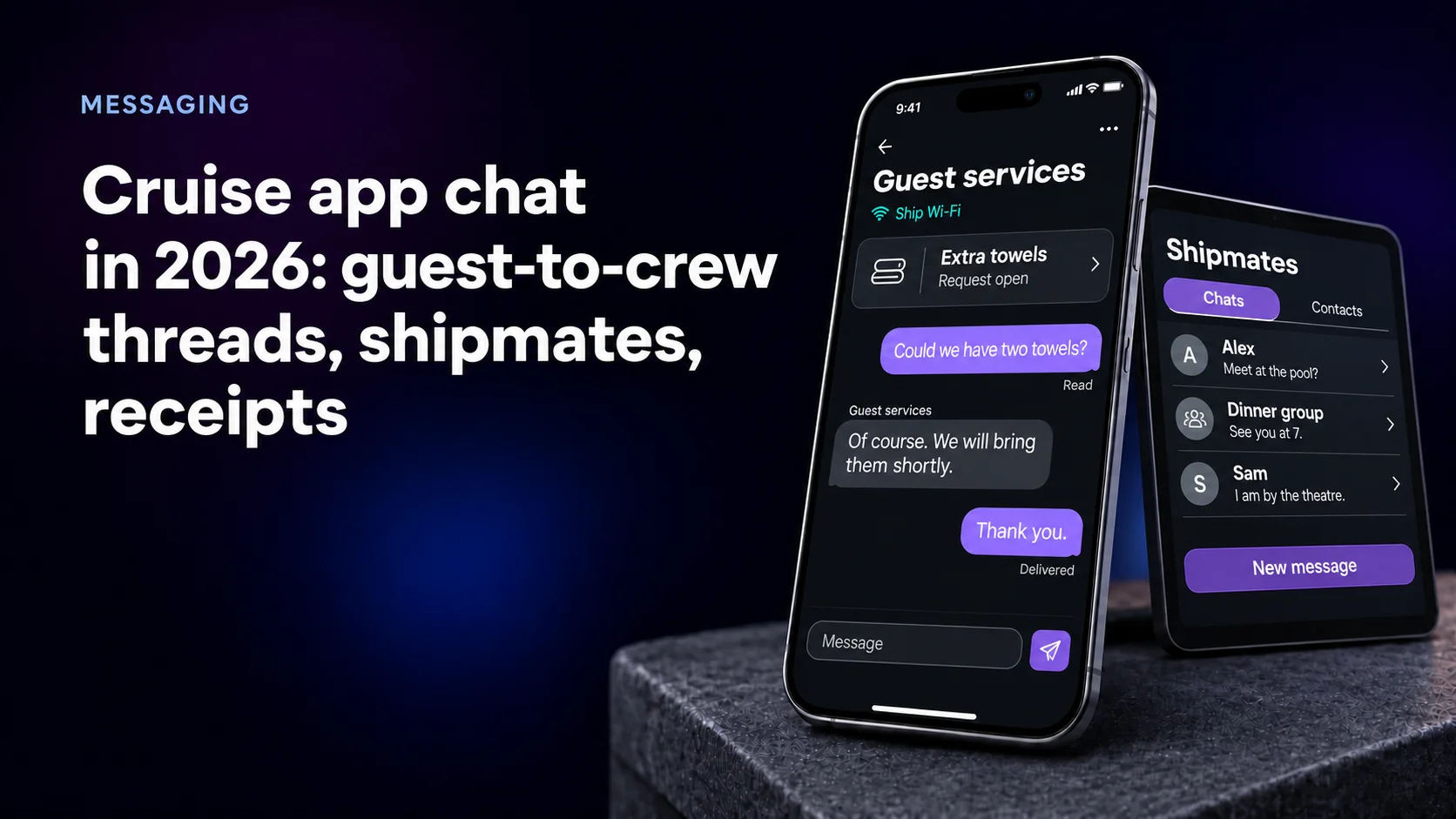
TL;DR
Cruise app chat in 2026 is part of launch scope. Guests expect to text their shipmates and reach a crew member from the line's app over free ship Wi-Fi, without an internet package. Royal Caribbean dropped its $1.99 per day chat fee on January 1, 2023, and TUI Cruises took chat across its Mein Schiff fleet in May 2026.
- Treat a guest-to-crew chat as a service request. One request gets one thread, and a reopened request never merges into another.
- Order messages by a sequence the ship server assigns. Lamport showed in 1978 that physical clocks cannot be trusted to order events across machines.
- A read receipt says a device displayed a message. Do not let it look like a crew answer.
- Mercury Development's onboard software for OneSpaWorld has run without external internet on over 160 ships since 2018.
Why cruise app chat moved into launch scope
Seatrade Cruise News, citing CLIA, reported 37.2 million ocean cruise passengers in 2025. On board, free Wi-Fi reaches the ship's servers; the open internet takes a paid plan.
Royal Caribbean shows chat going from extra to expected. Its guest chat was in beta from at least 2019, and Royal Caribbean Blog reported in July 2021 that it was live fleetwide at $1.99 per guest per day. The line then dropped the fee from January 1, 2023, a change the blog tied to the fact that most guests do not buy an internet package. MSC for Me chat also works without one, for guests 16 and older.
A product owner at one cruise line told us the app could not launch without guest-to-crew chat. Later the same team added: "we're doing a review of our chat because the current back ends are not great."
In May 2026 chat went fleetwide at TUI Cruises
CruiseMapper reported on May 16, 2026 that TUI Cruises had introduced MXP365 Mein Schiff Chat across its fleet, with private one-to-one and group conversations inside the app and no outside messenger. In September 2026 Seatrade Cruise News ran a Messagenius profile describing a messaging product installed on ship and port servers that works at sea without internet and can connect guests with authorized crew and guest services.
Guest chat is now the baseline. The open question is the crew side: who answers, in which thread, and what the guest sees meanwhile.
How we put this guide together
We read the pages that rank for cruise app chat. Consumer blogs explain how to switch it on; vendor pages describe a product. None explains why history jumps to the bottom of a thread or why a receipt promises an answer nobody gave.
Protocol behavior comes from XMPP Standards Foundation specifications and Apple documentation, read in November 2026. Cruise patterns come from Mercury's project records, without client names. Mercury Development builds this kind of software, so read this as an interested view.
Three chats in one app at a glance
| Chat | Who talks | Who is in it | Failure guests notice | MVP rule |
|---|---|---|---|---|
| Shipmates, one to one | Two guests | Linked bookings, then invites | Messages out of order | Ship server sets the order |
| Shipmates, group | A travel party | The booking party | A guest dropped after a cabin move | Membership follows the manifest |
| Guest to crew | A guest and a service team | Guest account and crew role | A reopened request swallows another | One request, one thread |
Shipmates chat starts with the booking
Royal Caribbean's app lists guests from linked reservations as contacts and lets a guest add others on board. That is the right default: the booking already knows who travels together.
Three rules keep shipmates chat safe:
- Build the contact list from the guest's own booking party. Anyone else needs an invite and an acceptance.
- Set an age rule with your legal team before launch. MSC opens its chat to guests 16 and older.
- Keep history per voyage. One cruise line told us guests switch between cruises in the app and chat has to follow them, so each sailing keeps its own threads.
Guest-to-crew chat is a request with a conversation
A guest who writes "two more towels for my cabin, please" is opening a service request. Model it as one, with an owning team, a status and an end.
We found the failure mode in a review of one cruise line's app. A guest had a chat open, a crew member followed up and reopened an older one, and the app merged the two. Our team logged it this way: "Then you're not able to continue the first conversation. The new conversation brings that chat history to the bottom."
Two faults sit behind that. The data model let two requests share one thread, and the client re-sorted the combined history by when messages reached the phone. Fix both:
- The ship server creates a thread ID with the first message of each request.
- Crew can reopen a closed request, which reopens that thread and no other.
- A new topic from crew opens a new thread that links to the old one.
- Every thread shows its state in words the guest can read: open, answered, done.
A crew alert flow with acknowledgements and escalation is covered in our guide to the casino employee mobile app.
Message order comes from the ship server
Leslie Lamport's 1978 paper shows that in a distributed system it is sometimes impossible to say which of two events came first. A ship is that system. Phone clocks drift, Wi-Fi drops packets, and the ship changes time zones.
So never sort a thread by device timestamps. The ship server stamps each accepted message with a per-thread sequence number, and every client sorts by it. XEP-0359 describes the same idea for XMPP: the server attaches an ID that never changes and never repeats, and the client keeps its own origin ID so it recognizes the echo of what it sent.
Use the two IDs this way:
- A phone that resends after a dropped connection reuses its origin ID, and the server discards the duplicate.
- A late message lands in its place by sequence, not at the bottom.
- Local time is for display only. Ship time changes are a display problem, covered in our guide to ship time across the date line.
A read receipt is not an answer
XEP-0333, the XMPP spec for displayed markers, is candid about its limits. A marker covers all messages up to a point and only moves forward, and because it assumes no reliable transport, the spec calls it a heuristic.
In feedback on one cruise app, status icons and receipt patterns suggested a crew reply that did not exist. Two ticks on a late checkout request read as a promise.
Show three states in words instead of icons:
- Delivered: the ship server has the message.
- Seen by the team: a crew member opened the thread.
- Answered: a crew member replied or changed the request status.
Crew on a shared console need their own receipt: which colleague holds the thread.
A weak chat backend shows up as missing messages
Most chat services assume a cloud region and a phone with internet. On a ship, the phone reaches the ship's servers and little else. Royal Caribbean's app showed a guest as online only while the app was open on the chat screen.
Notifications add a second gap. Apple's push service sits on the public internet, and when it cannot deliver, Apple's documentation says it stores only one notification per app per device. Our push notifications guide covers paths that work at sea.
Check the backend before chat ships:
- A message store on the ship server that keeps working when the satellite link drops.
- Ship-to-shore sync over a queue that tolerates hours without a link.
- Server message IDs and per-thread sequence numbers.
- Crew routing by team and shift, with assignment and handover.
- An API that behaves the same in QA and in production.
What goes in the chat MVP and what waits
Launch with guest-to-crew requests with visible states, shipmates chat seeded from the booking, server-side ordering, three-state receipts and history per voyage. Test it at large text sizes, because chat is read on the move.
Leave for later: photos and voice notes, reactions, typing indicators, translation, AI replies, and chat with people ashore. One product owner we worked with named shipmates chat and the service screens as the two he wanted in the first release.
Which release chat belongs in is covered in our guide to cruise app development.
What our cruise programs show
For cruise line clients Mercury cannot name under NDA, we rebuild passenger apps on React Native rather than porting old code, with guest and crew chat in scope. The patterns in this guide come from that work: crew chat set as a launch condition, a merged thread found in review, a chat backend the client was already reviewing, and behavior that reproduces only on a real ship.
Mercury's onboard spa platform for OneSpaWorld has run in production since 2018 on over 160 ships operated by multiple cruise lines, on servers with no external internet. Its E-Forms platform syncs data and app updates in near real time through RabbitMQ, designed for low and sporadic bandwidth. That is the sync model a ship chat store needs.
Build chat as a service desk with a message log
Chat gets scoped as a screen with bubbles. The hard parts sit behind it.
Ask vendors: "A guest reopens a towel request after crew closed it, the ship has just changed time zones and the satellite is down. Which thread gets the reply, in what order, and what does the guest see?" A team that has built this talks about thread IDs and server sequence. A team that has not talks about bubbles.
Written by Rob Devereaux, Chief Operating Officer at Mercury Development. Rob has run the firm's operations from Hudson, Ohio since 2019 and has over 20 years of operational and financial experience. The cruise scoping and delivery records behind this article's MVP section sit in the operations he oversees.
Chat on your launch list? Map threads, order and receipts before the build
Tell us which chats your app needs, who on board answers guests today, and where messages live now. We will sketch the thread model, the ordering rules and the receipt states, and mark what your backend has to add before chat can launch.