
In-house vs agency vs freelancer app development in 2026
Contents
- TL;DR
- What each model costs across the market
- Two 2026 platform deadlines after your build
- How we compared the models
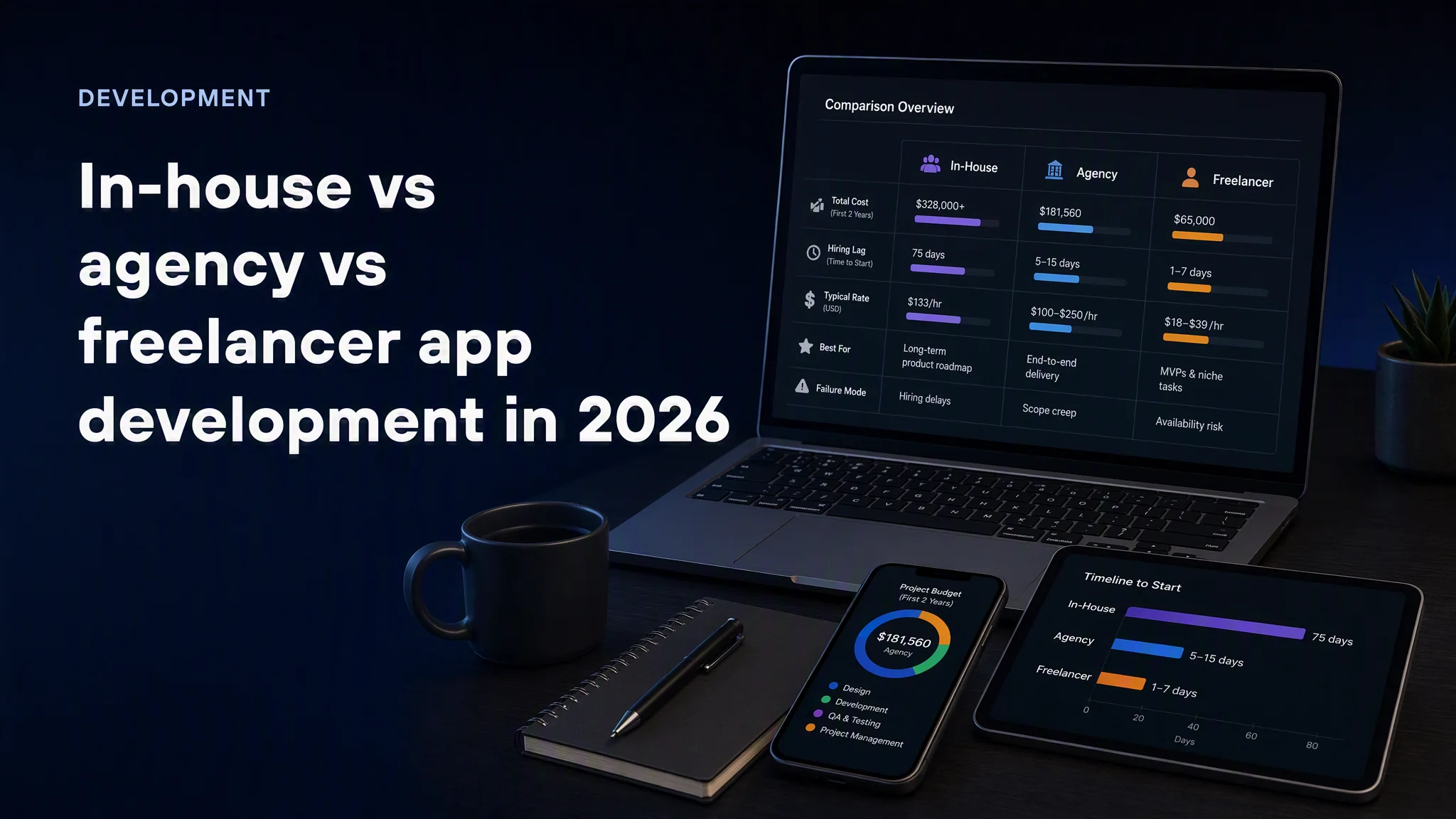
- In-house vs agency vs freelancer at a glance
- In-house team
- Development agency
- Freelance developer
- The hybrid most funded teams use
- Which model fits your project
- What one in-house developer really costs
- Whoever ships release twelve is the real answer
- Weighing an agency quote against a hire? Get a scope you can price both ways
- Frequently asked questions
- Sources
TL;DR
In-house vs agency vs freelancer app development is one decision with three cost structures, three failure modes and three answers to the question of who ships your next release. We compared them on published rates, hiring lag, and what happens when a platform deadline lands in 2026. No model wins outright. An agency is cheaper for the first two years, and in-house pays off later.
- US software developers earned a median $133,080 in May 2024, per the Bureau of Labor Statistics, and benefits add roughly 43 cents per salary dollar.
- Clutch puts the average app project at $90,780 over 11 months. Upwork lists app developer rates from $18 to $39 an hour.
- Technical roles take a median 75 days to fill, so in-house starts two and a half months behind the others.
What each model costs across the market
Most comparisons quote round figures nobody sourced. Here are public ones.
The Bureau of Labor Statistics put the median annual wage for US software developers at $133,080 in May 2024, and projects the occupation to grow 16% through 2034. That is the in-house line, before benefits and recruiting.
Clutch reports an average app project of $90,780 running 11 months, about $8,188 a month, with $25 to $49 an hour the most common US band. That is the agency line.
Upwork publishes app developer rates of $18 to $39 an hour on its own hire page, with a median of $27. That is the freelance line, well below the $75 to $200 agency blogs quote.
Three sources, three price tags, one app. The gap is not code quality. It is what you buy alongside it.
Two 2026 platform deadlines after your build
Every comparison of these models treats the build as the product. The stores disagree.
Apple has required since April 28, 2026 that apps uploaded to App Store Connect are built with Xcode 26 or later, using an SDK from the iOS 26 generation. Miss it and you cannot ship an update, hotfixes included.
Google sets August 31, 2026 as the date new phone and tablet apps and updates must target Android 16, API level 36. Existing apps have to target at least Android 15, API level 35, to stay available to new users on newer devices. Extensions run to November 1, 2026.
Two forced release cycles a year, as long as the app lives. The real question is who is under contract in April, and who answers the phone in August.
How we compared the models
Same five criteria for all three, applied in the cards below.
- Money committed before any code exists, including recruiting and notice.
- Time from decision to first build, from published benchmarks not vendor claims.
- Who carries the app through platform deadlines and OS releases after launch.
- What happens when the person who wrote the code leaves.
- Where the model quietly costs more than its headline rate.
One disclosure. Mercury Development is an agency, so we scored the agency model on the same criteria and left its weak spots in. If an agency's comparison finds no fault with agencies, close the tab.
Once the model is settled, the next step is how to choose a software development company.
In-house vs agency vs freelancer at a glance
| Dimension | In-house team | Development agency | Freelance developer |
|---|---|---|---|
| Best for | Apps that are the business | Fixed scope, hard deadline | Small, specified pieces |
| Published rate | $133,080 median salary plus benefits | $25 to $49 per hour on Clutch | $18 to $39 per hour on Upwork |
| Time to start | 75 days median to fill a role | Days to weeks | Days |
| Who ships release 12 | You, if the hire stays | The retainer, if you keep one | Nobody, by default |
| Main risk | Fixed payroll, variable work | Scope drift, vendor lock-in | Single point of failure |
| Hidden cost | Recruiting, management, idle time | Knowledge that leaves | Your time managing it |
In-house team
An in-house team is the only model where the people who wrote the app are still in the room a year later. That is the whole argument, and it holds when the app is the business, not a channel.
It is also the slowest to start. Ashby puts the median time to first fill for technical roles at 75 days, across 54 million applications and 93,000 jobs from January 2021 to March 2026. Add a notice period and ramp-up, and the first commit lands four months after you decide.
Best for: products where the app is the core business and the roadmap runs past 24 months.
Facts: BLS median wage $133,080, benefits at 30.1% of total compensation, 75 day median time to fill.
The honest minus: payroll is fixed and your workload is not. A team sized for launch is oversized for maintenance, and the first quiet quarter turns your best engineers into a retention problem.
Development agency
An agency sells a team that already exists. Project manager, designers, engineers, QA, from week one, under a contract with a delivery date. For a fixed scope and a real deadline, nothing starts faster.
The most common US hourly band on Clutch is $25 to $49. The variance sits in what you get: a named senior team, or the pitch team then whoever is free.
Best for: a defined scope, a deadline you cannot move, and no appetite to hire before product market fit.
Facts: average project $90,780 over 11 months on Clutch, about $8,188 per month.
The honest minus: knowledge walks out with the team when the contract ends, unless you pay for a maintenance retainer or a documented handover. Get both in writing, and ask which named engineers stay.
Mercury Development is one of these. Founded in 1999, 500+ engineers, 5.0 across 34 Clutch reviews. Two engagements show what continuity buys: the claims platform for Precision Practice Management, live since 2006 and on its fourth major release, and Fitbit, which started in 2011 and continues under Google.
Freelance developer
A freelancer is the fastest way to get code written and the slowest way to get an app maintained. For well specified work, an SDK integration or a screen flow, that trade is fine.
Upwork's own hire page lists app developer rates at $18 to $39 an hour with a $27 median. Those are platform numbers, unlike the $75 to $200 competing comparisons quote unsourced.
Best for: bounded work where you can write the spec and review the result yourself.
Facts: Upwork range $18 to $39 per hour, median $27, basic to intermediate iOS from $45.
The honest minus: bus factor of one. There is no bench, no QA and no cover when your developer takes a contract elsewhere in month seven, roughly when the next deadline arrives. US buyers should also watch classification: the Department of Labor published a proposed independent contractor standard in the Federal Register on February 27, 2026. The test for a long term contractor is being rewritten.
If you want a bench without onshore rates, compare nearshore vs offshore software development.
The hybrid most funded teams use
Most teams that ship well do not pick one model. They pick a sequence.
An agency builds version one against a deadline. The first in-house engineer joins during that build and owns the repository from day one. Agency load then drops to a retainer covering platform deadlines and spikes.
The sequence separates two jobs: getting to market, and staying there. It fails when the in-house hire arrives after handover: then you pay someone to reverse engineer a codebase instead of extending it.
What each half of that sequence costs on a fixed budget is worked out in outsourcing vs in-house development.
Which model fits your project
Fit splits by what the app is to your business.
If the app is the business, hire. A marketplace, a SaaS client, a connected hardware companion: roadmaps measured in years, where every month on contract adds knowledge you buy back later. Start recruiting 75 days before you need that engineer productive.
If the app is a channel, use an agency. Retail, healthcare, media, logistics: the app matters, and your own engineers should be working on whatever makes the money. Buy delivery, keep a retainer, hold the store accounts yourself.
If you are validating, use a freelancer. A prototype from one good developer costs less than a month of either other model. Do not let it become production.
What one in-house developer really costs
Here is the arithmetic nobody puts in these comparisons, from public numbers only.
For private industry workers in March 2026, the Bureau of Labor Statistics puts employer compensation at $46.60 an hour: $32.60 in wages and $14.01 in benefits. Benefits are 30.1% of the total, which adds about 43 cents to every salary dollar.
Apply that to the $133,080 median wage and one engineer costs roughly $190,000 a year in compensation alone. Add hiring costs, equipment, software seats and management time, and a two person mobile team is a $400,000 annual commitment before a single release ships. Against Clutch's $8,188 a month, about $98,000 a year, the in-house premium is close to four times. That premium buys continuity, worth paying when the roadmap is long enough to use it.
Whoever ships release twelve is the real answer
Opinion, stated plainly: this decision is almost always argued about the wrong release.
Buyers compare quotes for version one. Version one is the cheapest and best attended release the app will ever get. The releases that decide whether a product survives are the ones nobody is excited about. The April SDK bump. The August API level bump. The crash that reproduces on one Android skin.
Ask each option the same question. Who is contractually obliged to ship that release, and what does it cost when they do? A freelancer has no answer. An agency has one only if you pay for a retainer, so read the maintenance clause before the build clause. An in-house team has the best answer and the worst utilization, because the engineers who are essential in April are underused in June.
Price the models over 24 months, not over the build. The ranking changes, often more than once.
Written by Rob Devereaux, Chief Operating Officer at Mercury Development. Rob has run the firm's operations from Hudson, Ohio since 2019 and has over 20 years of operational and financial experience. The engagement models compared here are the ones he negotiates and staffs on the delivery side of the firm.
Weighing an agency quote against a hire? Get a scope you can price both ways
You have the trade-offs. What you may not have is a scope specific enough to compare. Tell us what you are building, how long you expect to run it, and who you have. We will come back with the phases, the team they need and what the year after launch costs.