
Media asset management testing in 2026: Adobe, storage, render nodes
TL;DR
Media asset management testing in 2026 is closer to systems integration than to app QA. A MAM product is tested inside Adobe hosts, across modular permissions, and on a database VM, a render node and shared storage that behave like the customer's facility.
- Adobe made UXP generally available in Premiere 25.6 in December 2025 and keeps CEP for at least one more major release cycle, so many MAM panels now ship in two extension models.
- Generic media QA pages cover streaming and devices. DeviQA's media page carries 12 FAQs, and none mentions Adobe, shared storage or render nodes.
- No vendor can size MAM QA honestly without a live demo and access to a working environment.
- Mercury Development fits vendors who need the environment built as well as tested: 100+ QA engineers inside a 500+ engineer firm that has tuned shared storage for media editing.
Why MAM testing is a different job from app QA
Search for media QA outsourcing and you land on streaming pages. DeviQA's media testing page is typical: a lab of 300+ devices, platforms and environments, playback quality and CDN delivery. Its 12 FAQ answers never mention Adobe, shared storage or render nodes. DAM appears as a link to DeviQA's CMS testing page, where one answer covers upload and transcoding pipelines, metadata, search and permissions.
That checklist misses the half of a MAM product that lives outside the browser.
A media asset manager sits in the middle of a post-production facility. Editors open it inside Premiere, a render node turns uploads into proxies, and everything reads the same shared storage. When one link breaks, the bug report says the panel is empty, and the cause is a mount point nobody on the QA team has seen.
Our comparison of media and entertainment software testing companies covers vendor selection. This piece covers what a MAM test plan contains and why the quote depends on access.
Premiere moved to UXP and the extension matrix doubled
In December 2025 Adobe announced that UXP had graduated from beta and was available in Premiere 25.6. The Premiere UXP changelog dates the first public beta to December 4, 2024, adds hybrid plugin support in 26.2 and now runs to Premiere 27.0.
CEP is not gone. Adobe's migration note for extensibility partners says CEP support continues for at least one more major release cycle after UXP 1.0, and that major cycles usually line up with Adobe MAX. It also calls those timelines targets, not commitments. Photoshop's own guide for CEP developers says CEP will be deprecated and then removed at some point, with no date.
For a MAM vendor this is a test problem first. During the overlap you may ship a CEP panel for older Premiere builds and a UXP panel for current ones, both talking to the same server and both needing regression on every host update. Adobe's partner note covers Premiere Pro only, so plan After Effects separately.
The five layers of a MAM test plan
Name the layers before the test cases:
| Layer | What breaks | What the test needs |
|---|---|---|
| Web client and API | Search, metadata, check-in and check-out, browser quirks | Seeded catalog with realistic asset counts |
| Adobe panels | Import, relink, export back, panel state after host updates | Each supported host version, CEP and UXP builds |
| Permissions | Users seeing or editing what their role should hide | Role and module matrix with test accounts per cell |
| Database VM | Slow queries at catalog scale, migration scripts | Production-like data volume and backups to restore |
| Render node and shared storage | Stuck jobs, missing proxies, files the client cannot open | Mounted storage, real codecs, real file sizes |
Testing Adobe-integrated workflows
Adobe integration is a round trip. An editor drops a folder structure from the MAM into Premiere, cuts, and sends the result back with metadata intact. A designer saves a Photoshop still that the MAM must register as a new version, not a new asset. An After Effects render has to land in the right project folder.
Test each leg for four things:
- The panel loads and authenticates on every supported host version.
- Paths resolve on Windows and macOS against the same storage.
- Metadata and versions survive the trip back.
- Large projects stay responsive, because editors stop trusting a panel that freezes.
Host versions are the moving part: the matrix is host version times extension model times operating system. Automate the smoke run across that grid and keep exploratory sessions for creative workflows.
The systems these panels connect to are compared in our guide to digital asset management systems for media.
Modular permissions turn into a roles-by-modules matrix
Professional MAM products sell in modules such as ingest, review, archive and publishing, and admins grant rights per module and per role. The vendor's own testing matrix is the best starting document: it shows which combinations count as supported.
Six roles across eight modules is 48 cells before you add project-level overrides. Each cell needs a test account and two checks: allowed actions work, hidden assets stay hidden. The second one is where client footage leaks.
Generate test accounts from the permission model, so a new module adds rows automatically. Test denial paths through the API too, because a hidden button is not a permission.
Database VM, render node and shared storage
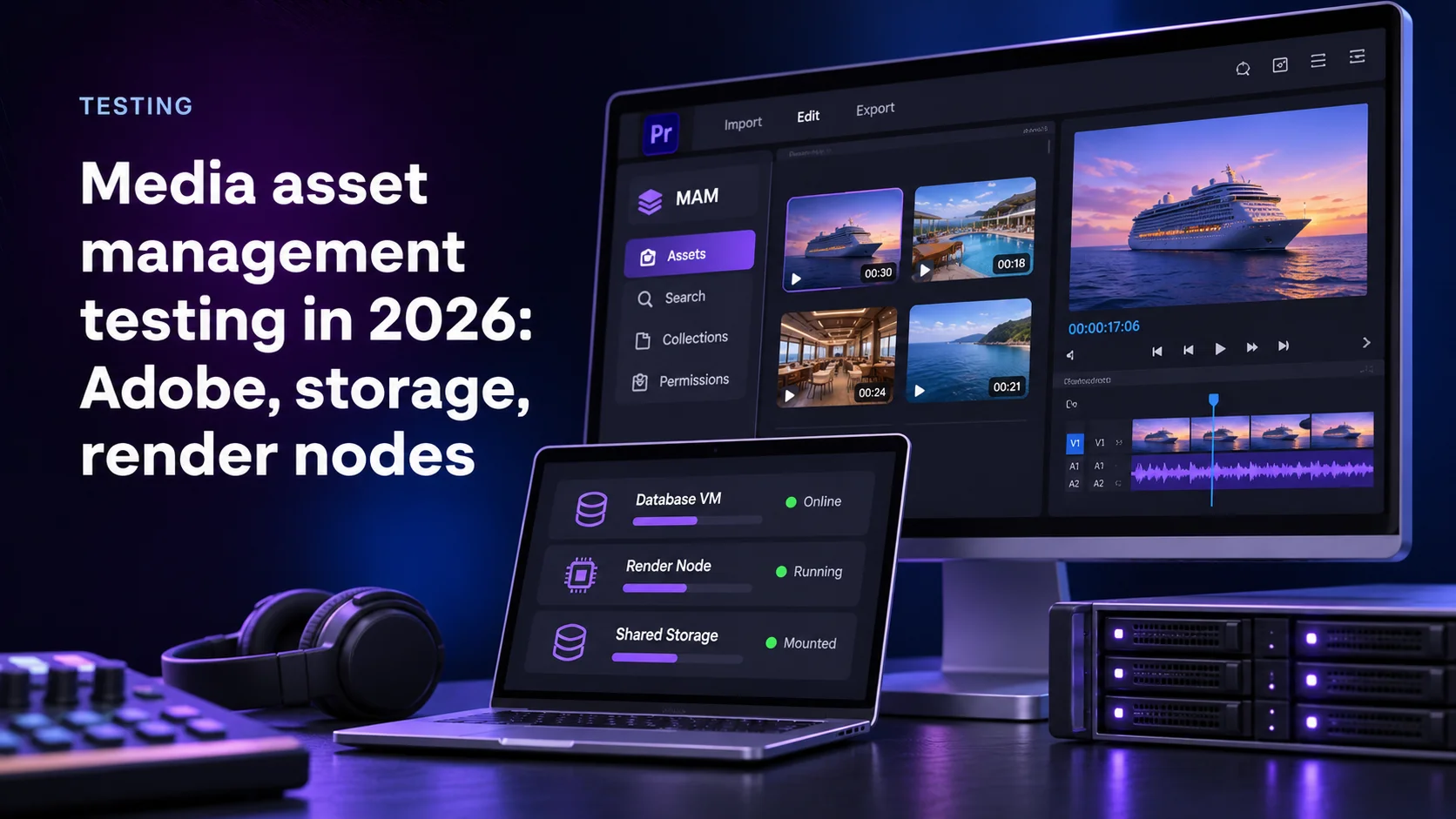
On-premises MAM software runs as several machines: a database VM, an application server, render or transcode nodes, and shared storage mounted on all of them. Test anything smaller and you test a product your customers do not run.
Shared storage is the layer teams skip and regret. Render nodes write proxies to it, the web client streams previews from it, the Adobe panel resolves paths against it. Unmounted, it makes half the product look broken.
Load matters here. Studio Network Solutions makes shared storage for media workflows, and Mercury's work on EVO reduced read and write latencies by analyzing the I/O traffic typical for video and audio editing, until the system hit record throughput and latency values for its hardware. A MAM test environment should replay that profile: many concurrent streams of large files.
Why an honest QA estimate needs a live demo
A MAM QA estimate written from a feature list is a guess with a price on it. The list does not show how modules interact, how long an ingest takes, or whether the environment even boots.
A live demo answers the first questions. Direct access answers the rest: the vendor installs the product, mounts the storage, runs one ingest end to end and sees where setup breaks. Only then can it count test cases and size the team.
If a vendor quotes a standard rate times a feature count, the environment work is missing and will return as a change request.
Which QA model fits a MAM product
| Model | Strength | Gap for MAM |
|---|---|---|
| In-house QA | Knows the product and the customers | Rarely has time to build a second facility for testing |
| Device-lab QA vendor | Broad device and browser coverage, published automation results | Media pages center on playback and delivery, not Adobe hosts or storage |
| Crowdtesting | Many testers and locations at launch | Cannot stand up a database VM, render node and storage |
| Engineering-led QA team | Builds and maintains the environment, tests desktop and server parts | Needs real access to the product from week one |
Mercury Development sits in the last row. Its QA practice has 100+ dedicated QA engineers working in the client's own tools, and the automation team covers desktop software, compatibility and migration testing, and multi-version runs in isolated Docker environments. The media engineering behind it includes the SNS storage work, a rebuild of RasterMAPPER for Element Labs and Barco from an application delivered without source code, and MiMedia, where Mercury's developers and QA engineers worked with the client's server team on legacy Mac and Windows apps. The desktop practice integrates software with storage and media systems.
What media software vendors bring us
These findings come from our own presales records for professional media tools, counted by hand and anonymized. They describe our buyers, not the market.
Every buyer in this group arrived with an environment constraint a generic QA vendor does not test for: shared storage, multi-gigabyte source files, a controller with no API, or a third-party publishing API.
The MAM case shows it end to end. The vendor wanted to improve its QA process as well as outsource testing, and sent the testing matrix for its main asset management platform. The product integrates with Premiere, Photoshop and After Effects, sells in modules with admin-controlled rights, and runs on separate VMs for the database and the render node. When those VMs came up, the shared storage the product depends on was not mounted. We told the vendor we could not size the QA scope responsibly without a live demo and direct access. The engagement that followed was contracted at $50,000.
Pay for access before you pay for test cases
MAM QA deals go wrong in the first month, not the twelfth. The vendor signs on a feature list, waits weeks for credentials and storage, and burns budget on setup nobody priced.
Flip the order. Make the first deliverable a working test environment and one full ingest-to-Adobe round trip, run by the vendor's own people. It tells you more about a QA partner than any device count, and the estimate rests on the product, not a brochure.
Written by Rob Devereaux, Chief Operating Officer at Mercury Development. Rob has run the firm's operations from Hudson, Ohio since 2019 and has over 20 years of operational and financial experience. The presales records behind this article's media vendor section sit in the operations he oversees.
Send us your MAM workflow and we will scope the testing
Tell us which Adobe hosts you support, how modules and roles are set up, and what your servers and storage look like. We will come back with the test environment, the team to run it, and the access an honest estimate needs.