
Marketplace dispute resolution in 2026: trust ops for a creator MVP
TL;DR
Marketplace dispute resolution in 2026 belongs inside the product of any creator marketplace that sells paid streams or custom video orders. A help desk added after launch cannot see what was paid, what was streamed or what the two sides told each other.
- Card networks count every bank dispute against you. Since April 1, 2026, Visa flags a merchant as excessive at a 1.5% ratio of fraud and disputes to settled card-not-present sales, down from 2.2%.
- Stripe charges $15 for each dispute received. On destination charges the platform pays it, not the creator.
- Apple and Google already require reporting and blocking in apps with user content.
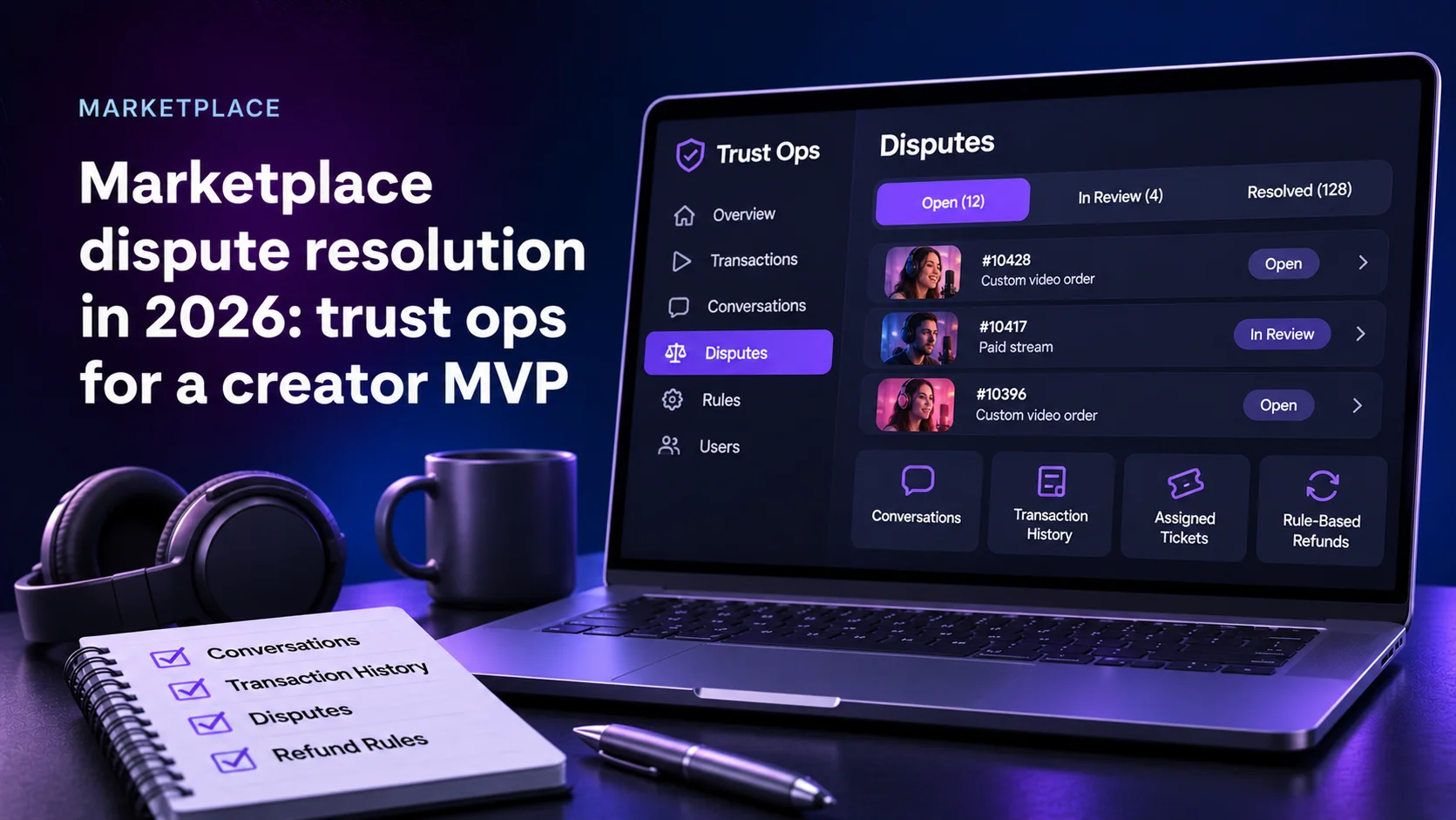
- Four mechanics carry most of the load: conversations nobody can delete, a shared transaction history, disputes that open assigned tickets, and refunds applied by rule.
Every paid stream is a future dispute
A creator marketplace sells something that disappears as it is delivered. When a viewer says the stream was not what the profile promised, there is no box to send back. There is only what each side can prove.
Disputes on these platforms come in three kinds. Quality: the drone footage in the profile turned out to be a phone camera. Timing: the creator started late or never showed. Payment: the charge is wrong or not recognized.
A founder of a paid live-streaming marketplace told us that without tooling for these conflicts he would have to employ 10,000 people to be judge and jury. He asked for a dispute that creates a ticket assigned to a customer service representative. He was right about where the work belongs: a help desk does not hold the order, the stream log or the chat. Your product does.
Visa's 1.5% line went live on April 1, 2026
On April 1, 2026, Visa tightened the excessive merchant threshold in its Visa Acquirer Monitoring Program (VAMP) from 2.2% to 1.5% for merchants in the US, Canada, the EU and Asia-Pacific, as Justt reports. The ratio counts fraud reports (TC40) plus disputes (TC15) over settled card-not-present transactions, and a fraud report that turns into a dispute counts twice. Enrolled merchants pay $8 per fraudulent or disputed transaction, according to the Merchant Risk Council.
On a marketplace, that merchant is usually you. Stripe's Connect dispute rules say that on destination charges and on separate charges and transfers, Stripe debits the disputed amount and the fees from the platform account. You can reverse the transfer to the creator afterwards, if the creator still has a balance. Stripe pricing lists a $15.00 dispute received fee, plus a $15.00 countered fee for each dispute you answer, returned only when you win.
The cheapest dispute is the one the viewer opens inside your app, not at the bank.
What app stores already make you build
Store review is your first auditor. Apple's App Review Guidelines, last updated October 16, 2026, require apps with user-generated content to filter objectionable material, take reports with timely responses, let users block abusers and publish contact information (guideline 1.2). Google Play's User Generated Content policy asks for accepted terms, in-app reporting and blocking, and moderation that fits your content. Any one-to-one chat must let users block each other.
Payments add a second layer. Under Apple guideline 3.1.3(d), a real-time person-to-person service between two individuals may be paid outside in-app purchase. One-to-few and one-to-many real-time services must use in-app purchase. A private stream for one viewer can run on your own processor and refund rules. A paid public stream sold in the iPhone app goes through Apple, and so do its refunds.
You still get a say. Apple's Send Consumption Information endpoint lets your server report delivery status, consumption and your refund preference within 12 hours of a refund request, with the customer's consent. It only helps if your app logged delivery.
The tools that scan reported streams and uploads are compared in our review of content moderation tools.
How marketplaces settle disputes without a crowd of judges
Large marketplaces did not hire a judge per order. They wrote rules that settle most cases first.
Cameo gives talent up to 7 days to complete or decline a request. If neither happens, the order expires and the payment is refunded automatically. On the website the card was only held and never charged, per Cameo's help center. Timing disputes never reach support.
Upwork releases fixed-price funds when a client does not respond within 14 days. In a dispute, its team gives a nonbinding recommendation, then either side can move to binding arbitration. The review covers dates, proof of delivery and messages exchanged, and skips subjective feedback about work quality, according to Upwork.
Airbnb keeps the evidence on its platform. Its policy forbids moving bookings or communication off Airbnb, and the company blocks messages that carry contact details or external links. Guests who pay outside lose AirCover. A deal struck in direct messages elsewhere leaves you nothing to judge.
The pattern is simple. Deadlines settle timing. Evidence settles quality. People handle what is left.
Mechanic 1: conversations nobody can delete
Every message about a paid job lives in your app, tied to the order. Neither side can delete or edit it after sending. A user can hide a thread from view; the record stays.
Build it like this:
- Attach each chat to an order or stream ID, so support opens the case with the conversation loaded.
- Store messages append-only on the server. Delete hides the message for the sender; the moderation copy remains.
- Detect contact details and payment handles before the job is complete, then warn or block, as Airbnb does.
- Let either side report a single message, which flags it with its context.
- State the retention period in your terms and have a privacy lawyer set it.
Mechanic 2: a transaction history both sides can see
Most disputes are arguments about what happened when. Log it as an order timeline: request sent, price agreed, accepted, stream started, stream ended, minutes delivered, payment captured, payout scheduled, refund issued. Both parties see the same timeline. Support sees it with technical detail added: stream session logs, the reported device, resolution and bitrate.
That layer catches a common cheat: a creator who lists pro equipment and streams from a phone. Check the profile claim against the session data, and the quality dispute becomes a lookup. Know the limit: your own app can report its camera, an external RTMP encoder may not identify the device at all.
Keep your own ledger of every cent, separate from the processor. Per-minute pricing needs it most: the bill is minutes times rate, and the minutes come from your logs.
Mechanic 3: a dispute that opens a ticket
A report button on the order creates a ticket, never an email. The ticket carries the order, the timeline, the chat and the payment state, and lands in a queue where a rule assigns it to a customer service representative.
The fields that matter:
- Reason code from a short list: not delivered, late, not as described, technical failure, billing error, safety.
- Status with deadlines: open, waiting for creator, waiting for viewer, decided, appealed.
- A response window for the creator. Miss it, and the default decision applies.
- Assignment rules: safety reports first, high-value orders next, everything else by age.
- A decision record with the reason, sent to both sides.
Hold the payout while a ticket is open, so disputed money never leaves before anyone decides.
The queue can live in your admin panel or in a help desk you already use. Either way the product creates the ticket with the evidence attached.
Mechanic 4: refunds as rules, not favors
Write the refund rules before launch and let the system apply them:
- Not delivered by the deadline: full automatic refund, the way a Cameo request expires.
- Stream ended early by the creator, or a technical failure on your side: refund the undelivered minutes.
- Viewer left early by choice: no refund.
- Quality claim: goes to a ticket and is decided on the timeline and session data.
The money flow matters as much as the rule. For short-lead jobs, authorize the card at booking and capture on delivery, so a cancelled job is a released hold instead of a refund. Pay creators on a delay that covers your dispute window. Keep viewer balances as credits spent in the app, so the product never looks like a bank.
What the EU expects once you grow
The Digital Services Act already asks hosting services for a notice mechanism (Article 16) and a clear statement of reasons when they restrict content or accounts (Article 17). Article 19 exempts micro and small online platforms from Section 3, which holds the Article 20 complaint system. Past that point, complaint decisions need qualified staff, not solely automated means. Reason codes and decision records cover most of it.
What creator marketplace buyers bring us
These findings come from our own presales records for consumer music and social video products, counted by hand. They describe buyers, not the market. Any group with fewer than three data points is not published.
Around 65% wanted monetization in the first release: subscriptions, paid discovery, per-minute billing or in-app purchases. Around 50% asked for an admin panel beside the mobile app. Requests for dispute, refund and ticket tooling came from products where money changes hands per job, such as paid streams and booked requests. Subscription-only products did not raise them in presales.
The patterns repeat. Founders named Airbnb as the model for keeping communication on the platform, and expected creators to overstate their equipment. On our side, identifying the streaming device over RTMP stayed an open question, and a wallet that held user funds raised the question of whether the platform was acting like a bank.
Build the evidence, not the moderation team
The army of moderators is what you hire when the product kept no evidence. Every case then starts from two stories, and each one takes a person.
Build in this order: the chat that cannot be deleted, then the order timeline and the ledger, then the report button that opens a ticket and holds the payout, then the refund rules. Moderation of public content comes last, sized to real report volume.
Mercury Development has built software since 1999 with 500+ engineers, and its apps reach more than 40 million users. Choosing a video engine? Compare private live streaming platforms. For payouts, see the swipe music discovery app model.
Written by Rob Devereaux, Chief Operating Officer at Mercury Development. Rob has run the firm's operations from Hudson, Ohio since 2019 and has over 20 years of operational and financial experience. The presales records behind this article's buyer section sit in the operations he oversees.
Tell us how money moves and we will draw your dispute flow
Tell us what viewers pay for, how creators get paid and what can go wrong between them. We will send back the evidence your app should log, the dispute and refund rules for launch, and the admin and ticket scope your first release needs.