
Swipe music discovery app: two-sided paid discovery in 2026
TL;DR
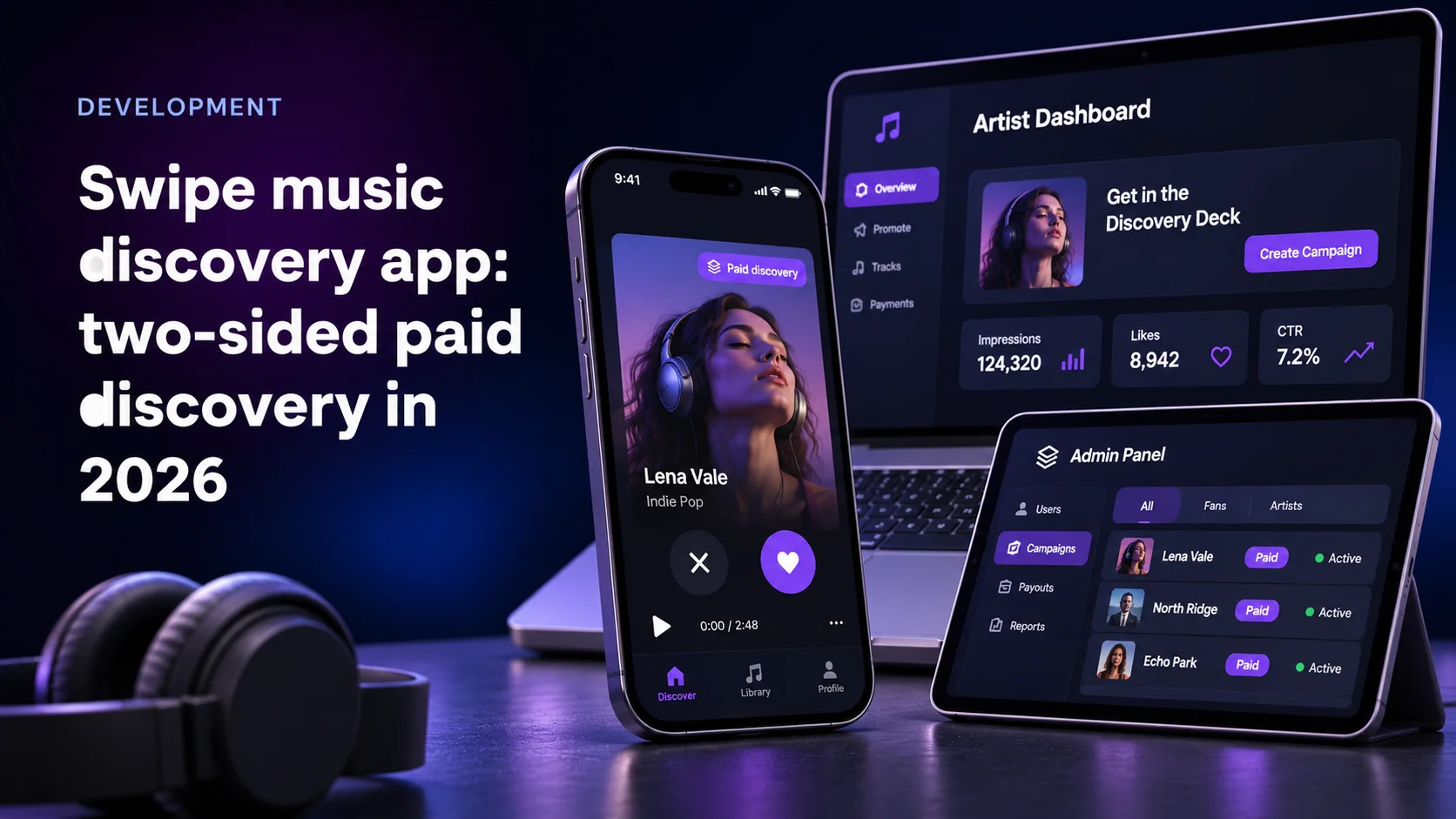
A swipe music discovery app in 2026 is a two-sided marketplace: fans pay to swipe through new artists, and artists pay to get into the deck. That makes it three products at once: a mobile app for fans, a web dashboard for artists, and an admin panel for the team in the middle.
- Fan payments inside an iPhone app go through Apple in-app purchase. Apple's commission is 15% under its Small Business Program, and US storefront apps may also link out to web checkout.
- Artist payments belong on the web dashboard, outside the app stores.
- Paying artists out through Stripe Connect costs $2 per monthly active account plus 0.25% + 25¢ per payout when the platform sets its own pricing.
- Label every paid placement. In April 2026 a US judge sent a payola suit over Spotify's Discovery Mode to arbitration, and the disclosure question has not gone away.
One deck, three products
Founders pitch this as Tinder for music. Fair for the screen, wrong for the business. Here both sides of the swipe are paying customers with opposite goals: the fan wants an honest deck, the artist wants a better seat in it. Your app takes money from both and has to keep each side's trust.
So scope three surfaces from day one. The fan app on iOS and Android: swipe, play, match, follow, share. The artist web dashboard: upload, tag, buy promotion, read stats, get paid. The admin panel: moderate clips, approve payouts, handle refunds, set the rules for paid placement. Scope only the first, and you meet the other two at launch.
Spotify's payola case is the warning label for paid discovery
Spotify's Discovery Mode lets labels boost songs in exchange for reduced royalty payments. A Spotify subscriber sued, arguing that the feature amounts to modern payola and that playlists marketed as personalized are shaped by undisclosed pay-for-play. On April 30, 2026, Judge John G. Koeltl of the Southern District of New York granted Spotify's motion to compel arbitration and stayed the case, as Music Business Worldwide reported.
Spotify won on its terms of use. The plaintiff's core demand was disclosure of paid promotion, and for a swipe app that sells placement, that is a product requirement. Mark the paid card in the deck. Let the swipe data, not the payment, decide whether a promoted artist keeps showing up.
Who has already built the swipe
The mechanic is a decade old. What changes is who pays.
| Product | Mechanic | Who pays | Source |
|---|---|---|---|
| The Best Song | 30-second samples, swipe left or right, likes saved to Spotify or Deezer | Not covered; the startup raised a $300,000 round | TechCrunch, 2015 |
| Discz | 15-second snippets, liked songs added to a Spotify playlist | Free download, no prices listed | Rolling Stone, App Store |
| Muzic Swipe | Artists upload 15-second genre-tagged clips, listeners swipe, several likes make a match | Fans pay to swipe, artists pay to be discovered | Mercury case study and project records |
| Groover | Artists send a track to curators and pros | Artists, 2 Grooviz per contact at €1 each | Groover pricing |
| SubmitHub | Artists submit to curators | Artists, premium credits from $1 each | SubmitHub help |
The Best Song reported 20,000 monthly active users doing 800,000 swipes in 2015. Discz, pitched as Spotify meets Tinder, reports users in over 200 countries, and its App Store listing shows a free app. Groover refunds credits when a curator does not reply within 7 days, and SubmitHub prices curators at 1 to 5 credits each. Artists already pay for a guaranteed listen, never for a guaranteed like.
The product model: swipe, stream, social
MuzicSwipe shows the loop. Artists upload 15-second genre-tagged clips. Listeners swipe to rate them. Several likes create a match that opens full tracks and the artist's profile. Mercury took the product from concept to launch on mobile and web, with media storage, CDN delivery, a custom recommendation and tagging system, and analytics with A/B testing.
The money side was there from the start. The founders defined MuzicSwipe around three themes, swipe, stream and social, and built it as a revenue model from the first release: fans pay to swipe and discover artists, artists pay to be discovered, and the platform processes money coming in and money going out.
Three engineering choices carry the model:
- Short clips make the deck fast. Clips sit on a CDN and the next few preload, so every card plays on arrival.
- Tags make matching possible before any swipe history exists.
- Events make the business measurable. MuzicSwipe tracks clip completion rates, match frequency and session duration, the same numbers that tell an artist what a boost bought.
How fans pay to swipe under app store rules
Apple's App Review Guidelines, last updated October 16, 2026, require in-app purchase for subscriptions and premium features sold in the app (3.1.1). Apple's commission is 15% for developers in the App Store Small Business Program, open to those with up to 1 million USD in proceeds. Music is a reader app category under 3.1.3(a), so an app built around a music subscription may let users reach a subscription bought elsewhere. On the United States storefront, apps may include buttons and external links to other purchase methods.
For US users, Google Play no longer requires Play Billing, and its alternative billing program charges a 10% service fee on auto-renewing subscriptions, with fees reported and paid from October 1, 2026.
In practice:
- Sell the fan subscription through each store's billing, then add web checkout for US users.
- Keep one entitlement service that knows who is premium, wherever they paid.
- Route fan tips through in-app purchase currencies, which Apple allows for tipping content providers.
How artists pay to be found
Artists should pay on the web, in the artist dashboard. They buy promotion and analytics from a laptop, and no app store sits in that purchase.
Price the boost as reach, not as outcome. A paid artist gets more cards in more decks. The fans still decide.
Build the guardrails in:
- A visible label on every promoted card.
- A frequency cap so one artist cannot flood a deck.
- A swipe threshold: a promoted clip that keeps getting swiped left stops being shown, paid or not.
- A refund rule for boosts that never reached their promised impressions.
Money in, money out: the payment architecture
Money comes in from two sides and goes out to one. That flow decides your payment stack.
Stripe Connect is the usual base for paying artists. When the platform sets its own pricing, Connect charges $2 per monthly active account, counted in any month a payout is sent, plus 0.25% + 25¢ per payout. Instant payouts cost 1% of payout volume. Fifty artists paid once a month cost $100 in account fees before the payout fee.
The charge type decides who absorbs problems. Stripe's Connect charges guide says refunds and chargebacks on destination charges reduce the platform's balance, while direct charges hit the connected account. For a swipe app, separate charges and transfers usually fit best: fans and artists pay the platform, the platform carries refunds and chargebacks, and it pays artists their share on a schedule.
Four rules keep this out of trouble:
- Let Stripe's hosted fields or Checkout collect card data, so card numbers never touch your servers.
- Do not hold fan balances that look like a bank account. Use subscriptions and credits that are spent in the app.
- Pay artists on a delay that covers your refund window.
- Keep an internal ledger of every swipe-earned and tip-earned cent, separate from Stripe, so payouts can be audited and disputed.
The artist dashboard and the admin panel
The artist dashboard is where artists upload clips, set tags, buy and track boosts, read swipe and match stats, finish Stripe onboarding, and see payouts. Build it as a web app first: artists manage catalogs on a desktop.
The admin panel is where your team keeps both sides honest. It needs clip moderation and takedowns, rules for paid placement, refund and dispute handling with a full transaction history, payout approval and holds, and reports that reconcile the ledger with Stripe. This web app is ordinary engineering. Skipping it turns a launch into a support queue.
What music and social video buyers bring us
These findings come from our own presales records for consumer music and social video products, counted by hand. They describe buyers, not the market.
Around 65% wanted monetization in the first release: subscriptions, paid discovery, per-minute billing or in-app purchases. Around 85% needed a web surface beside the mobile app, a website, an artist portal or an admin panel. Around 35% needed to pay money out to artists or creators, not only take it in.
The patterns repeat. Collecting card data in a custom screen would have pulled the product into PCI DSS scope, so we pointed the flow to Stripe-hosted pages. A wallet that held user funds raised the question of whether the platform was acting like a bank. Stripe onboarding that asks creators for sensitive data up front can cost sign-ups. A payment design that ignored store rules carried a real risk of App Store rejection.
Build the deck before you sell the boost
Two-sided payments tempt founders to build the money first. Build the deck first.
A promoted card is worth what fans do with it. If the swipe feels random, nobody renews, on either side. So the first release needs fast playback, honest tags and clean events. Charge fans once the deck holds them. Sell boosts once you can show an artist what a swipe is worth. Pay out once your ledger would survive an auditor.
Mercury Development has built apps since 1999, has 500+ engineers, and its apps reach more than 40 million users. If you are comparing vendors, our list of music streaming app development companies ranks six by shipped audio work.
Written by Rob Devereaux, Chief Operating Officer at Mercury Development. Rob has run the firm's operations from Hudson, Ohio since 2019 and has over 20 years of operational and financial experience. The presales records behind this article's buyer section sit in the operations he oversees.
Tell us how both sides pay and we will map the build
Tell us what fans pay for, what artists pay for, and how artists get paid. We will come back with the first release, the payment flow for each store and the web, and the dashboard and admin scope you need for launch.