
Cruise mobile check-in in 2026: passport capture to boarding pass
TL;DR
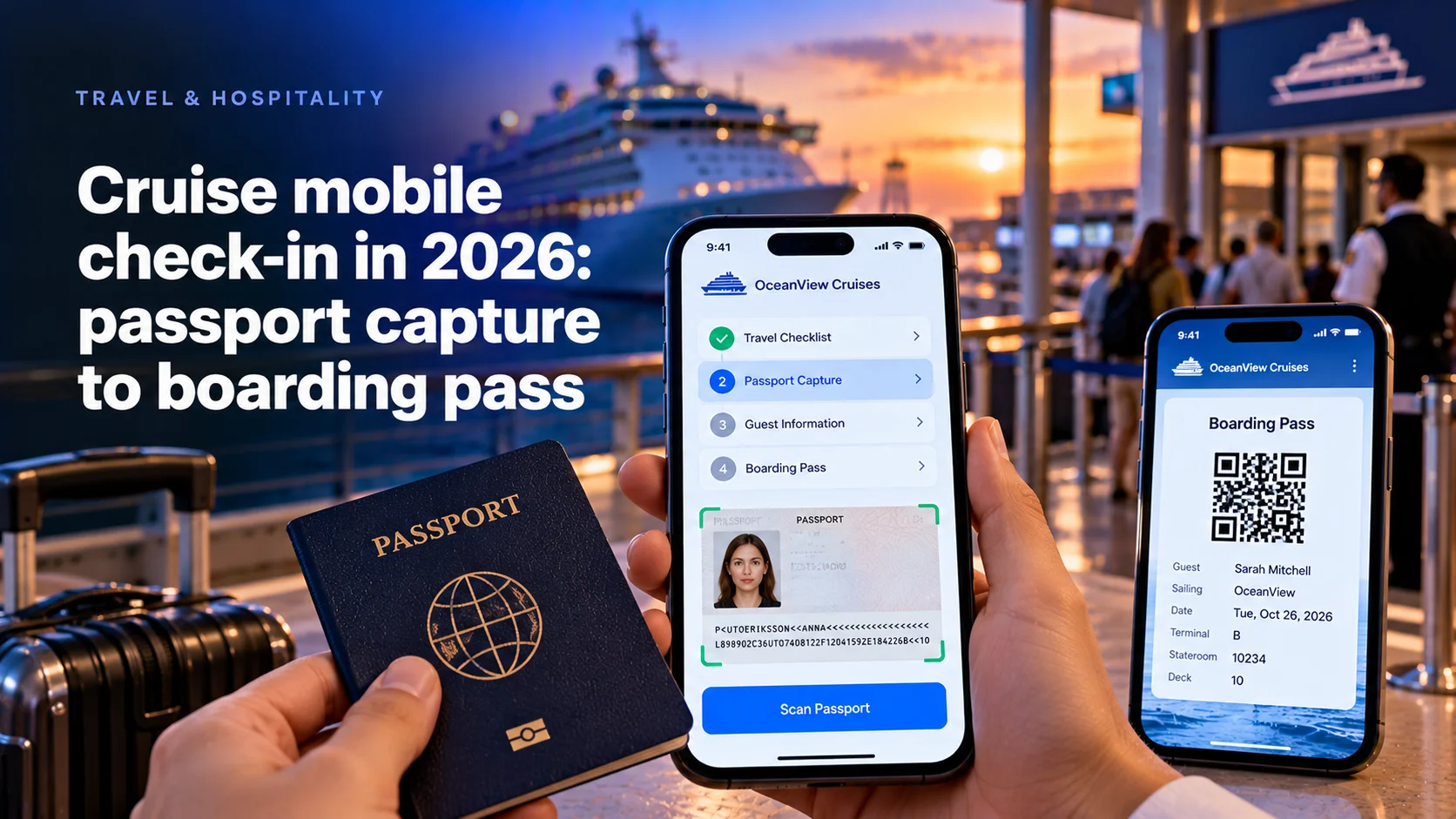
Cruise mobile check-in in 2026 is three products in one flow: a travel checklist that knows which steps each guest still owes, passport capture that reads the machine readable zone and, in a native app, the chip, and a boarding pass that opens with no signal at the pier. Royal Caribbean and Celebrity open online check-in 45 days before sailing.
- Buy the terminal side, such as eCruise Mobile Suite for agents or IDEMIA PaxPress Sea for biometric lanes. Build the guest side on your own reservation data.
- A web page cannot read a passport chip. Web NFC handles NDEF only, and iOS chip reads need Core NFC in a native app.
- CBP runs facial biometrics at 39 seaports, and a DHS rule in force since December 26, 2025 extends biometric exit to seaports.
- Mercury Development's onboard spa platform for OneSpaWorld has run on over 160 ships since 2018.
Why check-in decides embarkation day
Embarkation is the one day a cruise line meets every guest at the same door. Seatrade Cruise News, citing CLIA, reported 37.2 million ocean cruise passengers in 2025, up 7.5% from 2024. The app decides how much of each terminal crossing happens at home.
The large lines already moved the paperwork to the phone. Celebrity Cruises opens online check-in 45 days out, requires a credit card to finish and issues a boarding pass that needs no printing. The photo is optional. Royal Caribbean's flow, per the Royal Caribbean Blog, takes a security photo and a passport scan, offers half-hour arrival slots and puts a SetSail Pass in the phone's wallet.
The terminal end is changing too. CBP has expanded facial biometrics to 39 seaports. At debarkation, per CBP's release on the restart of cruising, a guest's photo is compared with the passport or visa photo on file within two seconds, with more than 98 percent accuracy.
US and EU biometric rules now reach seaports
A DHS final rule, effective December 26, 2025, lets CBP require photographs of all noncitizens entering or leaving the United States and names seaports among departure points. It says cruise exit will resemble air exit and that a notice will come before large-scale sea rollout.
Europe moved the same year. The EU's Entry/Exit System began on October 12, 2025 and was due in full by April 10, 2026, per the UK Chamber of Shipping. Non-EU travellers register a face and fingerprints when they embark or disembark at a Schengen port.
For a check-in product, the data a guest types at home now meets government records at the pier. A typo in a passport number stops being a data issue. It becomes a guest pulled out of line.
How we put this guide together
We read the three pages that answer this question in AI search. eCruise sells check-in and gangway apps for agents on iOS tablets, with passport validation and an offline queue. HotWay covers QR ticket scanning for sightseeing cruises and charters. IDEMIA pitches PaXpress Sea, a biometric journey with "mobile check-in options". None covers the guest's own phone, and none has an FAQ.
Platform and regulatory pages were read in October 2026. Cruise patterns come from Mercury's delivery records, without client names. Mercury Development builds cruise guest and crew apps, so read this as an interested view.
Build, buy or combine at a glance
| Option | What it covers | Where it runs | What you still build |
|---|---|---|---|
| eCruise Mobile Suite | Agent check-in, passport validation, photos, gangway scans | iOS tablets at terminal and gangway | Guest checklist, at-home capture, guest boarding pass |
| IDEMIA PaxPress Sea | Biometric identity from check-in to exit | Terminal, border and ship-side systems | Guest app flows, documents before the pier |
| HotWay | QR tickets, passenger lists, phone scanning | Event portal and scanning app | Documents, cabins, ship systems |
| Custom guest app | Checklist, documents, boarding pass, payment | Guest phones on your reservation systems | Integrations, compliance gates, store releases |
Most lines end up with a mix: bought terminal tooling and an owned guest flow.
Treat the travel checklist as a state machine
A checklist looks like a list. In production it is a set of states per guest that the reservation system can change at any time. eCruise's agent app collects emergency contacts, signed contracts and a health questionnaire.
- Store a status per guest per step. Two guests in one cabin share a booking, not a passport.
- Split required from optional. Celebrity makes the photo optional and the card mandatory.
- Drive document rules from data. Requirements depend on citizenship, residency and route.
- Validate across fields. A country of residency that does not match the phone's country code is a real edge case. Decide whether it blocks or warns.
- Recompute on every reservation change, such as a name fix or an added guest.
If a card is collected in a web view, PCI DSS requirements 6.4.3 and 11.6.1, mandatory since 31 March 2025 per the PCI Security Standards Council, require payment page scripts to be authorized and monitored for tampering. A processor-hosted card field usually shrinks that scope. Confirm it with your assessor.
How residency and market rules feed the app is covered in our guide to country-specific content in cruise apps.
Passport capture: read the MRZ first, the chip second
A passport carries two machine-readable sources. The machine readable zone is two lines of OCR-B text defined in ICAO Doc 9303. An ePassport adds a contactless chip with the same data and the holder's photo.
The MRZ is a camera problem. The chip is a permission problem.
- On iOS, apps read ISO 7816 tags through Core NFC's NFCISO7816Tag, available since iOS 13, and must declare the application identifiers they select.
- The chip opens with a key from the MRZ: passport number, date of birth and expiry date. The open-source NFCPassportReader library uses it for Basic Access Control.
- The web cannot follow. Chrome's Web NFC runs on Android, is limited to NDEF and does not support low-level I/O such as ISO-DEP.
Web camera capture works, with conditions. WebKit exposed getUserMedia to WKWebView apps from the iOS 14.3 beta, per the WebKit blog. Microblink's BlinkID web SDK lists Chrome 112+, Safari 16.4+ and a 720p camera as minimum requirements.
Our default: in the native app, scan the MRZ, then offer the chip read. On the web, capture the MRZ with manual entry as fallback and flag the record for an agent. Never make the chip the only path.
Make the boarding pass work without a signal
A pass that needs the network fails where every guest arrives at once. Build it to render from the device.
- Store a signed code on the phone the moment the checklist completes.
- Offer the wallet. Apple's Pass.BoardingPass type exists for transit passes such as airline boarding passes and train tickets.
- Never ask for a fresh login at the pier. On our cruise programs, a login token issued ashore has stopped working on the ship network.
- Keep a manual path. eCruise's gangway looks guests up by name or cabin number.
The pass identifies the guest. The ship's system decides. In Oracle's cruise property management system, Coming Onboard Validation blocks a guest flagged Deny Boarding and shows the reason.
The ship server that keeps the pass valid offline is described in our guide to offline-first mobile apps for ships.
Decide who owns the guest's face
Up to three photos meet one guest: the app's security photo, the terminal's photo and CBP's at debarkation. IDEMIA says its biometric data is minimized and processed in encrypted environments.
Settle four questions before the first sprint:
- Which photo is the record of truth for ship security.
- Whether the app photo is used for matching or only shown to crew.
- How long each photo is kept and which roles can see it.
- What the opt-out looks like. CBP lets U.S. travelers ask for a manual document check.
Cut the first release back from embarkation day
Check-in has a date that does not move: the first sailing that uses it.
- First release: per-guest checklist, MRZ scan, security photo, contract, payment method, offline boarding pass.
- Second release: chip read in the native app, arrival slots, the wallet pass.
- Later: biometric matching, which depends on the terminal vendor and CBP more than on the app.
Put two gates in the plan from day one. On our cruise programs ADA and PCI DSS have been release conditions, not polish. Mock what the reservation system cannot return yet, and log every missing field with an owner and a date.
Once check-in works, the next identity layer is the band or phone key covered in our guide to cruise ship wearable technology.
What our cruise programs show
Mercury's onboard spa platform for OneSpaWorld, which describes itself as the operator of health and wellness centers onboard cruise ships, has been in production since 2018 on over 160 ships operated by multiple cruise lines. Guests fill branded intake forms in several languages on Android tablets in kiosk mode. The forms take signatures, keep the history of every answer and sync with shore over low or sporadic bandwidth. That is the hard half of check-in: a document a guest signs on a device that may be offline.
For cruise line clients Mercury cannot name under NDA, we rebuild passenger apps on React Native rather than porting old code, with pre-cruise readiness, a travel checklist and the boarding pass in scope. The patterns above come from that work: a token issued ashore that fails on the ship network, an API that works in production and not in QA, and behavior that reproduces only on a real ship.
Check-in is an operations product
Most check-in projects get scoped as screens. The work sits in the rules behind them: which guest owes which step, which document the port checks, which system decides boarding. Get the rules right and the screens follow. Get them wrong and the terminal pays every sailing.
Change the vendor interview. Ask: "A guest whose residency does not match her phone number, whose passport chip will not read and whose phone has no signal at the pier. Walk me through her boarding." A team that has done this answers with states and fallbacks. One that has not answers with mockups.
Keep what you pay for. Mercury's About page states that the customer owns the code and all underlying IP.
Written by Rob Devereaux, Chief Operating Officer at Mercury Development. Rob has run the firm's operations from Hudson, Ohio since 2019 and has over 20 years of operational and financial experience. The cruise program delivery records behind this article's release scoping sit in the operations he oversees.
Planning mobile check-in for next season? Map the checklist first
Tell us which steps your guests complete today, where documents get checked and which system decides boarding. We will map that into a checklist state model and a first release cut back from your next embarkation date.