
Cruise PMS integration in 2026: Oracle SPMS, Fidelio and the ESB
TL;DR
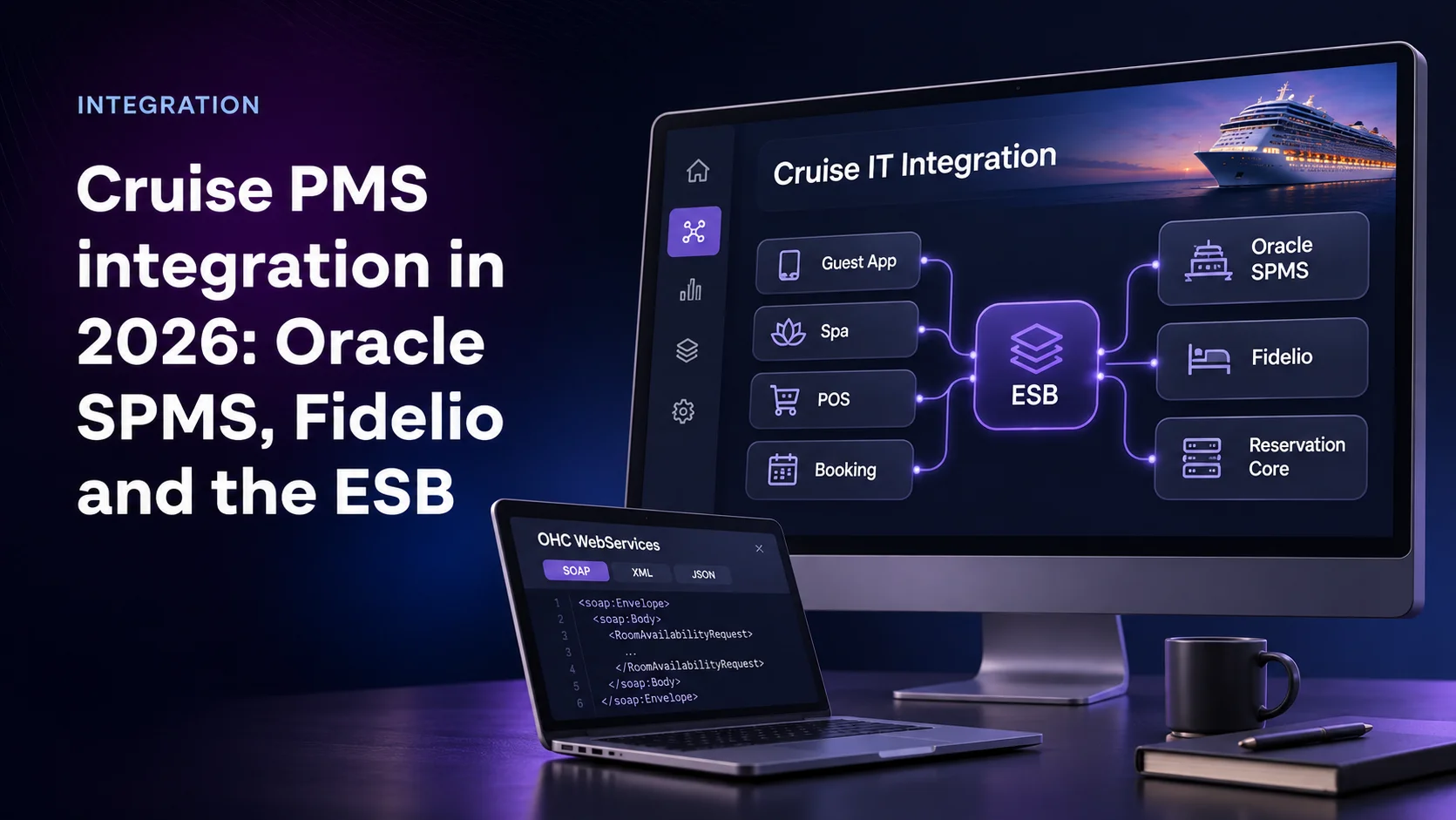
Cruise PMS integration in 2026 means connecting a guest app, spa, POS or booking flow to Oracle's shipboard PMS, to a reservation core ashore and to the line's enterprise service bus. Usually to all three.
- Oracle says its cruise software is used by 9 of the top 10 cruise lines. Most onboard integrations end at Oracle Hospitality Cruise SPMS, which grew out of Fidelio.
- Third parties reach SPMS through OHC WebServices, a SOAP service with XML or JSON messages. FIAS is the hotel protocol for OPERA and Suite8.
- Reservation cores speak OpenTravel XML. Royal Caribbean Group picked IBS Software's iTravel Cruise in 2023.
- An ESB sits between them. TIBCO describes one at Royal Caribbean linking more than 200 applications.
- Mercury Development's spa platform for OneSpaWorld reaches each cruise line's API through middleware on over 160 ships.
Why cruise PMS integration is harder than hotel PMS integration
A hotel PMS sits in one building with a steady internet line. A shipboard PMS runs on every ship separately, and the satellite link to shore is thin, slow or gone.
Oracle's cruise page describes its Shipboard Property Management system as a central database of all guest and crew information, with onboard transactions transferred to shore automatically, and says the solution is used by 9 of the top 10 cruise lines. MXP, the other big shipboard suite, says 60+ cruise brands trust it.
So your integration has two ends: the ship database owns the folio, shore systems own the booking.
Royal Caribbean Group is changing its reservation core
In November 2023, Cruise & Ferry reported that Royal Caribbean Group would deploy a new reservations platform, iTravel Cruise from IBS Software, with bundled flights and hotels and a guest wallet. The group's CIO called it replacing legacy technology with cloud-based retail systems. In June 2025, Cruise Weekly reported the platform was still a number of years away from launching, with Silversea first.
When the reservation core changes, every interface that reads bookings or fares changes with it. Build against a contract you can re-point.
How we put this guide together
We started from the three pages AI assistants return for this topic: Oracle's cruise page, Oracle's cruise partner integrations page and MXP's home page. None has an FAQ or names an API you can call. Oracle's partner page lists 16 partners, from Adyen to Tacit, behind the phrase "open APIs".
So we read the documentation: Oracle's SPMS web services and FIAS specifications, an OpenTravel guide for the Seaware booking engine, and case studies from TIBCO and Fiorano, all opened in November 2026. Cruise patterns come from Mercury's project records, without client names. Mercury Development builds this kind of software, so read this as an interested view.
Five integration paths at a glance
| Path | Where it runs | Format | Typical use | Watch-out |
|---|---|---|---|---|
| Oracle OHC WebServices | Ship, part of SPMS | SOAP with XML or JSON | Guest lookup, folio posting, check-in, bookings | One SPMS per ship to reach |
| Oracle partner APIs | Per product | REST for POS data | POS, payments, ordering, photos | Partner page names no cruise line |
| FIAS | Hotel PMS: OPERA, Suite8 | Pipe-delimited records over TCP/IP or serial | Phones, keys, room equipment, postings | Not the shipboard interface |
| OpenTravel XML | Shore, reservation core | OTA XML messages | Sailings, fares, cabins, bookings | Vendors extend the schema |
| ESB or middleware | Shore, sometimes ship too | Whatever both sides speak | Routing, translation, queuing | Becomes a product someone owns |
Fidelio is the name inside Oracle's shipboard PMS
Ask a cruise IT team about the Fidelio interface and they usually mean Oracle's shipboard PMS. Micros was the main shareholder of Fidelio Cruise Software, per Seatrade Cruise News, and Micros agreed in June 2014 to be acquired by Oracle at an equity value of about $5.3 billion. Oracle's SPMS 8.0 release notes from January 2019 still call the database the Fidelio schema.
The name also lives on in FIAS, the Fidelio Interface Application Specification. Oracle's FIAS specification, release 2.20.25 from May 2022, calls it "a universal protocol specification used by different kinds of third-party property systems to exchange data" and addresses vendors integrating with OPERA or Suite8. A record is a line of pipe-delimited fields with two-letter IDs: GI for check-in, GO for check-out, PS for a posting.
Two names, two systems. FIAS belongs to hotel PMS products; on a ship, third parties use SPMS web services. Ask which one a vendor means before you accept "we have a Fidelio interface" as proof.
What Oracle's shipboard web services expose
Oracle's OHC WebServices Technical Specification, release 23.2 from October 2024, is written for "third-party vendors who wish to integrate with SPMS". It is a SOAP web service hosted on Microsoft IIS, with messages in XML, JSON or JSONP. Fidelio shows up again in the names of its web methods, such as FidelioSPMSWSJsonGet.
Behind them sit named functions. The ones most integrations need:
- GuestSearch and SearchPassenger find the guest.
- FCUIPosting posts a charge to the folio, and GetAccBalance reads the balance.
- Checkin and CheckCabinAvailable serve embarkation.
- SpaBooking and ExcBooking book treatments and shore excursions.
- MessageSend delivers guest messages.
Because the service belongs to the shipboard PMS, it answers on the ship network. Call it from a ship-side server and keep shore out of anything a guest waits on.
Posting a charge to the cabin folio
Most guest-facing integrations come down to one move: a guest buys something, and the charge lands on the cabin account. The flow that survives a ship:
- Find the guest on the ship with GuestSearch, not in a shore profile.
- Save the sale in your ship-side store under its own transaction ID.
- Post it with FCUIPosting from a ship-side worker, never straight from the phone.
- Store the PMS reply against that ID.
- No reply? Check the folio first, then retry with the same ID.
Step 5 prevents double charges: a posting that timed out may have gone through.
Shore reporting should read from the feed Oracle sends ashore or from your own queue, never from live calls to the ship.
Reservation systems speak OpenTravel
The booking lives ashore, and the common language there is OpenTravel XML. HX publishes a partner API guide for the Seaware booking engine in which category availability is an OTA_CruiseCategoryAvailRQ message, with sailings, fares, cabins, holds and payments in the same family. The guide has a section called "Plain OTA vs Versonix OTA". That tells you what to expect: the standard gets you started, and each vendor extends it.
Norwegian Cruise Line took this road early. An undated Fiorano case study describes an ESB interface between Freestyle Connect, NCL's reservation application, and Amadeus, with more than 67,000 member agencies. The travel-agent pilot started two and a half months after implementation began, and the Fidelio cruise ship management system was on the list to connect next.
The ESB is where cruise integrations live
An enterprise service bus sits between systems, so each one talks to the bus instead of to every other system. In an undated post, TIBCO wrote that an enterprise service bus was central to how Royal Caribbean managed customer and ship data across more than 200 separate applications, back when the line had 22 ships.
For a vendor, the bus gives you one contract and a team that owns the mapping to SPMS and the reservation core. The price: your feature waits on that team's backlog and their test environment.
Before you design against a line's bus, ask:
- Which operations work in the test environment, and which only in production.
- Whether the bus runs on the ship or only ashore, and what a call does when the satellite is down.
- Who owns the message schema, and how you hear about changes.
One codebase, an interface per cruise line
Spa and retail operators often work across several lines, each with its own PMS setup and bus. The trap is a branch of the app per line, patched separately forever.
The fix is one codebase with a thin adapter per line. Booking and posting logic stays shared, and each line's API mapping lives in its own module, configured per ship. Our guide to one codebase for multiple cruise brands covers the architecture.
What our cruise integration programs show
OneSpaWorld describes itself as the operator of health and wellness centers onboard cruise ships. Mercury's spa platform for it has been in production since 2018 on over 160 ships operated by multiple cruise lines. It runs as ReactJS web applications on onboard servers without external internet. Middleware connects it to OneSpaWorld's ship-side backend, its shore data exchange and each cruise line's API, from one codebase. Its e-forms platform syncs ship and shore through RabbitMQ, designed for low or sporadic bandwidth.
For cruise line clients Mercury cannot name under NDA, we build passenger and staff apps and the backend components that aggregate data and functions from dozens of legacy microservices into one middleware layer for the apps. The same patterns keep coming back:
- An API works in production and not in QA.
- Test accounts expire, and VPN access is slow to arrive.
- A token issued on shore stops working on the ship.
- Some behavior reproduces only on a real ship.
Write the interface contract before the screens
Cruise integration projects get scoped as screens. The risk sits under them. Which system holds the truth about the guest? Which call posts the charge? What happens when the ship is cut off?
Write that contract first. Name each system by its real interface and list every field your screens need from it. A field nobody can map is a question for week one. Found in month four, it is a slipped release.
Change the vendor interview too. Skip "have you integrated with Fidelio". Ask: "A guest books a massage while the satellite is down. Which server takes the charge, and how does it reach the folio exactly once?"
Own the result: Mercury's About page states that the customer owns the code and all underlying IP, the adapters included.
Written by Alexey Rodionov, Lead Front-end Developer at Mercury Development since 2020. Alexey is a Google Developer Expert in Web Technologies and a Chromium contributor whose code ships in Chrome DevTools, Google's Bubblewrap and Microsoft PWABuilder. The ship and shore integration patterns behind this article come from architecture reviews of cruise programs in the front-end practice he leads.
Connecting an app to SPMS and a cruise line's bus? Map every interface first
Tell us which systems your product has to reach on the ship and ashore, and how each one exposes data today. We will map every call to its interface, mark what depends on the satellite link, and list the questions to settle with each line before the build starts.