
Outsourcing vs in-house development on a $300k budget in 2026
TL;DR
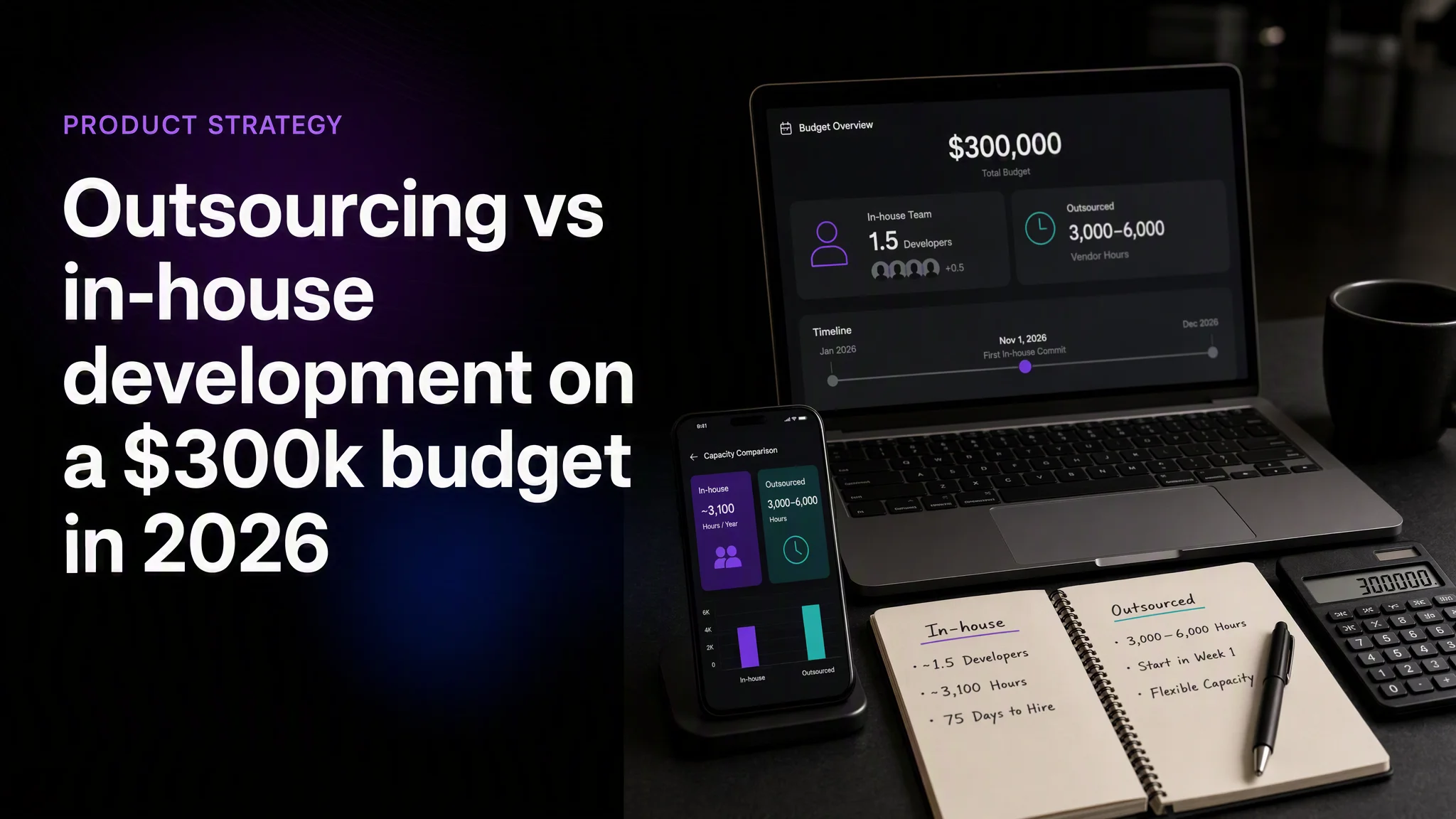
Outsourcing vs in-house development stops being a price question at $300,000 and becomes a capacity question. That budget covers about one and a half fully loaded US developers for a year, or a comparable number of vendor hours starting in week one. We priced both sides from published 2026 wage and rate data, and against our own fitness deal book. Neither model wins on money.
- US software developers earned a median $135,980 in May 2025, and benefits add about 46 cents per salary dollar for professional roles.
- Clutch puts US vendors at $50 to $99 an hour, so $300,000 buys 3,000 to 6,000 hours against roughly 3,100 in-house.
- Technical roles take a median 75 days to fill, so your first in-house commit lands after November 1.
- Around 35% of the fitness contracts we closed were $300,000 or above, median $700,000 in that group.
What the fitness market pays for now
Fitness stopped being an acquisition business. That is why the release calendar after launch decides what a budget returns.
Sensor Tower counted 3.96 billion Health and Fitness installs in 2025. Downloads edged up 0.8%. In-app purchases climbed 13% to a record $4.5 billion. Growth is coming from people who stay, not people who arrive.
Grand View Research puts the fitness apps market at $13.9 billion in 2026, reaching $33.6 billion by 2033 at a compound rate of 13.4%.
Read those together and the problem takes shape. The money is in retention, retention depends on how often you ship, and shipping depends on who is under contract next year. That is what a $300,000 budget has to answer.
What $300,000 buys on each side
Here is the arithmetic the comparison guides skip, from public numbers.
The Bureau of Labor Statistics put the median annual wage for US software developers at $135,980 in May 2025. In its March 2026 compensation survey, employer costs for management and professional roles in private industry ran $78.10 an hour, $53.50 in wages and $24.61 in benefits. Benefits add about 46 cents to every salary dollar in that group, which puts one developer near $199,000 a year in compensation alone.
So $300,000 is about one and a half developers, before recruiting, equipment, software seats or a manager. At 2,080 hours in a full-time year, call it 3,100 engineering hours.
Now the other side. Clutch puts US software development at $50 to $99 an hour, Poland in the same band, and Ukraine, India, Mexico and the Philippines at $25 to $49. At the US band, $300,000 buys 3,000 to 6,000 hours. At the lower band, 6,100 to 12,000.
The hours are close. That is the part nobody publishes. What the choice changes is when the work starts, who carries the estimate risk, and who is still there in month eighteen. This piece prices the team; the bands for the product itself sit in our fitness app development cost breakdown.
Three 2026 platform deadlines land before your first hire ships
Start recruiting today and the median technical hire accepts an offer in mid-November. Here is what happens first.
Google has required new apps and updates to target Android 16, API level 36, since August 31, 2026. An extension to November 1, 2026 can be requested. An app that misses it cannot be submitted.
Google supports the Google Fit APIs only until the end of 2026, and states that there is no alternative to the Fit REST API. If your Android app reads Google Fit, you are budgeting a migration to Health Connect on somebody else's calendar.
Apple has required since April 28, 2026 that uploads to App Store Connect are built with Xcode 26 using an SDK from the iOS 26 generation. Already in force.
Three deadlines, none of them yours. Two are already past. The third lands while your first hire is still reading the codebase. A team under contract absorbs that. An open requisition cannot.
How we compared the two models
Five criteria, applied to both models and to the hybrid.
- Money committed before any code exists, including recruiting and notice periods.
- Time from decision to first useful commit, from published benchmarks.
- Who is contractually obliged to ship the releases the platforms force.
- What happens when one person leaves.
- Where the model costs more than its headline rate.
Published wages and rates come from primary sources, each quoted and linked. Our own figures come from closed contracts and negotiation budgets in the fitness and wellness vertical, aggregated, with no client named. Any group with fewer than three data points is not published.
Freelancers are out of scope. One person does not absorb a $300,000 roadmap, and the three-model version at market rates is a separate comparison.
One disclosure. Mercury Development sells outsourced development, so we scored the vendor model on the same criteria and left its weak spots in. A vendor comparison that finds no fault with vendors is marketing.
Outsourcing vs in-house development at a glance
| Dimension | Hire in-house | Buy an outsourced team | Core plus vendor capacity |
|---|---|---|---|
| Best for | Apps that are the business | A dated scope you cannot miss | Products already live |
| What $300,000 buys | 1.5 loaded developers, near 3,100 hours | 3,000 to 6,000 US hours | One senior hire plus a part-time team |
| Time to first commit | 75 days to fill, plus notice and ramp | Days to weeks | Weeks, vendor first |
| Who ships release twelve | You, if the hire stays | The retainer, if you buy one | Both, by design |
| Main risk | Fixed payroll, variable workload | Knowledge leaves with the contract | Two managers, one roadmap |
| Hidden cost | Replacing whoever quits | A handover you did not budget | Coordination time |
Hiring the in-house team
An in-house team is the only model where the people who wrote your app are still in the room a year later. On a long roadmap that is worth paying for. At $300,000 it is also a team of one and a half.
Start with the wait. Ashby puts the median time to first fill for technical roles at 75 days, across 54 million applications and 93,000 jobs from January 2021 through March 2026. SHRM puts nonexecutive roles at 39 calendar days, which shows how far these benchmarks move on definition alone. Either way, add notice and ramp-up.
Best for: products where the app is the business and the roadmap runs past two years.
Facts: median wage $135,980, benefits 31.5% of total compensation, 75 day median time to fill.
The honest minus is concentration. Pave puts engineering turnover at 17%, the lowest of any function, across more than 396,000 employees. On a two-person team that is not a rounding error, it is half your delivery capacity. And Gallup prices replacement across employees generally at one-half to two times annual salary, which on the median developer wage runs $68,000 to $272,000. The top of that range is your entire budget.
Buying an outsourced delivery team
A vendor sells a team that already exists. Engineers, QA and a project manager are on it from week one, under a contract with a date on it. Nothing starts faster, and nothing converts more of the money into hours.
You also inherit the category's failure mode. Flyvbjerg and co-authors analyzed 5,392 IT projects in the Journal of Management Information Systems and found the mean ratio of actual to estimated cost was 1.8, with a power-law tail rather than a bell curve. Their largest overrun began as a $1,500 workflow customization and finished at $425,000 in 2015 prices. The older McKinsey and Oxford study of more than 5,400 projects found that builds priced above $15 million ran 45% over budget and 7% over time, delivering 56% less value than predicted.
Best for: a defined scope, a deadline you cannot move, and no appetite to hire before the product is proven.
Facts: US rates $50 to $99 an hour on Clutch, 3,000 to 6,000 hours at this budget, mean cost overrun ratio 1.8 across 5,392 projects.
The honest minus arrives with the last invoice. Knowledge leaves with the team unless you paid for a documented handover and a maintenance retainer. Read the maintenance clause before the build clause, ask which named engineers stay, and settle the vendor continuity plan in the same signature.
Without a technical owner on staff, follow our playbook to manage an outsourced development team without a CTO.
The hybrid most funded teams actually run
Most teams that ship well do not pick a side. They keep a core and rent capacity around it.
The market already works this way. Deloitte reports that 70% of executives have selectively insourced scope previously held by a third party over the last five years, while 80% plan to maintain or increase third-party investment. Both at once. Whitelane Research surveyed more than 2,500 European organizations and found 30% planning to raise external IT spend against 20% planning to cut it. Among the cutters, 59% cited keeping critical knowledge in-house, ahead of 51% citing money.
Knowledge is the argument for hiring. Capacity is the argument for buying. On $300,000 the sequence that works is one senior hire who owns the repository from day one, plus a vendor team sized to the release calendar and dropping to a retainer after launch. It fails when the hire arrives after the handover, because then you pay someone to reverse engineer a codebase.
Planning to staff the flexible half with individual contractors? Watch the classification rules. The Department of Labor published a proposed rule on February 27, 2026 to rescind its 2024 analysis and replace it, with modifications, with the 2021 test.
We can show this half rather than assert it. Tonal already had iOS and Android apps and its own engineers when we picked up ongoing support, then added a watch app and Bluetooth and ANT+ heart rate support. Fitbit started in 2011 and still runs under Google. The workflow system we built for Precision Practice Management has been in our care since 2006 and is on its fourth major release.
Where that outsourced half sits on the map is the next question, covered in nearshore vs offshore software development.
Which model fits your budget
Fit splits by what the $300,000 has to produce.
If the app is the business and the roadmap runs past two years, hire. Every month a permanent engineer spends in your codebase is knowledge you would buy back later. Start recruiting 75 days before you need that person productive, and accept that release one slips.
If the deadline is real and the scope is written, buy. A vendor turns the same money into more hours, sooner, against a date you can hold somebody to. Put the handover and the retainer in the same contract as the build, not in a later negotiation where you have no leverage. If the vendor list is still open, we rank ten of them in a separate shortlist.
If the product is already live, run the hybrid. One owner inside, capacity outside, one release calendar both sides sign. It is the only configuration that survives a platform deadline in a quarter when somebody is on leave.
What our own fitness contracts show
These are our own numbers: closed contracts in the fitness and wellness vertical, plus the budgets buyers brought into negotiation. Aggregated, no client named, shares rounded, because a supplier's deal book is a sample and not the market.
Around 35% of the contracts we closed landed at $300,000 or above, and the median inside that group was $700,000. So the objection has the direction right. By the time a fitness build genuinely costs $300,000, it sits at the entry of the serious band, not the top, and getting year two wrong costs more than the build did.
Around half the budgets buyers brought into negotiation were $300,000 or more. This is the normal conversation in the vertical, not an edge case.
Across the whole vertical the median closed contract was $75,000, on a spread from $5,000 to $1,000,000. Fitness spending is barbell shaped. Buyers fund a phase or they fund a platform, and $300,000 sits in the gap where those two stories stop agreeing.
If you want to keep the build inside your own sprint process, compare staff augmentation vs outsourcing.
The objection is right about the money and wrong about the year
Opinion, stated plainly. "You recruit at $300,000" is correct arithmetic and the wrong time horizon.
The sentence is true about hours. At this budget you can hire, and what you hire is durable in a way a contract is not. What it assumes is that the budget is annual and the roadmap permanent. In fitness it is usually neither. The budget is a release, the roadmap is a year, and the hire is a multi-year obligation signed to solve a nine-month problem.
Run it over 24 months instead of over the build. One and a half in-house engineers for two years is close to $600,000 in compensation alone, twice the budget you started with. A vendor team that builds for nine months and then drops to a retainer fits inside it, and hands you a continuity problem instead of a payroll problem. Neither is free. Choose which problem you would rather manage.
Then ask both options the same question in writing. Who ships the April SDK bump. Who ships the crash that only reproduces on one Android skin. What does it cost when they do. An open requisition cannot answer until it closes. A contract answers today, or it is a contract you should not sign.
Written by Rob Devereaux, Chief Operating Officer at Mercury Development. Rob has run the firm's operations from Hudson, Ohio since 2019 and has over 20 years of operational and financial experience. The closed contracts and negotiation budgets behind this article's fitness figures sit in the operations he oversees.
Weighing a vendor quote against two hires? Get a scope priced both ways
You have the trade-offs. What you probably do not have is a scope specific enough to price as a hire and as a contract at the same time. Tell us what you are building, how long you plan to run it, and who you have today. We come back with both versions.