
Cruise app login problems: why sign-in breaks at the gangway in 2026
TL;DR
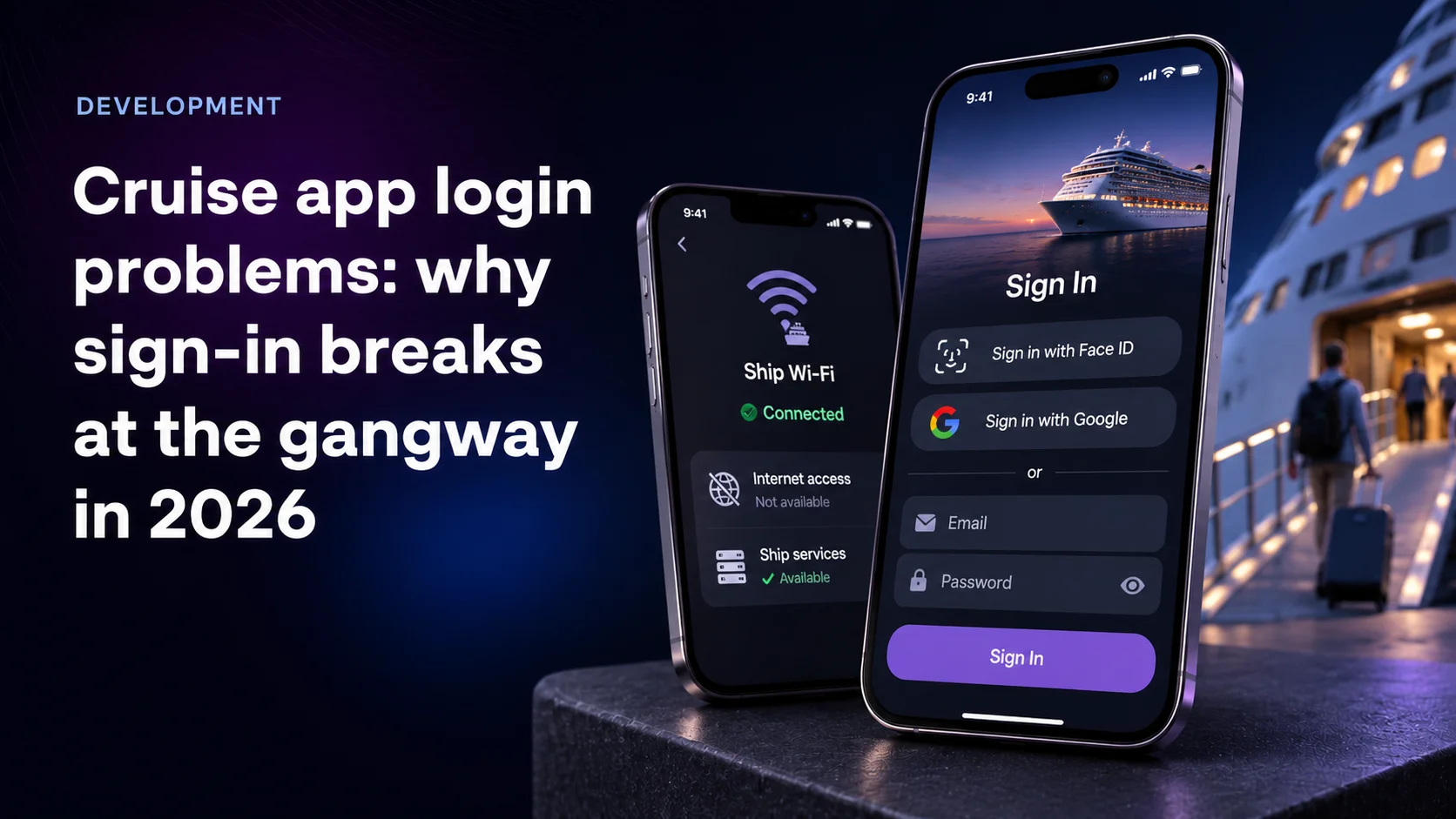
Cruise app login problems in 2026 usually start at the gangway. A guest signs in at home, joins ship Wi-Fi, and the token issued ashore stops working.
- Ship servers often cannot reach the shore identity provider over a thin satellite link.
- RFC 9700, published in January 2025, tells mobile apps to rotate or device-bind refresh tokens. With rotation, one reply lost in the network switch can end the session.
- Sign in with Google needs Google's servers. On ship Wi-Fi without outside internet it never finishes.
- Face ID and Android BiometricPrompt work at sea, because they release a key on the phone instead of calling a server.
- Mercury Development's onboard spa software for OneSpaWorld has run on ship servers without external internet on over 160 ships since 2018.
Why cruise app login breaks at the gangway
Seatrade Cruise News, citing CLIA, reported 37.2 million ocean cruise passengers in 2025. Many of them first sign in to the line's app at home.
At home the app talks to shore systems over the open internet. On board, free Wi-Fi reaches servers on the ship, and the satellite link to shore is thin and sometimes gone.
A guest-app lead at one cruise line told us: "if I'm logged in, and then I walk onto the ship that authentication token is no longer valid." Another counted the damage: "Within a month, logins broken like five times."
The shore side fails on its own. Royal Caribbean Blog reported in April 2024 that guests could not log in to the Royal Caribbean app and website, with problems that began on April 9.
The OAuth security standard now rotates refresh tokens
RFC 9700, the IETF's Best Current Practice for OAuth 2.0 Security, was published in January 2025. It says: "Refresh tokens for public clients MUST be sender-constrained or use refresh token rotation." A mobile app is a public client.
Rotation means every refresh returns a new token and spends the old one. At the gangway it fails like this:
- The app sends its refresh token while the phone switches from cellular to ship Wi-Fi.
- The identity provider rotates the token and replies.
- The reply never reaches the phone.
- The app retries with the spent token, and the provider ends the session.
Bind the token to a device key, which the standard allows instead of rotation, or accept the previous token for a short grace window.
How we put this guide together
We read the pages that rank for cruise app login. Identity vendors write about guest profiles in the cloud, and crew products describe a ship-side server for staff. None explains why a guest's session dies at the gangway.
Standards are quoted from IETF and OpenID texts, platform behavior from Apple and Android docs read in November 2026. Cruise patterns come from Mercury's project records, without client names. Mercury Development builds this kind of software, so read this as an interested view.
Six failure points at a glance
| Failure point | What the guest sees | Root cause | Fix |
|---|---|---|---|
| Shore token, ship validator | Signed out after boarding | Ship cannot fetch shore keys or sessions | Swap for a ship session at first contact |
| Refresh rotation | Logged out on the pier | Rotated token's reply lost in the switch | Device-bound token or grace window |
| Clock skew | Random expiry errors | Onboard clock drifts from UTC | Time sync, a few minutes of leeway |
| Social sign-in | The Google button spins | Provider is on the open internet | Link ashore, use a ship credential on board |
| Booking-number login | Cabin-mates see each other's account | Shared booking details | A credential per guest |
| Shore outage | Nobody can sign in | One central provider | Ship sessions that outlive it |
The shore token meets a ship validator
An OpenID Connect provider publishes its keys at a jwks_uri, which per OpenID Connect Discovery contains "the signing key(s) the RP uses to validate signatures from the OP." A ship API that fetches those keys on demand, or calls shore to look up an opaque session, fails its first check after the link drops.
Three more mismatches appear only on board:
- Issuer. A ship identity service that mints its own tokens rejects shore tokens unless it trusts that issuer by name.
- Audience. A token issued for the shore API is not meant for the ship API.
- Host. Cookies set for the shore domain do not travel to a ship domain, so web screens inside the app ask for login again.
Fix it with a handover. At first contact the app presents the shore token once, and the ship validates it against cached shore keys and issues a ship session that never calls shore again. Refresh the cached keys whenever the link is up.
Ship clocks and token lifetimes
RFC 7519, the JWT standard, says validators "MAY provide for some small leeway, usually no more than a few minutes, to account for clock skew." An onboard server that drifts further rejects valid tokens as expired or not yet valid.
Time zones are a separate trap. Token times are UTC seconds and ignore zone changes; code that converts them to ship time does not. Keep identity on UTC and sync every onboard server clock to it.
Size lifetimes to the voyage. A one-hour access token is fine if the ship refreshes it locally. One that refreshes against shore becomes a login prompt whenever the link is down.
Sign in with Google needs Google
Social sign-in sends the guest to the provider's servers, and without outside internet that redirect never completes. A technical lead at one cruise line told us that logging in "with gmail or Google when you don't have access to the outside Internet" left networking problems his team never solved.
The old workaround, a login page inside an embedded web view, is closed. Google announced that all embedded webviews would be blocked from its OAuth endpoint starting September 30, 2021, and pointed to RFC 8252, which says "native apps MUST NOT use embedded user-agents to perform authorization requests."
On Android, Google's migration guide says legacy Google Sign-In "is deprecated and will be removed" in favor of Credential Manager. Fix the ship path in the same rebuild.
The pattern that works: let guests link Google or Apple ashore, then issue your own credential for the ship. Social login proves identity once; the ship session carries that proof.
Booking-number login is a shared secret
Many cruise apps let guests sign in with a booking number, a name and a date of birth. Everyone on one booking knows all three about each other. A guest-app owner at one line put it plainly: because he and his wife share a booking number, "I could technically login as my wife."
Once the app holds a payment method or a private chat, use the booking number only to find the reservation and give each guest their own credential.
Biometrics release a key, not an account
Face ID and fingerprint checks run on the phone and never call a server, so they work mid-ocean. What they protect is a stored secret. Apple's keychain guide lets the app "dictate the conditions under which that item can be accessed later", including biometric authentication with a passcode fallback. On Android, BiometricPrompt can pair with a CryptoObject, and for a key that requires biometric credentials "the user must authenticate their biometric credentials each time" before the app uses it.
Biometric login on a ship then works like this:
- Ashore or at first ship contact, the app stores a device private key behind biometrics and registers the public key with the ship.
- On board, the guest looks at the phone and the operating system releases the key.
- The app signs a challenge from the ship server, which checks it against the registered public key.
It fails only when nothing was enrolled before boarding, so put enrollment in the pre-cruise flow.
Two identity tiers for guests and crew
Every fix above points to one design: shore issues identity, the ship issues sessions.
- Shore identity provider: accounts, social linking, password reset. It needs the internet.
- Ship identity service: validates the shore token once, issues sessions, holds device public keys, works with the satellite down.
- Sync: shore pushes keys, manifests and revocations to each ship when the link is up.
Crew software already works this way. Dualog's maritime crew identity product says that each vessel runs a local identity server that "works fully offline", while its cloud side supports SAML 2.0 and OpenID Connect. Its ship-side server page says the server keeps working offline using the last synced data.
Guests confuse free ship Wi-Fi with a paid plan, so name the state in plain words: signed in on board, account changes need internet.
What our cruise programs show
OneSpaWorld describes itself as the operator of health and wellness centers onboard cruise ships. Mercury's spa platform for it has run since 2018 on over 160 ships of multiple cruise lines, on onboard servers with no external internet connection. Middleware links it to shore systems and each cruise line's APIs.
For cruise line clients Mercury cannot name under NDA, we rebuild passenger apps on React Native rather than porting old code, with pre-cruise readiness, the boarding pass and payment methods in scope. The patterns in this guide come from that work: a token issued ashore that fails on board, a login service that goes down often, an API that works in production and not in QA, and behavior that reproduces only on a real ship.
Treat login as a network design problem
Login gets scoped as screens: two fields and a Face ID toggle. The failures sit between two networks, and no screen fixes them.
Change the vendor interview. Skip "have you built social login". Ask: "A guest signed in with Google at home boards while the satellite is down. Which server checks her session, and how does she pay for a drink?" A team that has done this talks about cached keys and a ship session. A team that has not talks about screens.
Own the result: Mercury's About page states that the customer owns the code and all underlying IP, the ship identity service included.
Written by Alexey Rodionov, Lead Front-end Developer at Mercury Development since 2020. Alexey is a Google Developer Expert in Web Technologies and a Chromium contributor whose code ships in Chrome DevTools, Google's Bubblewrap and Microsoft PWABuilder. The ship and shore login failure patterns behind this article come from architecture reviews of cruise apps in the front-end practice he leads.
Guests losing their session at the gangway? Map your login across both networks
Tell us how guests sign in today, which systems check their session ashore and on board, and where your login complaints come from. We will trace each step across shore and ship, mark where it depends on the internet, and show what should move on board first.