
Subscription app tech stack in 2026: what gets expensive at 10K users
TL;DR
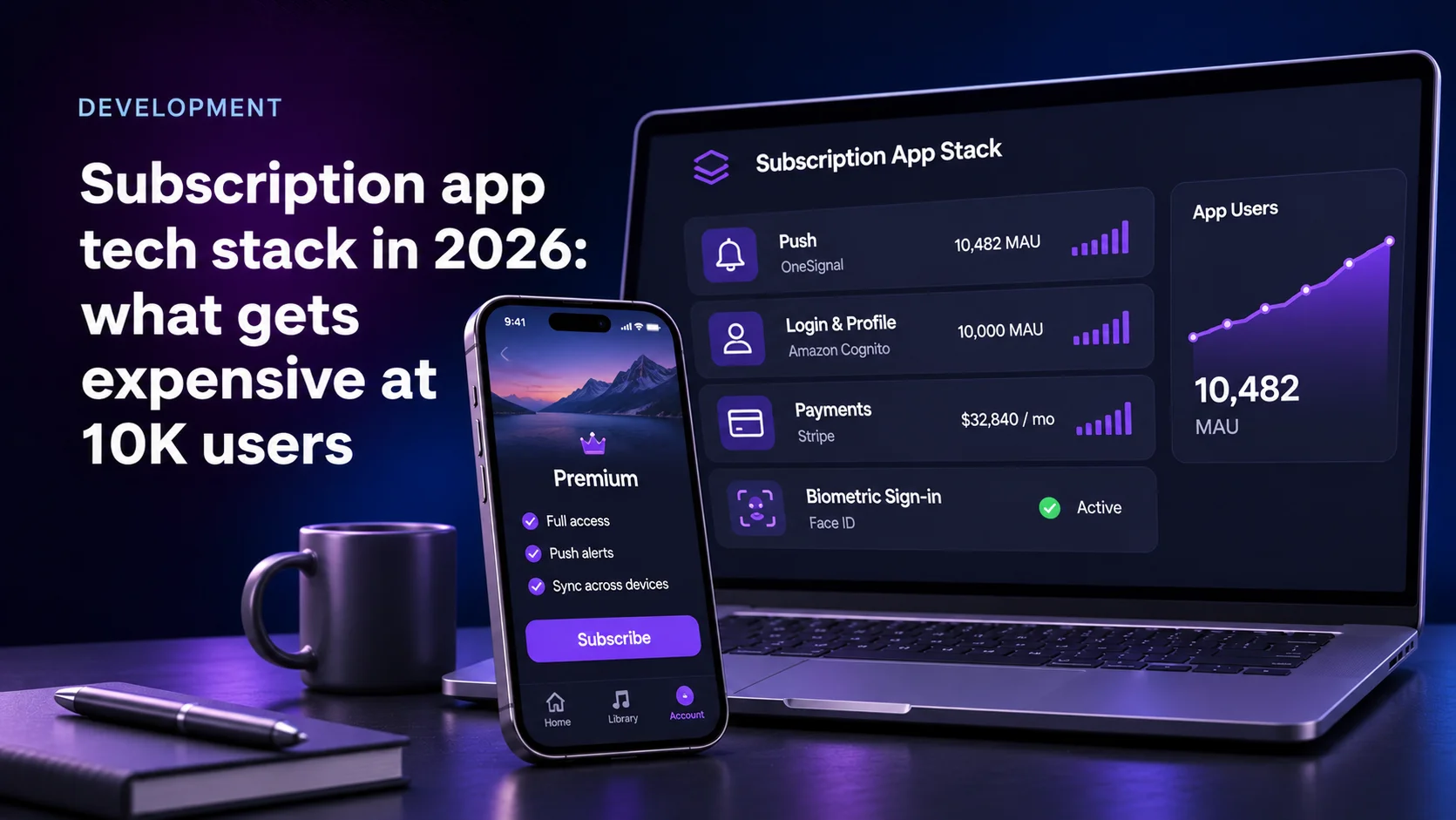
A subscription app tech stack in 2026 has four parts that get more expensive or harder to change after launch: the push platform, the login and profile provider, the payment gateway and biometric sign-in. The build is a one-time cost. These four are rented, and the rent follows your audience.
- Push is billed on app users, not on readers who opted in. OneSignal charges $0.012 per monthly active user, and since October 1, 2026 its free plan stops at fewer than 1,000 MAU.
- Login providers bill per active user too. Amazon Cognito Essentials is free to 10,000 MAU, then $0.015 each.
- Leaving a provider is the hidden cost. Auth0 exports password hashes only through a support case.
- A Stripe migration moves cards in about 10 business days once Stripe has the export, but subscriptions move separately.
- Face ID unlocks a stored token on the phone. It does not replace the account at your provider.
Four bills that grow after launch
Most publishers budget the app once. Then it ships, and four line items start to move on their own. The push platform bills by audience size. The identity provider bills by active users and holds your subscribers' passwords. The card gateway takes a share of every renewal. Biometric login costs nothing to run, but it depends on how long your provider keeps a session alive.
None of them is in a build estimate. One subscription publisher we worked with saw its push bill go from $100 to $150 a month in the month it crossed 10,000 users. A 50% jump on a small line is easy to absorb. The same line at 50,000 is not.
OneSignal cut its free push tier in October 2026
Under the new rule in OneSignal's billing documentation, you must have fewer than 1,000 monthly active users to send mobile push and in-app messages on the free plan. The change applied to new customers from September 1, 2026 and to existing customers from October 1, 2026.
For a publisher, 1,000 MAU is a small newsletter. Above the limit, the Growth plan starts at $19 a month and charges $0.012 per monthly active user for mobile push, with unlimited sends.
Urban Airship renamed itself Airship in April 2019, and its pricing page publishes no prices, so you re-quote every time your audience grows.
Push at 10,000 subscribers: what you are billed on
Find the unit on the invoice first. It is rarely the number your editors call subscribers. OneSignal counts a monthly active user as a mobile subscription record that was active in your app in the last 30 days, regardless of whether it opted in to push. Two more details matter:
- Each device counts separately. A reader with your app on a phone and a tablet is 2 MAU.
- Billing runs in increments of 10 MAU, rounded down.
Run the numbers on your own audience. At $0.012 per MAU, 10,000 MAU adds $120 a month on top of the plan fee. If those 10,000 readers each use a phone and a tablet, that is 20,000 MAU and $240. At 50,000 MAU the usage line is $600 a month. Tablet-heavy readerships pay for the same person twice.
The delivery pipe itself is free. Firebase lists Cloud Messaging (FCM) as no-cost on both its plans. A push vendor sells segmentation and a dashboard for editors. That is a fair trade until the per-user line passes the cost of a small sender you build on FCM. Know that crossover number before the renewal.
Login and profiles at a third-party provider
Many publishers keep subscriber accounts at a third party. It works on day one. The cost shows up in two places later.
The first is the per-user bill. Amazon Cognito gives its Lite and Essentials tiers a free tier of 10,000 MAU per account. Above that, Essentials costs $0.015 per MAU, so 40,000 active readers cost about $450 a month. User pools created before November 22, 2024 keep a free tier of 50,000 MAU. Auth0 is free up to 25,000 MAU. Google's Identity Platform, the paid tier behind Firebase Authentication, is free to 50,000 MAU for email, phone and social sign-in, then $0.0055 per MAU up to 100,000.
The second cost is control. When the profile lives with a vendor, adding a field or changing which social logins you accept is a change to someone else's system. We have seen subscriber apps where a profile edit was hard for exactly this reason.
Before you renew, ask who can add a profile field and what an export of every account looks like, including passwords.
Leaving the auth provider: what happens to passwords
The export is the expensive part. Passwords are stored as hashes, and not every provider will hand them over.
Auth0 says the only data not available through its API are password hashes and private keys. You can request them by opening a support ticket, but the operation is not available on the free tier, and Auth0 does not guarantee a date. Its hash export process also asks for an acknowledgment form signed by a CISO, CSO or a VP-level executive, and the download link expires after 3 days.
On the receiving side, Cognito's CSV import does not set passwords by default, so imported users must change their password at first sign-in. It can import existing hashes, but only in four formats: BCRYPT, SCRYPT, ARGON2ID and PBKDF2_SHA256. Anything else means a reset for every reader.
There is a gentler path. Cognito's migrate user Lambda trigger checks the password against the old system when a user who does not exist yet signs in, then creates the account. Readers move one by one. The trigger runs only for password-based flows, not SRP sign-in, so your app's login code has to match.
For a paying audience, a forced password reset is a churn event. Plan the lazy migration before you need it.
Moving card payments to Stripe
Moving the card gateway to Stripe is two migrations, and teams often plan only one.
The first is the card data. Per Stripe's data import guide, processors can take from a few days to several months to produce the export, and once Stripe has valid data, imports typically complete within 10 business days. Card security codes are not imported. PCI DSS forbids storing them after authorization.
The second is the subscriptions. Card import does not carry them. They move through Stripe's subscription migration tools or its API, and Stripe warns you to cancel the old subscriptions as soon as the new ones are active, or you will bill readers twice.
Then check the fees against your price. Stripe charges 2.9% + 30¢ per successful domestic card charge, and Stripe Billing adds 0.7% of billing volume on the pay-as-you-go plan. On a $20 monthly subscription that is $0.88 in card fees plus $0.14 for Billing, $1.02 a charge, or about 5.1%. On a $200 annual plan it is $7.50, about 3.75%. The fixed 30¢ is why annual plans keep more of the price.
If Stripe on the web is your checkout, Apple's reader app entitlement lets a news or magazine app link to your website for account creation and management, on the condition that the app offers no in-app purchases on iOS.
Whether to keep store billing next to Stripe is covered in our guide to in-app vs out-of-app billing.
Face ID and Touch ID for subscribers
Readers ask for smart login with the face or the fingerprint. It is cheap to build and easy to misunderstand. Apple's Local Authentication framework never shows your app the face or fingerprint data. The Secure Enclave handles it, and your app gets back only a yes or a no. So Face ID does not log a reader in to your provider. It releases a refresh token the app already stored in the keychain. Three consequences follow:
- The token's lifetime is set by your identity provider. If the provider expires sessions every 30 days, Face ID works for 30 days and then the reader types a password again.
- If you protect the keychain item with biometryCurrentSet, it is invalidated when fingers are added or removed for Touch ID or when the reader re-enrolls Face ID. You need a password fallback that works.
- The app must declare NSFaceIDUsageDescription. Apple requires the key for any app using Face ID APIs.
On Android, the BiometricPrompt dialog separates BIOMETRIC_STRONG, a Class 3 biometric, from BIOMETRIC_WEAK, Class 2. Google recommends Credential Manager for the first sign-in on a device. Password or passkey once, biometrics every day after.
We have shipped this pattern. The Grant's Interest Rate Observer app redesign for phones and tablets has Touch ID and Face ID login and a payment gateway integration for client-side PCI compliance. In the Mayday safety app, Touch ID is one of two factors, with verification codes sent by SMS.
What we find when we review subscriber apps
These patterns come from our technical reviews of existing subscriber apps before a redesign. They are what we check first, not a market survey.
The app is slow, and the screens are not the cause. Redesigns get layered on for years without anyone revisiting the API calls behind them.
Nobody can say whether the app crashes. Crash reporting is missing, so complaints in store reviews cannot be traced to a release.
Sharing a paywalled story needs the backend. The article link has to carry preview tags that social apps can parse, and it has to show part of the story before the paywall.
The push vendor was picked years ago and never re-priced. Someone looks at it the month the bill jumps.
The backend behind sharing previews is described in our guide to share paywalled articles.
Price the stack, not the build
A build estimate says what the app costs to make. Your board will ask what it costs to run at 10,000 and 50,000 readers, and what it costs to leave each vendor. Make that a table: one row per rented service, one column per audience size, one column for the exit. Mercury Development has built software since 1999 with 500+ engineers, and the subscriber apps that age well are the ones where someone wrote this table before the first renewal.
Written by Alexey Rodionov, Lead Front-end Developer at Mercury Development since 2020. Alexey is a Google Developer Expert in Web Technologies and a Chromium contributor whose code ships in Chrome DevTools, Google's Bubblewrap and Microsoft PWABuilder. The technical reviews and integration work behind this article's examples come from the engineering practice he works in.
Get a cost map of your subscriber stack
Tell us which push, login and payment services your app uses and roughly how many readers open it monthly. We will send back a table of what each service costs as you grow, what it takes to leave it, and where biometric login fits.