
How to share paywalled articles in 2026: link previews and lead-ins
TL;DR
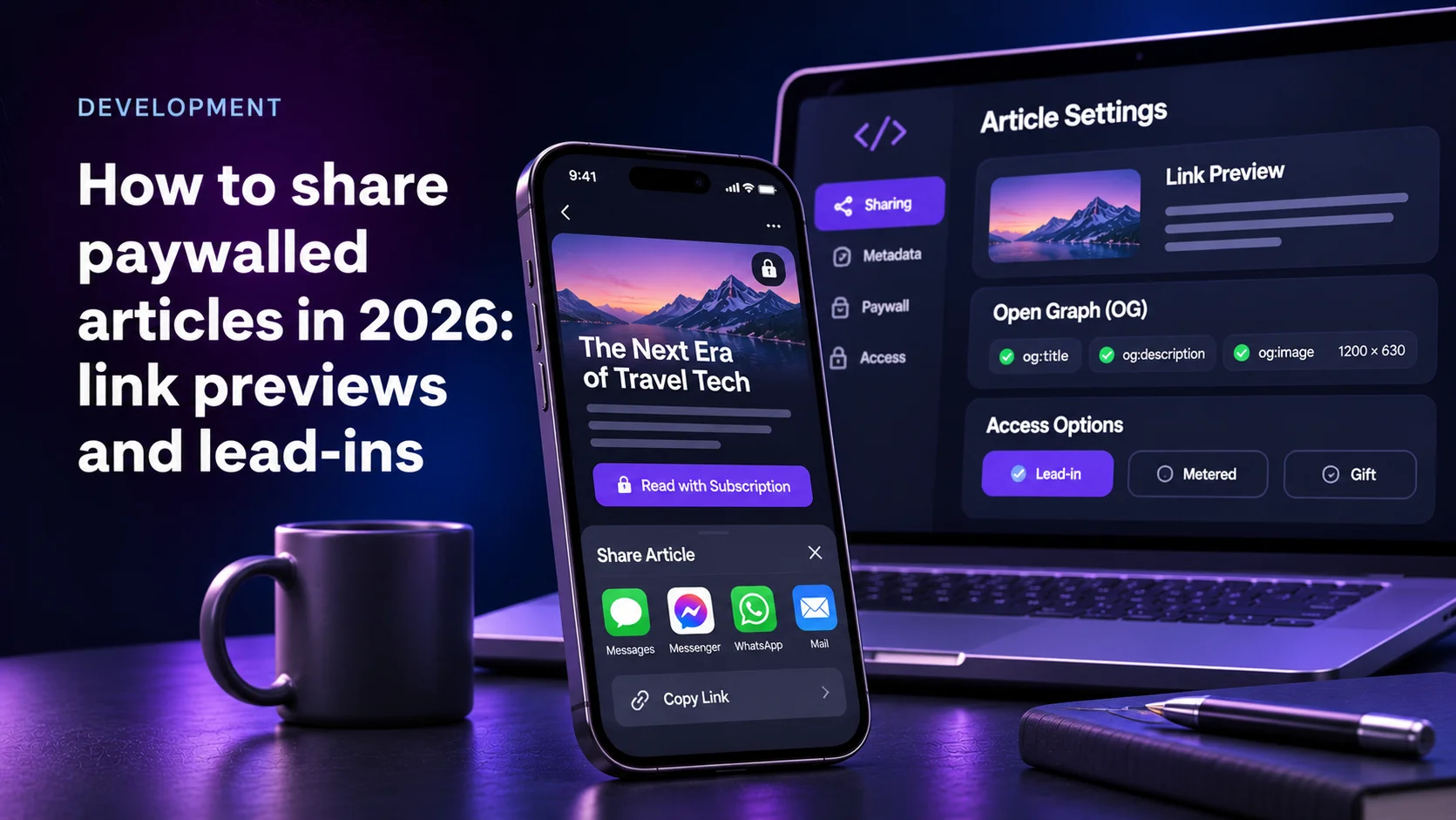
To share paywalled articles from a subscriber app in 2026, the backend has to give every story a dedicated landing link that third-party apps can parse and that shows non-subscribers a lead-in before the paywall. The app only calls the share sheet. The work sits on the server.
- Put the Open Graph tags in the first 1 MB of HTML, unlocked for everyone. Meta reads them there, and Apple Messages stops at 1 MB for the main page.
- Use a preview image of 1200 x 630 pixels. Meta recommends it, and Apple wants at least 900 pixels of width.
- Decide what the reader gets: a lead-in, a metered visit or a full gift. The New York Times now lets subscribers send unlimited gift articles, each readable for 30 days.
- Ask your vendor to list sharing as its own line in the estimate, with backend tasks named.
A shared link is read by machines before people
A subscriber taps Share on a story. Before a friend sees anything, a crawler from Facebook, X, Slack or LinkedIn requests the URL, or the subscriber's own phone does. It reads the page head and draws a card from its tags.
If that request hits a login wall or a paywall that hides the page head, the card comes out blank or shows your sign-in page. The friend sees a grey box with a domain name and scrolls past.
In subscriber-app redesigns we scope, the question arrives in the publisher's own words: can subscribers post a story to social media even though it's behind a paywall? The honest answer is yes, and most of the answer lives on the server. The backend must return a special landing link for the article that third-party apps parse correctly, so the icon and the description show up, and that lets unregistered readers see part of the story before the paywall.
Gift links at the New York Times went from 10 a month to unlimited
When the New York Times launched gift articles in June 2021, Nieman Lab reported that news subscribers could gift 10 articles per month and recipients had 14 days to read them. The current NYT help center page says subscribers can share unlimited gift articles, recipients have 30 days to read each one, and a recipient logs in or creates a free account to read it. Gifts do not count toward the meter for non-subscribers.
Two rules matter for your build. Gifts go out only through the Gift icon, and pasting the article URL does not share access. A gift link is a separate object with its own lifetime, and the backend issues it.
You do not have to copy the Times. A smaller publisher may want a cap or a shorter window. But readers who meet unlimited gifts there expect a shared link to open.
Three ways to let subscribers share a locked story
Pick one before anyone designs a screen.
- Lead-in only. The shared link shows everyone the headline, the first paragraphs and the paywall. Nothing new on the server beyond a landing page that renders the lead-in. Cheapest, and the reader may leave at the paywall.
- Metered access. The shared link counts against the reader's free monthly quota. Google's flexible sampling guidance names metering and lead-in as the two types it advises, and expects most daily news publishers to land between 6 and 10 articles per user per month.
- Gift link. The subscriber's share creates a token that opens the full story for the recipient. The server signs it, records who sent it, sets an expiry and can revoke it.
Many publishers combine a gift link from subscribers with a lead-in for everyone else. It is the most work and usually the best result: the reader who already pays becomes your acquisition channel.
The metering and paywall products behind these options are compared in our guide to paywall services.
What a link preview reader actually fetches
Every preview reader starts from the same tags. The Open Graph protocol requires four: og:title, og:type, og:image and og:url, where og:url is the canonical URL of the object. It adds og:image:alt and says a page with og:image should specify it.
The details differ by reader:
- Meta. Its image guide recommends at least 1200 x 630 pixels, an aspect ratio close to 1.91:1, a minimum of 200 x 200 and a file under 8 MB. Images are cached by URL, so a new image needs a new URL. Its crawler page identifies the crawler as facebookexternalhit/1.1 and requires Open Graph properties before the first 1 MB of the page.
- X. The cards markup reference falls back to Open Graph when twitter:title or twitter:image is missing, caps images at 5 MB and does not support SVG.
- Slack. Classic unfurling crawls the URL for Open Graph and X card metadata.
- Apple Messages. TN3156 limits the main resource to 1 MB, wants images at least 900 pixels wide, may ignore images under 150 pixels and does not follow meta redirects or run JavaScript. Server-side redirects are followed.
In tests published in 2020, Mysk found that iMessage, WhatsApp and Viber built the preview on the sender's device, while apps such as Slack and LinkedIn built it on their own servers. A preview built on the subscriber's phone still arrives without the app's session, so plan for an anonymous request every time.
The landing page your backend must return
Here is the contract for the publisher's server team.
- A public URL per article that responds without a session, with a server-side redirect at most, never a meta refresh or a JavaScript redirect.
- A page head that is the same for everyone: title, description, og:title, og:type set to article, og:url pointing at the clean article address, og:image at 1200 x 630 with og:image:alt, og:site_name and twitter:card set to summary_large_image.
- The head and the lead-in inside the first 1 MB of HTML, rendered on the server.
- An entitlement check after the head: a subscriber or a valid gift token gets the full text, everyone else gets the lead-in and the paywall.
- A gift endpoint the app calls when a subscriber shares. It returns a link with a signed token, stores sender and expiry, and lets you revoke it.
- A share event the analytics can count: who shared, which channel, how many readers opened it and how many subscribed.
Keep the token out of the canonical. If og:url and the canonical tag both point to the clean address, every gift link reads as the same article to crawlers. Check the result in Meta's Sharing Debugger and in a real Messages thread before launch, because each reader caches what it saw first.
Partial access without cloaking
The lead-in has to be real HTML that everyone receives. Hiding the rest of the story in the browser with CSS keeps it in the page source, and anyone who opens the source reads the article. Cut the text on the server.
If you serve the full text to Google's crawler while people see a paywall, Google's paywalled content markup asks you to set isAccessibleForFree to false and point a hasPart element of type WebPageElement at the locked section with a class selector such as .paywall. The page says this markup helps Google tell paywalled content apart from cloaking, which violates its spam policies. Use only class selectors and do not nest the marked sections.
Watch the dose. The same flexible sampling page reports that user satisfaction starts to degrade significantly when paywalls are shown more than 10% of the time. For most readers a shared link is a first visit, so a generous lead-in usually pays for itself.
Opening the shared link in the app
A subscriber who taps a shared link on their phone should land in your app on that story. That needs the same URL to work as a web page and as an app link.
On iOS, the site hosts an apple-app-site-association file in its .well-known directory, over HTTPS with no redirects, and the app declares the domain in its Associated Domains entitlement. Apple's CDN requests the file within 24 hours, so changes are not instant. On Android, the site publishes assetlinks.json in the same directory and the app sets autoVerify to true on its intent filters.
Gift tokens must survive this hop. If the app opens and drops the query string, the recipient who has your app installed sees a paywall the web page would have lifted.
Is paywall-aware sharing in the estimate
The next question is whether sharing is in the estimate at all. Sharing looks like one button in the design. In the build it touches four places: the share sheet in the iOS and Android apps, the landing page template, the gift token service and the entitlement check. If your authentication and subscriber profiles live with a third-party provider, add the integration with that provider as well, because the entitlement check needs its answer.
Ask for sharing as its own line in the estimate, with backend tasks named. If the vendor's estimate covers only the app and your team owns the server, the share button can be ready in the app long before the link it shares works. That gap is how this feature usually slips.
The other services a subscriber app rents are priced in our guide to the subscription app tech stack.
What we have shipped for subscription publishers
For Grant's Interest Rate Observer, an independent journal on the financial markets, Mercury redesigned the existing app for phones and tablets. The shipped feature list includes sharing articles to social networks, Touch ID and Face ID login and a payment gateway integration for client-side PCI compliance. The tablet layout was designed separately from the phone layout.
On the living room screen, our Apple TV and Google TV practice builds subscription models, paywalls and user access control. The entitlement rules are the same ones your share links depend on.
The share link is a product feature
Give it an owner and a test plan. The cheapest version is a lead-in landing page with correct tags. The version that grows subscriptions adds gift tokens and app links on top, with analytics to count them.
Mercury Development has built software since 1999, with 500+ engineers, more than 1,500 completed projects and more than 40 million users of its applications, and in subscriber apps the share flow is one of the features we scope first.
Written by Rob Devereaux, Chief Operating Officer at Mercury Development. Rob has run the firm's operations from Hudson, Ohio since 2019 and has over 20 years of operational and financial experience.
Send us your paywall rules and we will map the share flow
Tell us how your paywall works today, who owns authentication and which apps your readers share to. We will send back the landing page contract, the gift link options that fit your rules and the backend tasks to put in your estimate.