
Top femtech app development companies for period tracking in 2026
TL;DR
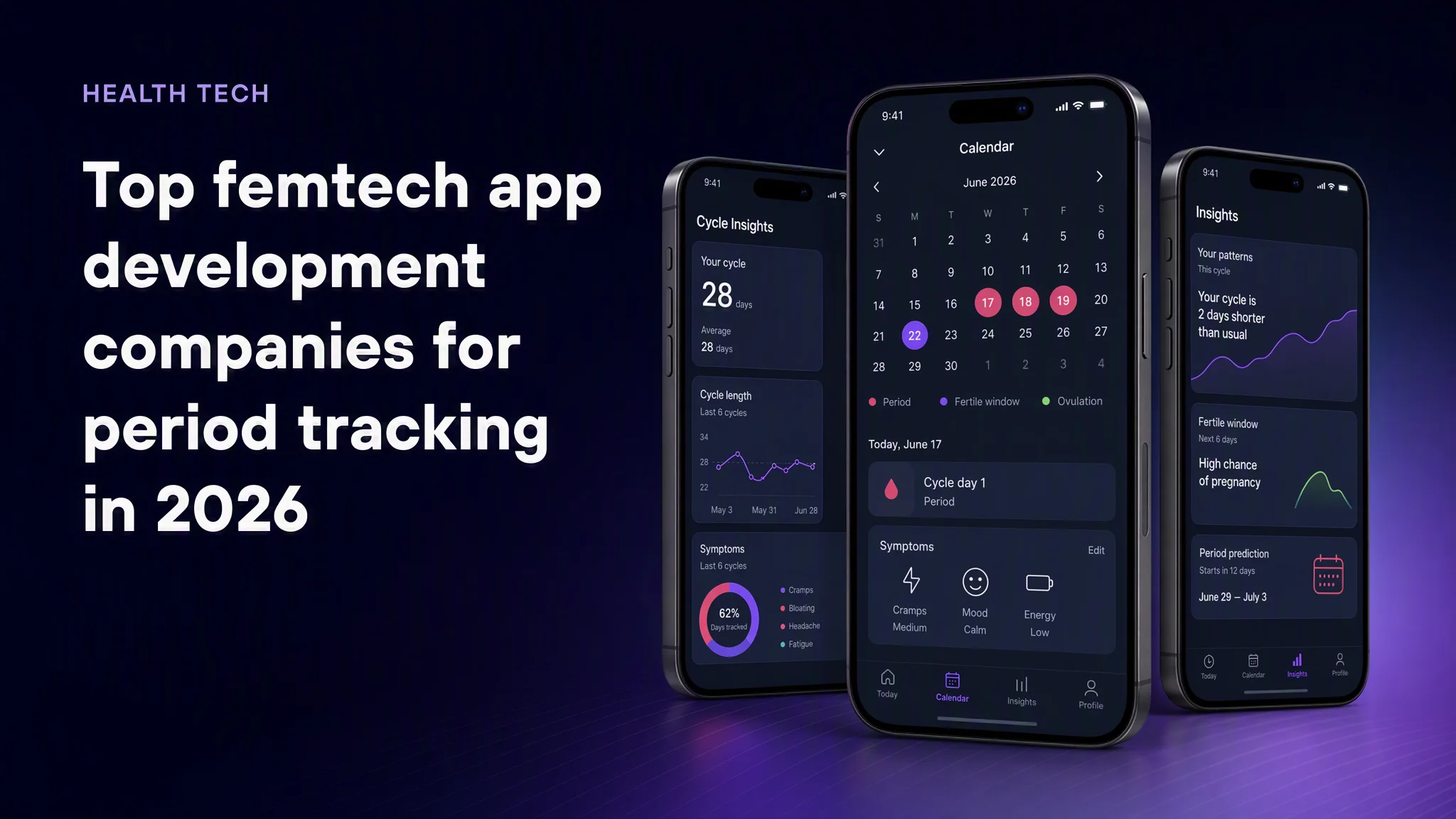
The ten femtech app development companies below are ranked for 2026 on two things you can check yourself: a named women's health product you can open, and a compliance credential that names a standard. Mercury Development takes first place with 1in4, a shipped app for infertility and pregnancy support, plus delivery work on MatchedFlicker, a 510(k)-cleared imaging application. Softeq follows on its ISO 13485 quality system, Yalantis on the widest published standards list.
- Flo reports 76 million monthly active users, and Global Market Insights puts the femtech market at $73.4 billion in 2026.
- Google Fit APIs are supported only until the end of 2026, so every Android cycle app reading Fit data needs a migration plan now.
- As of August 27, 2026 we could not find a named women's health case on the sites of the other nine firms. Ask for one before you shortlist.
Femtech market in 2026
Cycle tracking is one of the few consumer categories where a single app reaches a country's worth of users. Flo's July 2025 announcement puts it at 76 million monthly active users and more than 420 million people who have chosen the app. Natural Cycles reports over six million registered users. Clue, Ovia Health and Peanut fill out the set your product gets benchmarked against.
Global Market Insights sizes the femtech market at $66.2 billion in 2025 and $73.4 billion in 2026, reaching $255.5 billion by 2035 at a 14.9% CAGR from 2026. Demand is not the question. Your vendor is.
Menopause is the segment nobody scopes
Most femtech briefs stop at the reproductive years, and the market moved past that. Flo launched Flo for Perimenopause on July 21, 2025, citing more than a billion women worldwide who will have gone through perimenopause and menopause by 2025. In its own survey, 54% of women said they do not feel adequately informed about perimenopause, and 72% said symptoms limit their life experiences.
The platforms already carry the data types. Apple's HealthKit ships menopausalState and bleedingAfterMenopause alongside the cycle identifiers, so a menopause feature is a product decision rather than a platform limit. Ask any vendor here what they have built past ovulation.
Google Fit ends in 2026 and two rules already bind you
Android's data plumbing is being replaced this year. Google closed new Fit API signups on May 1, 2024 and supports the existing APIs only until the end of 2026. Health Connect replaces them on device, carrying cycle records from MenstruationPeriodRecord to BasalBodyTemperatureRecord. The same page names the Google Health API for cloud, account-centric storage and the Recording API for step data on mobile. None is a drop-in replacement for the Fit REST API, so cloud sync gets redesigned rather than ported.
A second deadline landed in February. The FDA's Quality Management System Regulation took effect on February 2, 2026, replacing the Quality System Regulation in 21 CFR Part 820 and incorporating ISO 13485:2016 by reference. That turns a vendor's ISO 13485 certificate from a marketing line into the shape of the federal requirement, which is why the cards below treat it as the strongest credential on offer.
Your app is already regulated, and probably not by HIPAA. The FTC's amended Health Breach Notification Rule has covered health apps outside HIPAA since July 2024. An unauthorized disclosure counts as a breach, so an ad SDK forwarding cycle data is reportable at up to $53,088 per violation, as adjusted in 2025. Washington's My Health My Data Act adds private enforcement: it applied from March 31, 2024, and June 30, 2024 for small businesses, names reproductive and sexual health information, and lets consumers sue. Nevada's SB 370 took effect the same day.
The same consent logic applies to every sync route, and health data integration for fitness apps compares those routes one by one.
How we evaluated
Every list in this category claims rigor. Here is what we checked, and the same tests repeat in the cards.
- A named women's health product in a store or a case study, not a services page about femtech.
- A credential naming a standard: ISO 13485, IEC 62304, ISO 27001, a 510(k), or documented HIPAA delivery. We record whether a registrar certified it or the vendor declared it on its own site, because those are different claims.
- Verified reviews. Every Clutch figure here was captured on August 27, 2026.
- Health data plumbing already shipped: HealthKit, Health Connect, wearables, Bluetooth Low Energy.
- Claims that survive a cross-check: the vendor's site agrees with its Clutch profile.
One caveat on the HQ column: every address below is a registered office, often not where engineers sit. If data residency matters, ask which country delivers the work.
For cycle tracking built into a broader training app, compare this list with our ranking of fitness app development companies.
Company comparison at a glance
| Company | Founded | HQ listed | Clutch | Women's health case | Shipped cycle tracker |
|---|---|---|---|---|---|
| Mercury Development | 1999 | Ft. Lauderdale, FL | 5.0 / 34 | 1in4 | None found |
| Softeq | 1997 | Houston, TX | 4.9 / 27 | None found | None found |
| Yalantis | 2008 | Warsaw, Poland | 4.8 / 79 | None found | None found |
| MindSea | 2007 | Halifax, Canada | 5.0 / 41 | None found | None found |
| Topflight Apps | 2016 | Irvine, CA | 4.9 / 43 | None found | None found |
| Orangesoft | 2011 | San Francisco, CA | 4.9 / 42 | None found | None found |
| Goji Labs | 2014 | Los Angeles, CA | 5.0 / 87 | None found | None found |
| Empat | 2013 | San Francisco, CA | 5.0 / 148 | None found | None found |
| Cleveroad | 2011 | New York, NY | 4.9 / 81 | None found | None found |
| RisingMax | 2011 | New York, NY | 5.0 / 43 | None found | None found |
The last column is the uncomfortable one: nobody here, us included, publishes a shipped menstrual cycle tracker. Treat any cycle-tracking pitch as adjacent experience to probe, not a product to check.
1. Mercury Development
Mercury Development has built software since 1999 and is the only firm here with a women's health product you can open. 1in4 supports people going through infertility, surrogacy and miscarriage, and ships pregnancy, baby development and fertility tracking tools beside a private community layer. The team drew 42 illustrations of fetal development for it and built it in Flutter.
Regulated delivery sits behind that. Mercury migrated MatchedFlicker, EyeIC's 510(k)-cleared retinal imaging application, from desktop to web in 3 months on a project begun in March 2011, delivering secure, HIPAA-compliant online access. The claims platform it built for Precision Practice Management processes $395 million in claims across 168 practices and 422 physicians. It has worked with Fitbit since 2011, its wearable practice covers watchOS and Wear OS, and FitnessBank reads Apple Health, Google Fit, Garmin and Fitbit.
Best for: cycle and fertility products that also touch wearables, hardware or protected health information.
Facts: founded 1999, HQ Ft. Lauderdale, FL, 500+ engineers, 1,500+ apps shipped, Clutch 5.0 across 34 reviews.
2. Softeq
Softeq builds the device and the app in one shop, from Houston since 1997, and is certified against ISO 13485, the standard the FDA folded into 21 CFR Part 820 in February 2026. Its medical work includes a non-invasive glucose monitoring prototype, with Applied Biosystems and BD among named clients.
Best for: femtech with hardware in the box, such as a basal thermometer or a wearable sensor.
Facts: founded 1997, HQ listed Houston, TX, 250-999 employees, Clutch 4.9 across 27 reviews, $50,000+ minimum.
The honest minus: the ISO 13485 claim on its site names neither the registrar nor the certificate, so ask for both. Clutch also puts medical at 10% of its mix, which makes the quality system the draw rather than category fluency.
3. Yalantis
Yalantis publishes the widest standards list here: ISO 13485 and ISO 27001 certification, IEC 62304 alignment, and 25+ FDA and CE approvals across client products, on 17+ years of healthcare work. Named work includes an EHR-integrated patient portal for Duo Health and a wound care platform for RestorixHealth.
Best for: teams pursuing a device clearance rather than staying in general wellness.
Facts: founded 2008, HQ listed Warsaw, 250-999 employees, Clutch 4.8 across 79 reviews, $50-$99 per hour.
The honest minus: the flagship cases behind those approvals are anonymized, so the strongest claim on the page is the one you cannot verify before signing an NDA.
4. MindSea
MindSea is the most health-concentrated firm here, with Clutch listing medical at 75% of its work. Its clients are research institutions rather than consumer brands: a COPD remote monitoring platform with University Health Network and the University of Toronto, and a family mental health app with a University of Manitoba team.
Best for: products with a clinical partner, an ethics board or a published protocol behind them.
Facts: founded 2007, HQ Halifax, Canada, 10-49 employees, Clutch 5.0 across 41 reviews, $150-$199 per hour.
The honest minus: research delivery and consumer retention are different disciplines, and nothing in this portfolio is a direct-to-consumer subscription product.
5. Topflight Apps
Topflight Apps writes the most detailed public guide to women's health app development we found, refreshed for 2026, and its record leans on venture-stage healthcare. Clutch shows medical at 40% of its work, with the clinical trials platform Medable among named cases.
Best for: funded health startups wanting a partner fluent in fundraising milestones.
Facts: founded 2016, HQ listed Irvine, CA, 10-49 employees, Clutch 4.9 across 43 reviews, $50,000+ minimum.
The honest minus: the femtech evidence is a guide rather than a shipped app, and a 10-49 person team at a $50,000 floor cannot run many workstreams at once.
6. Orangesoft
Orangesoft is one of the few firms marketing femtech as its own service rather than a subheading under healthcare. Its published healthcare work covers a stroke patient app with telemedicine and a virtual hospital platform.
Best for: mid-market teams wanting a femtech-framed conversation without an enterprise price floor.
Facts: founded 2011, HQ listed San Francisco, CA, 50-249 employees, Clutch 4.9 across 42 reviews, $25,000+ minimum.
The honest minus: HIPAA and GDPR compliance and ISO 9001:2015 are stated on its own site without a registrar or certificate number, and the femtech page has no named femtech case behind it. Ask which cases in that deck are women's health products.
7. Goji Labs
Goji Labs appears in Clutch's August 2026 health and wellness ranking with the second largest review count here, at 87. The Los Angeles studio delivers onshore, which matters when counsel wants the build and the data in one jurisdiction.
Best for: consumer product work where onshore delivery is part of the requirement.
Facts: founded 2014, HQ Los Angeles, CA, 50-249 employees, Clutch 5.0 across 87 reviews, $100-$149 per hour.
The honest minus: no named healthcare client appears in its public profile, and no health regulatory credential is published, so the review volume is doing all the work.
8. Empat
Empat carries 148 verified Clutch reviews, the largest count here by a wide margin, and tops Clutch's August 2026 health and wellness ranking. Medical is 25% of its mix, including a HIPAA-compliant platform for Confident Doctor reporting 40% faster onboarding of practitioners.
Best for: teams needing delivery capacity per dollar, supplying their own compliance oversight.
Facts: founded 2013, HQ listed San Francisco, CA, 250-999 employees, Clutch 5.0 across 148 reviews, $25-$49 per hour.
The honest minus: a $25-$49 rate band buys build hours, not a regulatory function. Nothing in its profile shows a device credential, so budget separately for the privacy and consent design.
9. Cleveroad
Cleveroad also sits in Clutch's August 2026 health and wellness ranking, with 81 verified reviews and a $10,000 minimum that puts a first version inside a seed budget.
Best for: a budget-first version, validating demand before hardening anything.
Facts: founded 2011, HQ listed New York, NY, 250-999 employees, Clutch 4.9 across 81 reviews, $25-$49 per hour.
The honest minus: education is 50% of its Clutch mix against 10% medical, so you are buying general mobile capacity and supplying the health domain knowledge yourself.
10. RisingMax
RisingMax publishes one of the femtech rankings competing with this one, and places itself first in it. Its Clutch profile shows a 5.0 rating across 43 reviews, a $10,000 minimum and medical at 10% of its work.
Best for: fast, cheap scoping conversations early in your search.
Facts: founded 2011, HQ listed New York, NY, 10-49 employees, Clutch 5.0 across 43 reviews, $10,000+ minimum.
The honest minus: its own femtech listicle describes the firm as founded in 2013 with a 250+ team, while its Clutch profile says 2011 and 10-49 employees. The same ranking tells readers to scrutinize how vendors handle sensitive health data while giving no headquarters for any vendor it lists.
Which company fits your femtech product
Fit splits by what your app is legally and physically made of, and that split does not follow the ranking order.
A consumer cycle, fertility or menopause tracker turns on whether the team has handled a regulated data model, because the FTC rule reaches you with or without a doctor involved. Mercury Development, Topflight Apps and Orangesoft sit closest, and only Mercury ships a women's health product.
Hardware in the box makes a quality system the bottleneck, and February's QMSR change raised the stakes on that certificate. Softeq and Mercury Development are the two here with device delivery behind them. If you intend a claim a doctor would repeat, Yalantis and Softeq publish the credentials a clearance needs, while MindSea is the pick when a study rather than a store listing is the product.
Validating demand on a seed check puts Cleveroad and Empat in front on build per dollar. Decide in the contract who owns privacy and consent design, because at those rates it is not them.
If a clinic or an insurer sits behind your product, read the steps for HIPAA compliant app development before you sign.
What to make a vendor prove about data
The opinion, stated plainly: in femtech the data model decides the contract, and buyers scope it last.
The reason is specific to this category. A period app knows when someone had sex, when they missed a cycle, and when a pregnancy started or ended. That is not analytics exhaust. The FTC finalized its order against Flo Health on June 22, 2021, after the company shared data from millions of Period and Ovulation Tracker users with Facebook and Google.
So four demands belong in the evaluation, not the retrospective. Ask to see a consent flow the vendor shipped, screen by screen. Ask which analytics and advertising SDKs sat on health screens in their last build, and which they removed. Ask them to demonstrate export and deletion on a product they built, backups included. Ask who signs the breach notice in the contract.
The accuracy claim is the other trap. Prediction quality keeps users past month three and it is the fastest route into device regulation. Natural Cycles took the first FDA De Novo clearance for a birth control app in 2018 and received its sixth FDA clearance on July 27, 2026. Since December 2024 the FDA's Predetermined Change Control Plan guidance has let cleared AI-enabled software update inside an agreed plan, which changes any prediction roadmap. A vendor who raises this unprompted has been here before.
Written by Rob Devereaux, Chief Operating Officer at Mercury Development. Rob has run the firm's operations from Hudson, Ohio since 2019 and has over 20 years of operational and financial experience. The vendor screening procedure behind this ranking follows the supplier reviews he runs on the delivery side of the firm.
Building a cycle app? Know the sequencing before you shortlist
You have the shortlist. What is left is order of operations: what ships first, which consent and data residency choices get locked before code, and what waits until you know the claim you want to make. Tell us what you are building and we will send back a sequenced plan.