
Amazon IVS pricing in 2026: the margin on a 10-cent paid minute
TL;DR
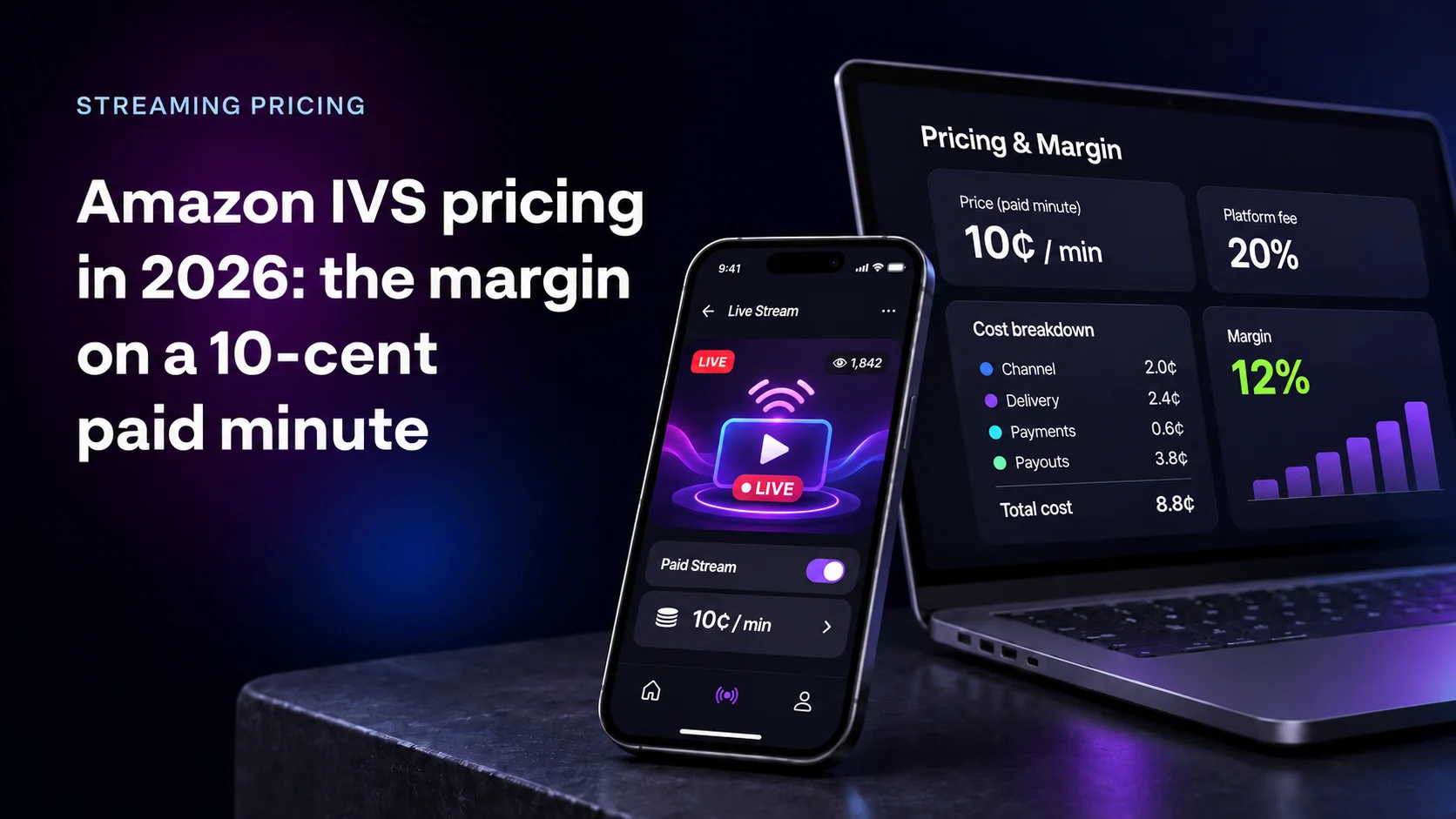
Amazon IVS pricing in 2026 turns a 10-cent paid minute into anything between a 12% margin before payouts and a loss. Three choices decide it: channel type, payment rail and free-tier size. The model prices a marketplace where viewers pay streamers by the minute and the platform keeps 20%, at list prices read on November 11, 2026.
- A Full HD viewer-minute on IVS costs $0.0024 to deliver, the same as a one-to-one Real-Time stage.
- A Standard channel bills $2.00 an hour of input, watched or not: 36% of the price for one private viewer.
- Apple's 30% in-app commission exceeds a 20% platform fee. Stripe web credits cost about 6%.
- Stripe Connect payouts cost at least $2.25 per streamer a month, more than the margin on three paid hours.
- A free Full HD hour for 100 viewers who watch half of it costs $9.20, the margin on 13 to 20 paid hours.
Free streams are where live platforms lose money
Video costs money when it moves, and a free stream moves as much video as a paid one.
Amazon IVS runs on the streaming technology that powers Twitch, says the IVS features page. In December 2023 CEO Dan Clancy announced it would shut down its Korean business on February 27, 2024. Twitch had capped source quality at 720p and tested peer-to-peer delivery, yet its network fees there stayed 10 times higher than in most other countries.
A pay-per-minute marketplace prices every minute, until the free tier arrives. One founder we worked with put it plainly: open the app to free streaming and you owe a lot of money at the end of the month.
Apple's November 2026 filing reopens the payment math
The second leak is the store. On November 3, 2026, Apple filed its annual report for the fiscal year ended September 26. Apple writes that a US court order prevents it from charging any commission or fee on digital purchases completed through external links in iOS apps, and that the Supreme Court is reviewing the contempt standard in the case.
In the app, Apple's standard commission is 30%. Developers in the Small Business Program, with up to $1 million in proceeds, pay 15%.
For a per-minute marketplace that gap is the business. In-app purchase takes 15 to 30 cents of every dollar; web credits lose about 6. Build both rails: the price of a US link-out is still before a court.
Which paid stream and credit flows Apple rejects is covered in our guide to the guideline 3.1.1 rejection.
How we built the cost model
- Vendor list prices, read on November 11, 2026 and linked in Sources. AWS rates are North America, first tier.
- The unit is one viewer-minute at 10 cents, a rate founders bring to us. The 20% platform fee is our assumption.
- Viewers buy $10 credit packs, since a 30-cent card fee cannot ride on a 10-cent charge.
- Viewers watch about 50% of a stream, the AWS rule of thumb.
Our buyer data is counted by hand, and any group with fewer than three data points is not published.
Amazon IVS pricing per minute, next to Mux and Cloudflare Stream
Amazon IVS prices input per hour by channel type and output per viewer-hour by resolution. Divide by 60:
| What you pay for | List price | Per minute |
|---|---|---|
| IVS Standard channel input | $2.00 an hour | $0.0333 |
| IVS Standard input, Multitrack Video | $0.50 an hour | $0.0083 |
| IVS Advanced HD input | $0.85 an hour | $0.0142 |
| IVS Basic input | $0.20 an hour | $0.0033 |
| IVS Full HD output, per viewer | $0.144 an hour | $0.0024 |
| IVS HD output, per viewer | $0.072 an hour | $0.0012 |
| IVS SD output, per viewer | $0.036 an hour | $0.0006 |
| IVS Real-Time, per participant | $0.072 an hour | $0.0012 |
| Mux 720p delivery, after 100,000 free minutes | $0.0008 a minute | $0.0008 |
| Cloudflare Stream delivery | $1 per 1,000 minutes | $0.001 |
One line in the AWS terms matters more than any rate: every stream sent to IVS incurs input charges even if nobody watches it.
A Basic channel passes the source through untranscoded, at up to 3.5 Mbps. Real-Time stages deliver under 300 milliseconds but cap input at 720p and audiences at 25,000. Mux and Cloudflare Stream bill per minute delivered and come in under IVS HD at 720p.
What one paid minute at 10 cents leaves the platform
One viewer pays 10 cents a minute. The streamer gets 8 cents, and the platform pays card fees and delivery out of its 2.
| Scenario | Payment cost | Delivery cost | Platform net before payouts |
|---|---|---|---|
| Private request, web credits, Real-Time stage | $0.0059 | $0.0024 | $0.0117 |
| Private request, web credits, Basic channel | $0.0059 | $0.0057 | $0.0084 |
| Private request, web credits, Advanced HD channel | $0.0059 | $0.0154 | -$0.0013 |
| Private request, web credits, Standard channel | $0.0059 | $0.0357 | -$0.0216 |
| Public paid stream, Apple in-app at 15% | $0.0150 | $0.0024 | $0.0026 |
| Public paid stream, Apple in-app at 30% | $0.0300 | $0.0024 | -$0.0124 |
Payment cost is Stripe's 2.9% + 30¢ on a $10 credit pack. Public rows count output only: input is shared across the audience. A Standard channel transcodes renditions for weak networks: worth $2 an hour when hundreds watch, 36% of the price for one viewer.
The rail follows the audience. Apple's App Review Guidelines let real-time person-to-person services between two individuals use other payment methods, while one-to-few and one-to-many real-time services must use in-app purchase. A private request can run on Stripe. A paid public stream sold in the app goes through Apple.
One decision hides in the table: is the streamer's 80% a share of list price or of what you collect? On list price, the store fee comes out of your 20%.
Payouts cost per streamer, not per minute. Stripe Connect charges $2 per monthly active account plus 0.25% + 25¢ per payout when the platform sets pricing. A streamer selling 10 paid hours a month earns $48 and costs $2.37 to pay, about $0.004 a minute, leaving the best row near $0.0078. A streamer selling one paid hour a month costs $2.26, over three times the platform's $0.70 on that hour.
Refunds and chargebacks eat into this margin, which is why we cover marketplace dispute resolution as MVP scope.
Why free public streams burn cash
A free stream carries every cost of a paid one, and input bills even with zero viewers.
Price one free hour on a Standard channel with 100 viewers who watch half of it in Full HD. Input is $2.00, output is $7.20, total $9.20. At the best margin in the table, $0.0117 a minute, that hour costs 13 hours of private requests. After payouts to a streamer selling 10 hours a month, it costs about 20. The same free hour on a Basic channel at SD costs $2.00.
One paid web minute on a Real-Time stage funds about three free viewer-minutes in Full HD after payouts, or about 13 in SD. Past that ratio, the free tier spends money the paid tier never earned.
AWS warns in its cost guidance that it is very hard to build a live audience from non-live users. Expect small free audiences and a full input bill.
Recordings keep billing after the stream ends
IVS records to Amazon S3 at no IVS charge. You pay for S3 storage, requests and serving.
The default multiplies the bill: a recording configuration saves all renditions unless you pick a custom set, per the AWS CLI reference. Record one. A 720p stream at the 4.5 Mbps ceiling in the IVS streaming configuration is about 2 GB an hour. At $0.023 per GB-month on S3 Standard, that hour costs about 4 cents a month to keep.
Replays bill delivery again: on Cloudflare Stream, a one-hour replay watched by 100 people costs $6.
Delete free recordings on a schedule. Keep paid requests until the dispute window closes: the recording is your evidence when a viewer says the stream never happened.
CDN delivery for those recordings is priced in our guide to video streaming cloud costs.
What streaming marketplace buyers bring us
These figures come from our presales records for streaming and social video, counted by hand. They describe buyers, not the market.
Around 75% of the paid streaming products we scoped also planned free viewing next to the paid tier: free with ads, free public streams, or free and paid subscriptions. Around 65% of the social video and live streaming products needed a running-cost estimate next to the build quote. One server estimate we wrote for a short-video app sized for 10,000 daily active users ranged from about $11,000 to $110,000 a month.
The same patterns keep coming back:
- Card-based monetization carried a high risk of App Store rejection.
- Card data in a custom screen pulls the app into PCI DSS scope. Stripe-hosted pages keep it out.
- Direct transfers to streamers can be too slow for instant viewing. Platform credits fix that and raise a question: is the platform holding funds like a bank?
- One buyer wanted 8K scenic video. IVS ingests up to 1080p.
Price the minute, budget the free tier
Our view: free viewing is marketing spend, not a product default.
- Run private requests on a Real-Time stage and sell credits on the web too.
- Give free streams a cheaper pipe: Basic channel, SD output, a time cap, an idle cutoff.
- Record one rendition, expire free-stream recordings, and pay streamers monthly above a minimum balance.
Then track free viewer-minutes per paid minute every week. Above about three in Full HD, the free tier is eating your margin.
We build that layer around engines like IVS: the app, credits and payouts, the dispute admin. Mercury Development has built apps since 1999, has 500+ engineers, and its apps reach more than 40 million users. For a Burger King video contest app we chose AWS for high loads and concurrent uploads, and the contest collected 46,272 uploads. Our comparison of private live streaming platforms prices eight engines.
Written by Rob Devereaux, Chief Operating Officer at Mercury Development. Rob has run the firm's operations from Hudson, Ohio since 2019 and has over 20 years of operational and financial experience. The presales records behind this article's buyer section sit in the operations he oversees.
Send us your stream mix and we will price your minute
Tell us how viewers pay, how streamers get paid and how much viewing you plan to give away. We will come back with a per-minute cost model for your stack, the payment rail for each store and the web, and free-tier limits that protect your margin.