
Pediatric hospital family engagement app in 2026: the container model
TL;DR
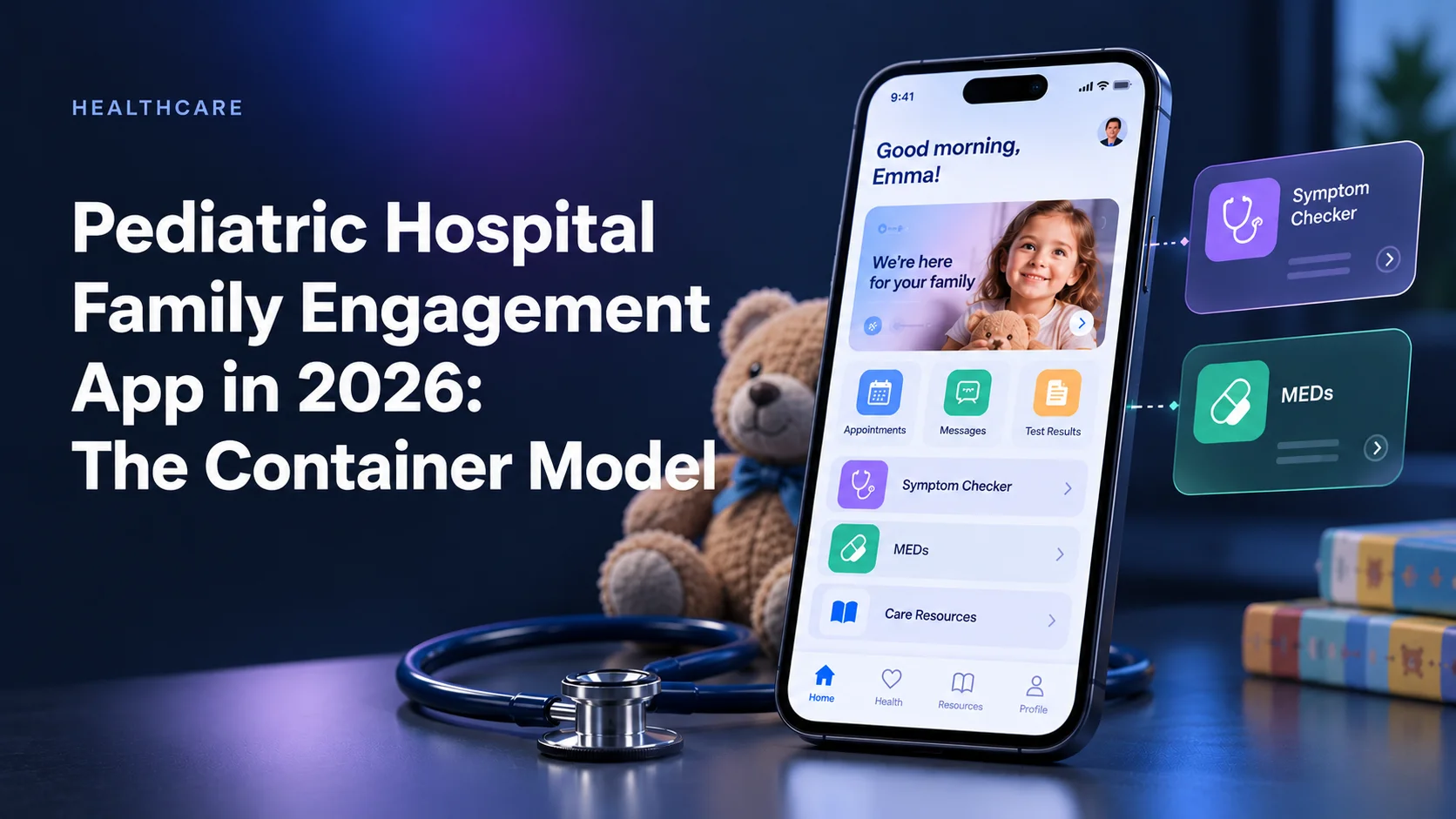
A pediatric hospital family engagement app in 2026 works best as a container: a hospital-owned shell that hosts licensed tools, such as a symptom checker and medication dosing tables, next to links into the patient portal. The hospital rents clinical content and keeps login, consent, data flow and the release calendar.
- Accessing the portal of someone you care for rose from 24% to 51% between 2020 and 2024, per ASTP/ONC.
- From May 11, 2027, HHS requires WCAG 2.1 AA for most hospitals' web content and apps, licensed content included.
- Apple's guideline 1.4.2 accepts dosage calculators from a hospital; 4.7 makes the app owner answer for plug-ins inside it.
- Apple rejected 2,093,244 of 9,100,620 submissions in 2025.
- Our approximate integration cost per tool runs from about $200 for a link out to $10,000-$20,000 for a vendor API behind your own screens.
Why a portal visit is not engagement
A patient portal is built for transactions: book, pay, read a result, log out. Families of sick children need help between visits. A fever at 2 a.m. A dose for a toddler. An urgent care that is open now.
Per ASTP/ONC Data Brief 77, accessing the portal of a person you care for rose from 24% in 2020 to 51% in 2024. A JAMA Network Open study at three children's hospitals estimated that guardians accessed 64% to 76% of adolescent portal accounts with outbound messages.
ChildrensMD from Children's Hospital Colorado combines a symptom checker, weight-based dosage tables, a medication and allergy list and connections to MyChart. Children's On Call from Children's Wisconsin pairs dosage tables with 145 parent advice messages.
If the portal itself has to change, compare our ranking of patient portal development companies.
May 11, 2027: accessibility rules reach the modules you license
An HHS interim final rule published May 11, 2026 moved the Section 504 compliance date in 45 CFR 84.84 to May 11, 2027 for recipients of HHS financial assistance with 15 or more employees. The standard stayed: WCAG 2.1 AA for web content and mobile apps a recipient provides "directly or through contractual, licensing, or other arrangements."
That clause is the container problem. A licensed symptom checker in your app is your content under this rule. Hospitals run by a state or local government also answer to ADA Title II, where the Department of Justice moved the date to April 26, 2027 for public entities with a total population of 50,000 or more.
Ask vendors for an accessibility conformance report, test each module inside your app, and put remediation deadlines in the license.
How we built this guide
- Rule text and dates come from primary sources, checked in October 2026.
- App examples come from hospitals' own pages; we did not test the apps.
- Our figures are shares of our pipeline records, rounded to five points; groups with fewer than three data points are not published.
- Price ranges are approximate estimates from our delivery team.
- Operational guidance, not legal advice.
Disclosure: Mercury Development has built custom software since 1999 and earns more when hospitals build, so read the build-side advice as a vendor's.
Four ways to put a vendor tool in the app
| Integration | Who controls the screens | Where the data goes | App Review exposure | Cost to switch vendors | Our integration estimate per tool |
|---|---|---|---|---|---|
| Link out to the vendor | Vendor | Vendor only | Low | Low | About $200 |
| Web embed in a WebView | Vendor, with your colors | Vendor servers, plus what your app passes | Yours, guideline 4.7 may apply | Low to medium | $1,000-$5,000 |
| Native SDK | Vendor, partly themable | SDK code runs in your binary | Yours, including privacy manifests | High | $5,000-$10,000 |
| Vendor API, your screens | You | Your backend calls the vendor | Lowest | Medium | $10,000-$20,000 |
The last column is approximate: our work to wire one licensed tool into the app, without the vendor's license, validated by our team against your scope before any quote.
The AAP's KidsDoc is the web-embed case: practices license it through an iFrame, and HealthyChildren.org manages all content updates. Vendor changes reach your app without a release from you, and Apple's guideline 4.7 makes you responsible for HTML5 and JavaScript mini apps and plug-ins offered in your app.
Where a web embed stops being enough is the subject of our comparison of wrapper app vs native app.
What the container owns and what each vendor owns
The hospital owns:
- One family login, with each child and teen as a separate profile.
- Consent, asked module by module.
- An integration layer between the app and every API, so changes behind it need no app update.
- The App Store listing and the release calendar.
Vendors own clinical content. Contracts name response times, content change notice, accessibility fixes and data return at exit.
Symptom checkers: buy the protocol, own the handoff
Buy the protocol. Pediatric triage content needs clinical editors. Self Care Decisions says its Symptom Checker contains 166 pediatric care guides and runs within 30+ mobile phone apps.
Own the handoff. Each outcome, from call now to home care, should open your next step: the nurse line, your urgent care finder, a portal message.
Regulation is light for now. FDA lists software that uses a checklist of common signs and symptoms to suggest possible conditions and when to consult a provider under enforcement discretion. Its January 6, 2026 CDS guidance covered clinician-facing tools only, and Covington notes FDA plans to revise its mobile medical apps policy in FY26, which may redraw the symptom checker boundary. Apple's guideline 1.4.1 asks apps to remind users to check with a doctor.
Medication tools and Apple's dosage calculator rule
Apple is strictest here. Guideline 1.4.2 says drug dosage calculators must come from the drug manufacturer, a hospital, university, health insurance company, pharmacy or other approved entity, or receive FDA approval, because Apple needs long-term support and updates.
A children's hospital is on that list, so publish under the hospital's own developer account with the dosing module licensed inside. Guideline 5.1.1(ix) agrees: healthcare apps should come from the legal entity that provides the service.
Name the feature you are buying. Weight-based dosage tables are reference content. A medication list with reminders is a tracker, which FDA also places under enforcement discretion. A tool that takes a weight and returns a dose is the calculator 1.4.2 means.
Every module's data is your hospital's PHI
HHS's tracking guidance says information collected by a regulated entity's mobile app generally is PHI, and tracking vendors need a signed business associate agreement before receiving it. A parent typing symptoms into a licensed module creates PHI in your app. Sign a BAA with each vendor that receives identifiers, or strip the identifiers.
Apple's third-party SDK page says you are responsible for all the code an SDK includes. Since May 1, 2024, apps adding a listed SDK need its privacy manifest. Guideline 4.7.3 bars sharing data with software inside your app without consent each time, and a November 13, 2025 update added third-party AI to the disclosure rule in 5.1.2(i).
One family account for parents and teens
One child means at least two users who should not see the same things. At UCLA Health, full parent portal access changes automatically when a child turns 12 under California law; parents keep immunizations and growth charts but lose visit notes, messages and confidential results. Let the portal enforce state rules.
- A profile per child, with the teen as a separate identity.
- Modules shown by profile age.
- No portal data cached in the shell.
App Review is a dependency you cannot contract away
Apple reviewed 9,100,620 submissions in 2025 and rejected 2,093,244, about 23%, per its 2025 App Store Transparency Report. Apple reviews at least 50% of submissions in less than 24 hours.
The risk is judgment. A reviewer decides whether embedded tools fall under 4.7 and whether a dosing screen is a calculator under 1.4.2. Nobody can promise approval. You can lower the odds:
- Submit from the hospital's account with a demo login and sample family data.
- Expose no native APIs to web content; 4.7.2 forbids it without Apple's permission.
- Keep buffer before campaign launch dates.
Distribution routes and the submitting entity are covered in our guide to App Store approval for healthcare apps.
Unstable APIs move the budget and the schedule
The hospital's own APIs are what slip: scheduling, locations, the portal handoff. When an interface changes mid-build, every screen that calls it is rework, and under a fixed estimate that is a change order.
- Agree the contract first: a written specification and a mock server before mobile work starts.
- Route the app through your own backend, so a changed field is fixed once on the server, with no App Store release.
- Price the dependency: the estimate names each API, its owner and its delivery date.
We have worked this way: our developers and QA engineers ran parallel sprints with MiMedia's server team. Some dependencies cost calendar time regardless. On Fitbit, we spent two months deciphering Samsung's proprietary Bluetooth technology to make tracker sync work on Android.
Hospital APIs are one of the client side dependencies in our breakdown of healthcare software project delays.
Build, buy or white-label: which path fits
- White-label the whole app: fastest, with the least control over roadmap and data.
- Buy the shell: platform vendors sell a hospital app foundation you configure, and Gozio argues hospitals should buy the features they don't need to custom build.
- Build the shell and license the content: the highest upfront cost, and the only route where the family experience is fully yours.
If the app is licensed tools plus portal links, white-label it. If it must reach your scheduling and programs, build the shell.
What our pipeline records show
Counted by hand in October 2026 from our healthcare pipeline and estimate records. Record counts stay unpublished under our client agreements; shares are rounded to five points.
- Around half of patient engagement and portal requests named third-party systems the app had to embed or connect to before scope was set.
- In around a quarter of healthcare mobile app requests, our estimate or analysis named an input the client had to supply as a budget or schedule risk: an API, content, code or environment access, or screen designs.
- App Store review was a named delivery risk in around 10% of those mobile requests.
Requests framed explicitly as a container of purchased tools had fewer than three data points, so we publish no share.
Own the shell, rent the content
Our view: a children's hospital should own what families feel and regulators audit, meaning login, profiles, consent, the data path and the store listing. It should rent what needs clinical editors.
The limit: a shell is a standing cost. Someone tracks store deadlines, accessibility audits and vendor contracts every year. Without that capacity, a white-label app and a clear portal link beat a custom shell nobody maintains.
Written by Rob Devereaux, Chief Operating Officer at Mercury Development. Rob has run the firm's operations from Hudson, Ohio since 2019 and has over 20 years of operational and financial experience. The pipeline and estimate records behind this article's risk shares and price ranges sit in the operations he oversees.
Send us your module list and we will map the container
List the tools you plan to license, the hospital systems the app must reach and your launch window. We will mark where each tool sits, which contracts need a BAA or an accessibility clause, and which dependencies belong in the estimate as dated risks.