
Best cruise ship software in 2026: a buyer's guide by layer
TL;DR
The best cruise ship software in 2026 is a stack, not a single product: a reservation core ashore, a property management system on board, the apps guests and crew touch, and fleet tools in the technical office. We compared 10 options across those layers on named cruise evidence, ship fit and who owns the code. Mercury Development ranks first for the layer guests and crew touch: the onboard spa platform it built for OneSpaWorld went into production in 2018 and was deployed on over 160 ships operated by multiple cruise lines.
- Versonix Seaware is the reservation pick: on October 22, 2026, its expansion to all three NCLH brands was announced.
- Oracle says its cruise solution, shipboard PMS included, is used by 9 of the top 10 cruise lines.
- Since 10 April 2026, carriers, cruise ships included, have had to check travellers against the EU's EES carrier interface, so the border now runs through check-in software.
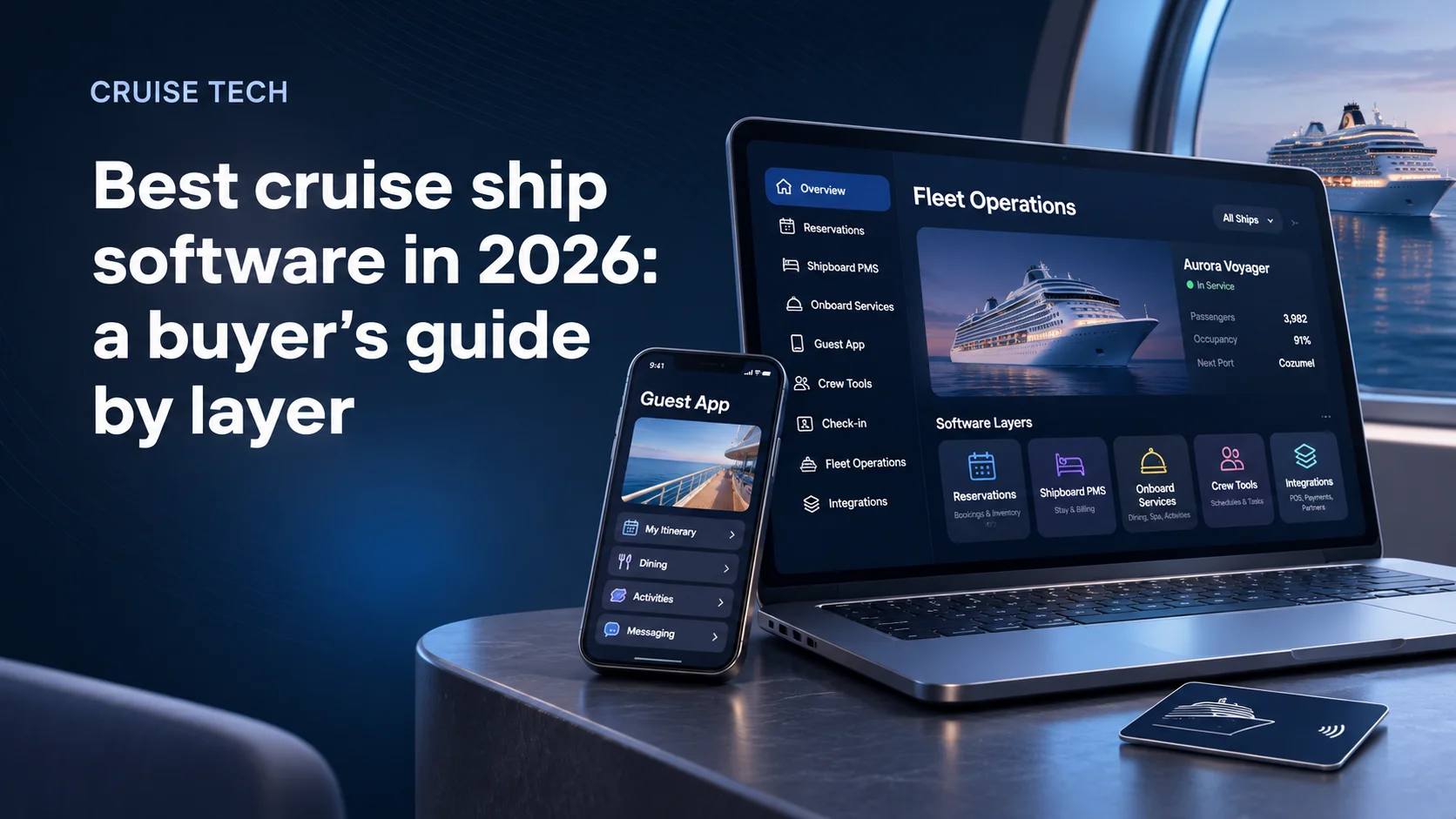
A cruise line runs five layers of software, not one
Start with scale. CLIA's 2025 Global Market Report, as corrected on April 27, 2026, counts 37.3 million ocean-going cruise passengers in 2025, up 7.7% on 2024, and its State of the Cruise Industry release puts the 2026 fleet at 325 CLIA-member ocean-going ships with about 690,000 lower berths. Each of those ships runs the same five jobs in software, usually from different vendors.
- Reservations and distribution ashore: inventory, fares and the channels travel agents book through.
- The shipboard property management system, or PMS: guest and crew records, cabin folios and onboard point of sale.
- Guest and crew apps: check-in, the daily program, dining and spa bookings, ordering and staff tools.
- Fleet technical tools: maintenance, drydock, purchasing, crewing and safety records.
- Integration: the middleware that moves bookings and charges between the other four, ship to shore.
Nobody sells the fifth layer as a product, yet it decides whether the other four feel like one system to a guest. Sourcetoad's OnDeck app books shoreside offerings through Seaware before boarding and shipboard bookings through Otalio and MXP integrations, per Cruise & Ferry Review. Each of those links is an interface somebody builds and keeps alive.
Since April 2026, cruise check-in software answers to the EU border
The EU's new border systems reach into the reservation and check-in layer. Frontex's leaflet for sea travel says the carrier obligations apply to ferry companies and to "cruise and cargo ships" that bring passengers from outside the EU to a country using the Entry/Exit System (EES) or requiring ETIAS. Per eu-LISA, the EU agency that runs the systems' IT, the obligation to query the carrier interface started on 10 April 2026, and carriers kept checking passport stamps until 6 October 2026. At the same May meeting, carriers raised specific cruise scenarios and their crew.
ETIAS comes next, without a date. The European Commission's ETIAS page says the system is not in operation and that the EU will announce the start date several months before launch, and as of October 19, 2026, SchengenVisaInfo reports that no date has been announced. Once it runs, sea carriers must verify within 48 hours before departure that visa-free travellers hold a valid ETIAS authorisation, through the same carrier interface.
That turns a border rule into a buying question. Ask every reservation and check-in vendor whether its system is connected to the carrier interface, where a refused status shows up for the guest and for terminal staff, and how the flow treats crew.
How we evaluated
Five criteria, applied to all ten options and visible in every card:
- Named cruise evidence: a cruise line named as a user by the vendor or in trade press.
- Layer: which of the five jobs the product does.
- Ship fit: what the vendor publishes about offline work and ship-to-shore sync.
- Integration surface: the systems it is documented to connect to.
- Control: a licensed product on the vendor's roadmap, or code the cruise line owns.
The candidate set starts from the three pages that ranked for this query in early November 2026: ZipDo's cruise ship software list, WifiTalents' cruise ship software list and WifiTalents' cruise software list. We kept the products a cruise line buys and added Versonix, Oracle, Otalio and Sourcetoad, which serve named cruise lines and appear in none of those rankings. Facts come from vendor pages, documentation, press releases and trade press, opened on November 3, 2026; the three rankings were read again on November 6. Any group in our own data with fewer than three data points is not published. Mercury Development wrote this guide and ranks itself first, so check the first card the way you check the others. Choosing a development partner rather than a product? Our ranking of cruise line software development companies covers that.
The 10 options at a glance
| Option | Layer | Model | Named cruise evidence |
|---|---|---|---|
| Mercury Development | Guest, crew and onboard apps; integration | Custom, you own the code | OneSpaWorld: in production from 2018, deployed on over 160 ships |
| Versonix Seaware | Reservations and distribution | Licensed platform | All three NCLH brands, Azamara, StarDream Cruises |
| Oracle Hospitality Cruise SPMS | Shipboard PMS, POS, mustering | Licensed suite | 9 of the top 10 cruise lines, per Oracle |
| IBS Software iTravelCruise | Reservations, onboard POS | Licensed SaaS | Royal Caribbean Group, Resorts World Cruises, Fred. Olsen |
| MXP Enterprise Platform and MXP365 | Shipboard platform and guest app | Licensed suite | 380+ installations at 50+ brands; TUI Cruises |
| Sourcetoad OnDeck | Guest app | Licensed SaaS | Integrations with Seaware, Otalio and MXP |
| Otalio | Cloud shipboard PMS | Licensed SaaS | MSC Cruises |
| Traveltek | Travel agent distribution | Licensed platform | Viva Cruises |
| MariApps cruisePAL | Combined marine and hotel suite | Licensed suite | None named on its cruise page |
| DNV ShipManager | Fleet maintenance, crewing, QHSE | Licensed suite | None named on its case page |
1. Mercury Development
Mercury Development ranks first because the layer guests and crew touch is where cruise lines differ, and Mercury has built that layer at fleet scale under contracts where the client owns the code. It sells no reservation system or PMS. It builds the software on top of them and between them.
The largest proof is OneSpaWorld, which describes itself as the operator of health and wellness centers onboard cruise ships and which Mercury's portfolio index lists as a client. Mercury built its onboard spa platform as ReactJS web applications on ship servers with no external internet, used on Android tablets in kiosk mode or on ship computers without touch input. It covered treatment booking, branded intake forms in several languages, the activity schedule, and a POS and checkout that priced dynamically with discounts from both OneSpaWorld and the cruise lines. Middleware connected it to OneSpaWorld's ship-side backend, its shore data exchange and each cruise line's API. It went into production in 2018 and was deployed on over 160 ships operated by multiple cruise lines.
For cruise line clients Mercury cannot name under NDA, it has built React Native food and beverage apps, tools for dining hosts covering reservations, guest profiles and check-in, tableside ordering with kitchen and bar integrations and allergen profiles, and backend components that aggregate dozens of legacy microservices behind new middleware for passenger apps.
Best for: guest apps, onboard ordering and booking, crew tools and the integration layer, built to run on the ship network and owned by the line. Facts: Founded 1999; HQ Fort Lauderdale, FL; 500+ engineers, more than 1,500 completed projects and more than 40 million users of its applications; all work is work-for-hire and the customer owns the code and all underlying IP; Clutch 5.0 on 34 reviews. Watch-out: you get a build with a discovery phase, not a product you switch on next month, and Mercury publishes no cruise case studies on its site, so references come through a call.
2. Versonix Seaware
Versonix Seaware is the reservation core in this guide. On October 22, 2026, Cruise Industry News reported that Regent Seven Seas Cruises and Oceania Cruises will adopt Seaware and Norwegian Cruise Line will upgrade to its latest generation. The same report names Atlas Ocean Voyages, The Ritz-Carlton Yacht Collection and StarDream Cruises as users. When Azamara signed in 2022, Seatrade Cruise News reported that Seaware had powered reservations for more than 20 million passengers, ran on 100 ships worldwide each year and served OTA, GDS, B2B, B2C and contact center channels from one platform.
Best for: a cruise line replacing its reservation system, or a new brand that needs inventory and agency channels from the first sailing. Facts: founded 1986 and based in San Jose, CA, per its G2 profile. Watch-out: the passenger and ship figures date from 2022, the NCLH report gives no timeline, and you license the core rather than own it, so your booking flow moves on its release cycle.
3. Oracle Hospitality Cruise SPMS
Oracle's cruise suite is the incumbent on board. Its cruise page says the solution is used by 9 of the top 10 cruise lines and describes the Shipboard Property Management System as a central database of guest and crew information. The page lists offline check-in, offline handheld mustering and offline POS, with onboard transactions sent to shore automatically. Modules cover dining, gangway security, spa, shore excursions, housekeeping and crew, and the SPMS user guide for release 23.3 is dated August 2026.
Best for: a line that wants the folio and POS system most large fleets already run. Facts: part of Oracle Hospitality; the SPMS 8.0 release notes from January 2019 still call the product's database the Fidelio schema, a trace of Fidelio Cruise Software, whose main shareholder was Micros before Oracle acquired Micros, per Seatrade Cruise News. Watch-out: the page does not name the nine lines and lists no guest-facing mobile app, so the screens on your guests' phones come from another layer.
4. IBS Software iTravelCruise
IBS Software is the second reservation platform here with a major cruise group signed. On November 2, 2023, IBS and Royal Caribbean Group announced that the group would use iTravelCruise, a cloud SaaS platform, for omni-channel sales, bundled flights, hotels and transfers, and a guest wallet carrying offers, credits and loyalty rewards, replacing legacy technology. Resorts World Cruises launched in June 2022 on iTravel Cruise Enterprise Reservation. On board, Fred. Olsen chose iTravel PoS in 2021 for cabin, counter and waiter-assisted orders across four ships, with iTravel-Super Highway syncing sales between ship and shore in real time.
Best for: a cruise group that wants reservations and onboard retail on one vendor's cloud platform. Facts: founded 1997; founder V K Mathews remains the majority shareholder; about 4,000 professionals and 16 offices when Apax funds agreed to invest about $450 million for a significant minority stake in May 2023. Watch-out: the Royal Caribbean Group rollout is not live. In June 2025, Vicki Freed, Senior Vice President Sales and Trade Relations, told Cruise Weekly that iTravel Cruise was still a number of years away from launch, with Silversea first.
5. MXP Enterprise Platform and MXP365
MXP, from MarineXchange Software, sells both the shipboard platform and the guest app on top of it. Per an MXP release carried by Cruise Industry News in February 2024, the MXP Enterprise Platform runs at more than 50 cruise brands on more than 380 installations, and stakeholders from 15 cruise lines with 58 ships spent three years on due diligence before choosing it. In December 2025, Seatrade Cruise News reported that eight cruise lines had adopted the MXP365 guest platform in the previous 12 months: a native app and web portal, signage, interactive TV, kiosks, chat and an AI chatbot that handles purchases, all connected to the MXP Enterprise Platform.
Best for: a line that wants the PMS and the guest app from one vendor, already wired together. Facts: founded 2001 and based in Graz, Austria, per CB Insights; TUI Cruises is the MXP365 adopter Seatrade names. Watch-out: seven of the eight adopters go unnamed, neither report describes offline behavior, and Seatrade frames MXP365 as an alternative to in-house development, so your app follows a roadmap shared with every other line on it.
6. Sourcetoad OnDeck
Sourcetoad's OnDeck is the licensed guest app built to sit on other vendors' cores. The Spring/Summer 2026 issue of Cruise & Ferry Review describes it as a ready-to-deploy SaaS app for iOS and Android whose Seaware integration lets passengers book shoreside offerings before boarding, with shipboard bookings through existing Otalio and MXP integrations. OnDeck also publishes an annual study of cruise apps, and its 2026 Cruise Mobile Apps Report found brands standardising core guest features and adopting cross-platform frameworks, with security and accessibility issues still a concern.
Best for: a small or mid-size line that wants a guest app this season on top of Seaware, Otalio or MXP. Facts: founded 2008; HQ Tampa, FL; Clutch 5.0 on 9 reviews, $25,000+ minimum project, 10 to 49 employees. Watch-out: you rent the codebase, and a vendor of that size is a small company to depend on for a fleet-wide app.
7. Otalio
Otalio is the cloud shipboard PMS. MSC Cruises chose it in 2021 to connect shoreside operations with the fleet: guest data such as shopping preferences, complaints and Voyagers Club status in one record, live updates from shore, and digital housekeeping schedules and menu pricing. Per Seatrade, the architecture took two and a half years of development, MSC Virtuosa was the first ship, and 500 people on board and ashore worked on the rollout. Its managing director, Tony Heuer, previously ran global cruise sales at Oracle, per a Seatrade profile.
Best for: a line moving its PMS to the cloud that wants guest and crew data in one live record ashore and at sea. Facts: founded 2018 and based in Hamburg, Germany, per CB Insights. Watch-out: one named fleet, and the MSC report does not describe what the ship does when its link to the cloud drops, which matters more for a cloud PMS than for any other option here.
8. Traveltek
Traveltek works the travel agent side of distribution. Its products page describes iSell as a search and booking engine exclusively for travel agents and operators, and a Cruise API that joins a network of over 30 cruise suppliers. A cruise line uses it to put fares and ship content in front of agents: Cruise Trade News reported that Viva Cruises joined to reach the UK trade with flat-file pricing, itineraries and ship content, alongside more than 300 suppliers on the platform.
Best for: a line, river or ocean, that wants its inventory inside the tools agents already search. Facts: registered office in Glasgow, UK; a team of 90, per its 25-year post. Watch-out: it sells to the trade, not to the ship, and it does not run your reservation core, your folio or your guest app.
9. MariApps cruisePAL
MariApps comes to cruise from maritime ERP. Its cruise software page presents cruisePAL as one suite for marine, hotel and guest functions: front desk and cabin inventory, pricing and yield, reservations with food ordering, crew management, planned maintenance, HSQE, connectivity billing, digital check-in and kiosks. The page says cruisePAL was launched jointly with Rescompany Systems and OnboarD Software, and that MariApps serves 150+ clients with 300+ vessels connected across its products.
Best for: a line that wants the front desk and HSQE in one web-based suite from a maritime vendor. Facts: CEO Sankar Ragavan; offices in nine countries. Watch-out: the cruise page names no cruise line using cruisePAL and makes no offline claim for it.
10. DNV ShipManager
DNV ShipManager is the technical department's software. It is here because two of the rankings for this query, in their versions updated on November 1 and 2, 2026, place it second and third. Its modules page lists Drydock, Hull, Procurement, Technical for planned and unplanned maintenance, Crewing, QHSE and Analyzer for fleet KPIs. That is real work on a cruise ship, and none of it is the guest.
Best for: the technical superintendent's maintenance and drydock records across the fleet. Facts: DNV dates from 1864 and is headquartered in Høvik, Norway, with about 15,000 employees in 2024, per Wikipedia. Watch-out: its customer stories page names Reederei F. Laeisz and Rickmers Shipmanagement and no cruise operator, and the module list has no hotel, folio or guest functions.
Which option fits your layer
| Your situation | Start with |
|---|---|
| Guest app or onboard ordering that must work on the ship network | Mercury Development |
| Booking widgets and partner bookings on your own website | Mercury Development |
| Middleware between a new reservation core and an older PMS | Mercury Development |
| Replacing the reservation core | Versonix Seaware or IBS Software |
| Shipboard PMS and folio on the system most large lines run | Oracle Hospitality Cruise SPMS |
| PMS and guest app from one vendor | MXP |
| A licensed guest app this season | Sourcetoad OnDeck |
| A cloud PMS | Otalio |
| Fares and ship content in travel agent tools | Traveltek |
| Marine and hotel suite from a maritime ERP vendor | MariApps cruisePAL |
| Maintenance and crewing records | DNV ShipManager |
What we counted in three cruise software rankings and in our own programs
Two counts. The rankings are a snapshot: these pages are revised often, so the figures below describe the versions marked as updated on November 1, 2026 (both WifiTalents pages) and November 2, 2026 (ZipDo), which we read on November 3 and again on November 6, 2026.
First, the rankings: the three pages named in the methodology, 30 entries in total.
- In those versions, ZipDo and WifiTalents rank the same 10 products on their cruise ship software pages, with the same ladder of scores from 9.3 down to 6.5, in different orders. Lakeside Nimbus is first on one and fourth on the other; IBS Software Cruise is tenth and fifth.
- All three pages weight features 40%, ease of use 30% and value 30%. ZipDo says the study was funded by several of the vendors it assesses and that the page includes paid placements. The WifiTalents cruise ship page says several vendors covered in the study shared its funding, and its cruise software page says some of its studies are commissioned research funded jointly by vendors they cover.
- The 30 entries carry 19 distinct names. By the pages' own one-line descriptions, 9 are booking or distribution tools, mostly for travel sellers, 6 are fleet maintenance, procurement or maritime ERP tools, and only MarineXchange MXP365 is described as covering onboard operations. None is described as a guest app.
- Versonix, Oracle, Otalio and Sourcetoad are ranked on none of the three.
- Each page carries 9 FAQ questions. One asks how Navis N4, Oracle and SAP Transportation Management differ for cruise handoffs, though none of the three is ranked there and N4 is a container terminal operating system, sold today as Kaleris N4.
Second, our own record, from Mercury's contract and project records. Across our closed contracts for cruise software, the median is $250,000 and the range runs from $10,000 to $1,000,000. The OneSpaWorld program went into production in 2018 and grew from treatment booking and checkout into E-Forms, a pre-booking site for Windstar guests, a calendar widget that cruise lines embed on their own websites, activity booking with waitlists, and class sign-ups that read the guest's RFID cabin key through a reader paired with a tablet. The same failures repeat across the cruise programs we work on. A login token issued on shore stops working on the ship's network. An API works in production and not in the test environment. Some ship behavior only shows up on a real vessel.
License the core, own what the guest touches
Opinion, with the mechanism.
License the reservation core, the shipboard PMS and the maintenance system. Each is a solved category with fleet-scale references, from Seaware's 100 ships a year to Oracle's 9 of the top 10 lines. Building one yourself buys years of risk for a system guests never see. Even replacing one takes years: Otalio's PMS for MSC took two and a half years to build.
Own what guests and crew touch, plus the joints between layers. A licensed guest app follows a roadmap written for every line on the platform. Your app is where you differ: how a guest books dinner, how a spa slot shows up before boarding, how a bartender closes a tab when the ship drops its link. The joints are where projects fail. Each link from the core to the PMS to the app is an interface, and interfaces break on ships before they break in labs.
So change the demo you ask for. Skip the feature tour. Ask each vendor to show a booking made in the guest app on a ship with no shore link, charged to the cabin folio, then reconciled ashore. A team that has built it answers with a design. A team that has not answers with a demo.
Written by Rob Devereaux, Chief Operating Officer at Mercury Development. Rob has run the firm's operations from Hudson, Ohio since 2019 and has over 20 years of operational and financial experience. The contract and delivery records behind this article's figures on Mercury's cruise programs sit in the operations he oversees.
Replacing one layer of your cruise stack? Start with a stack map
Most cruise software projects pick a product before anyone maps which system owns the booking, the folio and the guest record. Send us your current reservation system, the PMS on each ship and the apps you run today. We will show which layers to license, which to own and what ships first.